Friday, 25 March 2016

Rhymes and Rivalries: Water, Place Prejudice, Death

Not all Angus folk were regarded as equal in the halcyon days of long ago.  Previous entries have shown that ‘Angus bodies’ (as inhabitants of God’s own county were once known) frequently regarded their near parish neighbours as untrustworthy, suspicious, or just downright different.  At one time apparently the lowland inhabitants of Strathmore and the Mearns looked upon the inhabitants of the northern glens with undisguised mistrust. There was once a common slur in Angus and the Mearns which ran:

                                      We may ken ye’re a Glenesk man            
                                      by your scraggy face.

 There was story about a man from the glen who wandered into an eating establishment in Stonehaven.  During his dinner he looked up and thought he saw a neighbour from the glen sitting opposite.  He immediately shouted out the jibe about the scraggy face then everyone in the dining room suddenly stared at him.  What he had actually encountered for the first time in his life was a mirror, hung on the wall opposite him!

   Some of the old rhymes of Angus have lost their meaning because the things they speak of have altered forever or in some instances they refer to places which have also changed their names. Sailors were once guided back to the Angus shore by the sight of Barry in the distance, known centuries ago as Fothmuref, which locals corrupted into Fettermore:

                                         The braes o’Fettermore
                                         has been a gude ship’s shore.

     In olden times too the provision of clean water and the disposal of waste effluent was a difficulty for people, especially in larger towns before the provision of proper sewerage or piped water from purpose built reservoirs.  The hazard of couped oot urine and worse from upstairs windows from chanties or bed pans must have been common, and even the supposedly warning shout of ‘Gardyloo!’ might not have always prevented a stinky soaking.

Gardyloo!

   Before Dundee got most of its drinking water from the purpose built reservoir at Monikie, the townsfolk had to rely on the various wells around the burgh; among the most trusted was the Lady Well at the foot of the Hilltown.  There may have been a common belief that that springs named after saints were somehow assured of being pure and safe to consume.  But enterprising Dundonians began to draw water on a commercial basis from various sources and there grew up competition between rivals, which each claiming that their water was the best.  The major players in the Dundee water war were those who exploited sources at Logie and Invergowrie. Each firm drove barrels of their water through the streets and shouted out the benefits of their product.  One would bellow:

                                  Invergowrie’s crystal spring
                                  for Tea surpasses everything!

    Their Logie rivals would retort with this doggerel:

                                  Of a’ the wells that’s here aboot
                                  there’s nane compar’d  to Logie Spoot!

   Those were the days of unsophisticated marketing techniques!

   Other things that have vanished from certain districts over the years are certain families which may have resided there for umpteen generations.  In the parish of Stracathro there was a notable interconnected branch of the Martin family who occupied a large cluster of neighbourhood farms and outsiders were warned that they should be careful what should say to one farmer about another because they were all inter-related:

                                     Crawhill an’ Ba’hill,
                                     Rochie an’ the Greens –
                                     a’ thae three are friens.

   It was a proud and honourable boast among some kindreds that they had farmed the same soil for centuries.  The Spences of Balgavies, Aberlemno, were one such, proud of their longevity in the region, as attested to by an inscription on a tombstone dated in 1756, erected by John Spence in memory of his father and mother:

                                     Here ly’s an honest old race,
                                     Who in Ballgavies land had a place
                                     Of residence, as may be seen,
                                     Full years three hundred and eighteen.

   The Spences occupied their farm from the year 1438, and it was passed down from father to son until the year, 1820, after which some of the family removed themselves to Broughty Ferry (and may have been related to the writer Lewis Spence).

   Another boast sometimes found on local tombstones is extreme longevity, sometimes coupled with allegations of extreme fruitfulness.  Gilbert Mille died in Newtyle in 1675 and was said to have fathered twenty-six children by two wives.  Despite all this effort in procreation he still managed to reach the grand age of 100.  The inscription on his grave also contains an acrostic forming the patriarch’s name:
             
                                     Great is the wonders God hath Worked
                                     In Heaven, and Earth, and Sia;
                                     Lykuays he many mercies hath,
                                     BeStoued Wpon Me.
                                     Euen in this World, an Hundred Years,
                                     Remain’d I honestlie;
                                     Tuo Weded Wives the tym I had;
                                     Much Comfort was to Me.
                                     In Wedlocks Band ue Procreat
                                     Lauffully Ws Betuix;
                                     Loues Pledges, Whos Right number wer
                                     Euen tuo tymes ten and Six.
                                              My Spritt to God, I do commit,
                                              My Body to the Graue;
                                              When Christ shall com and jidg shall sitt,
                                              Shall them Both Recauie.

      Epitaphs often provided an outlet for unsung poetic endeavour in long past communities.  The oldest recorded gravestone in the kirkyard of Kirkden has this simple but satisfying inscription:

                             Heir lyis ROBERT DVTHIE, hvsband to
                                   Evphane Gvdlet, somtyme in Balmadie, who died
                                   In Descm 1667, and of his age the 47:
                                             I rest in hope
                                            And shal Aryse
                                            To reigne with Christ
                                            †Above the Skyes.


   The profession of the Scotts at Balmossie, Monifieth, was waulking, or fulling cloth, hence the punning inscription on one of the family’s tombs (now lost):

                                  On earth I waulked for many years,
                                  But here I now do sleep;
                                  Where I shall waulk when I away,
                                  To you’s a mystery deep.

   This last rhyme takes us back even further in time and is alleged to have been made by no less that King James IV, when the lands of Keillor, near Auchtertyre, were granted by him to the guidwives of the Haddon family who had entertained him.  It takes the form of a reddendo, conditions of tenure for the land grant which were, in this case, rather unusual.  The family would have had difficulty supplying a rose at Christmas or a snowball at Lammas (August first).  James IV was unaccountably fonder of wandering about the neighbouring county of Fife, otherwise we would have had more rhymes like this one:

                                  Ye Haddons o’ the Moor,
                                  ye pay nocht
                                  but a hairen tether –
                                  if it’s socht,
                                  a red rose at Yule
                                  and a sna ba at Lammas.


Keillor Pictish symbol stone, Kettins parish (now in Perthshire, but historically part of Angus).

Tuesday, 15 March 2016

Fisher Folk(lore)

The coastal communities of Angus, as in other places, long had their own customs, beliefs and superstitions, some of which were widespread among fisher communities and others which were peculiarly local.  In 1790 the minister of Arbirlot wrote that, ‘The sea-gulls are considered ominous.  When they appear in the fields, a storm from the south-east generally follows; and when the storm begins to abate, they fly back to the shore.’  But in neighbouring Arbroath the gulls were considered harmless and were called Swankie’s Doos.  The surname Swankie was common in the town and the nickname may originate in some long-forgotten jibe about one of the family.  Another theory states that the saying is linked particularly to one Betsy Swankie, a larger-than-life character in the Fit o’ The Toon at Arbroath.  This lady was prominent in the fish merchant firm of Swankie & Smith in the 1920s.  Her influence was so powerful that it was rumoured the seagulls were in her employment, hence the nickname – perhaps. (Another bird with an odd nom-de-plumage (!) was the stormy petrel, known in Angus and indeed elsewhere as Mother Carey’s Chicken, a baffling nickname which originated in the 18th century.)

  The puzzling fear of pigs among seafarers was widespread in northern Scotland and certainly common among Angus sea-folk.  Arbroath and Auchmithie crews would turn back home if some evil person placed a piece of pork on their vessel (as reported by J. M. McBain in Arbroath, Past and Present (1887)):  ‘those on board would return to land without shooting their nets rather than proceed with their fishing with the hated junk aboard.’


   Another ‘ill-fitted’ creature was the humble pigeon.  Andrew Douglas, a 19th century schoolteacher at Ferryden, was told by a returning boat crew that they had not shot their lines that day because a pigeon had landed on their boat.  Douglas scoffed at their credulity, but a crew member addressed him angrily:  ‘It’s easy for you to speak there; but, had we no’ turned in time, ye’d ne’er seen halt nor hair o’ our boat’s lines; we’d been i’ the boddom o’ the sea...’  The exhausted pigeon had landed on the mast after being chased by a hawk.  One of the men attempted to dash its brains out in his presence, but the bird flew off.  One of the crew, splendidly nicknamed Jimacks called after it, ‘Ye unearthly creature, may ye get better rest, and ne’er be see there agin, fearin’ fowk to death afore their time...This fleg’ll no be frae my heart tis twalmonth...Gudekeeps a’ frae seein’ unearthly sights – they’re nae couthie.’  Another strongly held belief in Ferryden was that no boat must go out fishing on Christmas Day.  One boat had done so on one occasion and it caught only one haddock – and that fish had no eyes.  If there was a theft in the community the older residents could divine the guilty party by opening the Bible at random and placing some keys in different directions upon it.  The letters of the words the keys pointed to were compared with the initials of villagers, and if they matched they pronounced guilty.  The custom was still prevalent when Douglas was writing, in 1855 (when he published his book, The History of the Village of Ferryden).

   Although many of the community were illiterate in the 1820s when Douglas became the schoolteacher, both education and religious gradually civilise the village to the extent that it became a fervent hotspot for the Free Church in the 1850s. But the extraordinary religious revival in Ferryden which came to a peak at the end of that decade was described by more urbane (and urban) observers as a 'vortex of mad excitement' and 'the result of mental derangement', in other words merely a more respectable continuation of fisher-folks' inbred inferior superstition. The temperance movement also all but eradicated the once rampant drunkenness and put out of business most of the six dram sops which once operated in the village.   But the economics of those who were reliant on the selling of fish, in particular the cadgers who carried the catch inland and sold it, necessitated a manner of life which did not accord with Victorian civility.  ‘I am no admirer of the cadger profession,’ Douglas wrote.  ‘A more undeserving class are not to be met with; and the filth, squalor, savagery, cheating, and lying with which they have become associated in the minds of all, will not be palliated by me.  I have seen much of their cruelty to their poor dumb beasts, and little of their good dispositions to any one, unless their indirect services to the whisky shops be regarded as coming under that head.’
   The historian A. J. Warden, whose 5 volume Angus or Forfarshire appeared in the 1880s, had a poor opinion of the fisher communities in his own county. ‘The population composing these assemblages of fishers,’ Warden considered, were,’...rude and uncouth in their manners.’  And he was at pains to point out that these coastal communities were different not only in their speech but also alien in their customs, for they almost invariably married among themselves.  ‘Indeed so clannish are the fishers of each village that they seldom go even to neighbouring fishing communities for spouses.  It is a common saying among fishers “we’ll keep our ain fish-guts to our ain goo-maws.”  The affect of so much intermarrying is to degenerate the race, and in most of the fishing villages there are generally a proportion of the inhabitants affected with scrofula or other diseases, and several having a weak intellect.’  In common with outside observers from other parts of Scotland, Warden believed that the quaint and distinct manners of these fringe societies could be explained by the supposition that the coastal populations were the descendants of Dutch or Flemish people who had settled in Scotland centuries before.  This theory was also common in other regions and is likely an erroneous explanation of the perceived ‘other-ness’ of the fishing villages.

   In Warden’s opinion the most picturesque fishing village in the county was Auchmithie, near Arbroath.  This was the model for Walter Scott’s village of ‘Mussel-Craig’ in his novel The Antiquary.  Another author enamoured of Auchmithie was James Glass Bertram, who featured the Angus settlement in his book The Harvest of the Sea (1885).  Despite a prevailing Victorian prejudice against fisher folk, Bertram acknowledged the charming politeness of the wee girls when they met incomers visiting them:

...they invariably stoop down, making a very low curtsey, and for this piece of polite condescension they expect that a few halfpence will be thrown to them. If you pass on without noticing them they will not ask for anything, but once throw them a few halfpence and a pocketful will be required to satisfy their importunities.

   Bertram also noted the ingenious manner of smoking fish practised at Auchmithie, which the inhabitants would soon bring to Arbroath and popularise as the now-famous Arbroath Smokie:

Their peculiar way of smoking their haddocks may be taken as a very good example of their other modes of industry. Instead of splitting the fish after cleaning them, as the regular curers do, they smoke them in their round shape. They use a barrel without top or bottom as a substitute for a curing house. The barrel being inserted a little distance in the ground, an old kail-pot or kettle, filled with sawdust, is placed at the bottom, and the inside is then filled with as many fish as can conveniently be hung in it. The sawdust is then set fire to, and a piece of canvas thrown over the top of the barrel: by this means the females of Auchmithie smoke their haddocks in a round state, and very excellent they are when the fish are caught in season.

   But even a casual look through the records will reveal the harsh realities of the fishing life in terms of fishermen lost at sea.  Three brothers, surnamed Spink, were drowned off Red Head, to the north of the village in June 1814, along with a man named Eaton.  Seven years later there was another tragedy, where another three Spink brothers were lost, along with two men from the Cargill family.  Yet another unfortunate Spink lost his life in 1836, along with another four Auchmithie men.  Again, in 1876, there was further loss of life when the Aberdeen steamer ‘Queen’ collided with local fishing boat ‘David and Ann’, killing one fisherman.  Further local men were killed in 1888 and again in 1918.

[Fairly recent works detailing specific coastal communities in Angus - Panbride and Usan - are the fine studies by David G. Angus, as pictured below.  Those who wish to research further afield could root out Peter F. Ansom’s classic Fisher Folk-lore and his other works.]


Tuesday, 8 March 2016

Well, Well, Well.


Right, you asked for this:  an extensive, but frustratingly un-comprehensive, list of wells which exist or once existed in Angus, with informative notes.  Who could resist?  In fact, nobody asked for this at all, but you’re going to get it anyway.  Some of these astounding springs have been mentioned before and I have helpfully labelled these with an asterisk [thus *].  Names in the list with square brackets denote wells in locations where the specific name of the well is either unknown or unsure, so the location as been used instead.   Apologies in advance for failing to distinguish between healing wells, holy wells and miscellaneous wells.

   Hold on to your hats and we’ll begin, with a hot hundred or thereabouts of the hottest springs:

1. Aberneathan Well, two miles NW of Kiriemuir.  Possibly from the Pictish personal name Nechtan,  either St Nechtan or King Nechtan?
2. Agricola Well.  At Castleton, Eassie, a reputed Roman site; supposed to have been named by locals after the Roman general, but more probably given the name by a local antiquary.
3. [Balmossie Den*], near Broughty Ferry.
4. Barrel Well, Brechin.
5. Batties Well, Haughead, Arbirlot.
6. Battle Well, Battle Drum, Montreathmont Moor, Brechin.
7. Beardie’s Well, Brechin. A well which was on the north side of the Nether Wynd in Brechin, supposedly the property of the Earls of Crawford.  This well was therefore supposed to be linked with Alexander, the 4th Earl of Crawford, one of whose nicknames was Beardie.
8. Bell’s Witter, Clach of Glentaire, Clova.
9. [Benvie*]  Well haunted by the White Lady since plague times.
10. Bra Well, Stracathro.
11. Camperdown or Cammerdown Well, Dunnichen.  This was renamed after  the late 18th century naval encounter won by Duncan of Lundie. It was originally St Causnan’s Well (there was a St Causnan’s Chapel nearby.)  Causnan again is a colloquial form of Constantine.  Local dignitary George Dempster took it upon himself to give the spring its new name following the battle.
12. Camp Well, near the site of supposed Roman site at Campmuir, Kettins.
13. Cardinal’s Well, south of Lownie Hill, near Dunnichen.  Local tradition says it was named after Cardinal Beaton, who favoured this spot.  The cardinal is also associated with many castles in Angus. It was said that the water from the well was conveyed for some special use at Arbroath Abbey.
14. Carlin Well*, Craigton of Airlie.  Now vanished and named after the Cailleach, the Old Hag of Scottish Folklore. Adjacent is Carlinwell Farm.
15. Cartyheugh Well, Kelly Den, St Vigeans.
16. Cattle Well, Lochmill, near Kirriemuir.
17. Chapel Well, near Whitemire, Aberlemno.
18. College Well, St Michael’s Mount, Brechin.
19. Corryvannoch Well*, on the slopes of Mount Keen.  The most famous healing well in Angus where pilgrimages would be made and sick children carried.
20. Craig Well, Lundie.
21. Cuttle Well, the Den, Kirriemuir.  One of the more conspicuous and best loved wells in Angus, it has been damaged in recent times by land slips and is ripe for restoration.

Long gone children play around the Cuttle Well, Kirrie Den.

22. Docken Well, Lintrathen.
23. Dripping Well, Arbroath.
24. Droustie’s Well*, Lochlee, near the home of the Dark Age saint.  Also, more formally known  as St Drostan’s Well.  It was located in a field named ‘Piper’s Shade’ and cured all sorts of diseases.  When some jealous healers poisoned the well some locals stones them to death and buried them in a circle around the spring.
25. Duckladge Well, Lintrathen.
26. Dundas Well, Pitlivie Moor, Arbirlot.
27. God’s Well, Arbirlot.
28. Golan Well, Auchenchapel, Glen Isla.
[Hangie’s Well, Cargill.  This is a  dubious example, cited by Andrew Jervise in Memorials of Angus and the Mearns, in that Cargill is in Perthshire and not Angus(so we won't count it), though Jervise states that it may have been in Angus once.  The well was on the property of a local hangman and, when it was excavated, a large number of human bones were found here.  So good a tale that we forgive the Perthshire-ness of the location.]
29. Hassock Well, North Whitehills, Forfar.
30. Helly Well, near Shelterfield, Arbirlot.
31. Hen Well, east of Finavon Hill.  Note nearby place-name Henwellburn.
32. Hogg’s Well, Fairy Knowe, Dunnichen
33. Holy Well, Balnaboth, Cortachy.  Near ancient church ruins.
34. Holy Well, Broughty Ferry.
35. Hore Well, Lundie.
36. Horse Well, Smithton Hill, Lundie.
37. Iron Harrow Well, south of Hayston Hill, Tealing.
38. Jenkin’s Well, in Balrownie Wood, Menmuir.
39. King’s Well, Carmyllie.
40. King’s Well, Newtyle.
41. [Kirkden Well] renowned for reducing swelling in feet and legs.
42. Knellock Well,  Gallows Hill, Inverarity.
43. Lady Well, Auchterhouse.
44. Lady Well, Brechin.
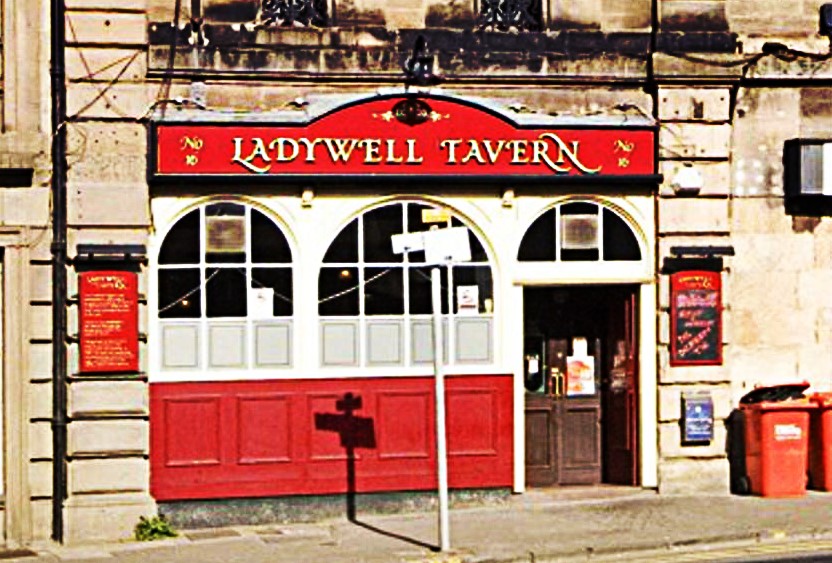
45. Lady Well, Dundee.  Perpetuated in the name of the pub Ladywell Tavern and in the Wellgate, Dundee.  ‘The Well of the Blessed Marie de Dundee’ was a holy site in the medieval burgh and was one of the primary water sources for the city until it was demolished on the construction of Victoria Road in 1872.

Ladywell Tavern Dundee, where many a thirst has been quenched.

46. Lady Well, Farnell.
47. Lady Well, Chapelton, Menmuir
[Note also the place-name Ladlewell, east of Forfar:  possibly a corruption of Lady Well?]
48. Lammer Well, St Vigeans.
49. Lanuner Well, by Newton Hill, near Arbroath.
50. [Logie-Pert*]  well in kirk-yard, used to treat sores.
51. Lunan Well, Lunanhead Forfar.
52. McComie’s Well*, Glen Isla.
53. Madie's Well, on the banks of the Lunan, Kinnell.  Nearby was Madie's Heugh.  Possibly a corruption of parish patron St Maelrubha (or other wise Magdalen?).
54. Maid’s Well,  Rescobie.  Any connection with St Triduana who once reputedly lived here?
55. Marywell, Craig parish (anciently Inchbrayoch), close to the coastal village of Usan.
56. Mary Well, Kirriemuir.  Recalled in the local name Marywell  Brae.
57. Mary’s Well, Edzell.
58. Mary’s Well, St Vigeans.
59. Matty’s Well, Panbride.
60. May’s Well, Dunnichen.
61. Medicine Well, Idvies, also known as Medicie Well.
62. Medicine Well, Montrose.  This was, for a short spell in the 18th century, a fashionable spa.
63. Meg Blair’s Well, Lochlee.
64. Monk’s Pool, Kirkton, Lochlee.
65. Monk’s Well, St Vigeans.
66. Naughty Well, Kinnell.  Is this a colloquial corruption of an older (Celtic?) name?  We would love to get to the bottom of this one. The well was close to the ancient chapel of Bolshan.
67. Neil's Well, near the kirk of Kingoldrum.
68. Nettle Well, near Edzell.
69. Nickie’s Well, Witchwood, St Vigeans.
70. Nine Maidens’ Well, Bracken Bruach, Auchterhouse.
71. Ninewells, Dundee.  Close to the River Tay, on the west of the city.  Now commemorated as the name of the largest hospital in the region.
72. Nine Wells, Finavon.  On the hill above the old kirk.  A burn trickles down from the spot.
73. Nine Maiden’s Well, Forfar.  Located in the vicinity of Craig O’ Loch Road.
74. Nine Maiden’s Well, Kirkton of Strathmartine.  Near the kirk, this is importantly in the vicinity of the folk-tale of Martin and the Nine Maidens.
75. Nine Maiden's Well, Cortachy.  Near the church.
76. Nine Wells, Glamis.  The supposed home of the Nine Maidens, in Glen Ogilvy, was located within Glamis parish.
77. Nine Wells, close to Peallock Quarry, Lunan.
78. Nine Wells, Oathlaw.

[Few other areas in Great Britain have so many Nine Wells/Nine Maiden’s Wells, which points to a significant  local cult in the area which became Angus.]

79. Pater Well, near Deerpark Cottage, Kinnaird.
80. Paterlochwell, near Cottarward, Dunnichen.
81. Peatmire Well, Black Wood, Arbirlot.
82. Purdie’s Well, near Ochterlony, Rescobie.
83. Queen’s Well*, Glenmark, Lochlee.  Re-named in honour of Queen Victoria, but originally named Tobar na clachan gualaich, the Well of the White Stone.
84. St  Aidan’s Well, Kirkton of Menmuir.
85. St  Andrew’s Well, Monikie.
86. St Andrew’s Well, Lintrathen.
87. St Anthony’s Well, Auchterhouse.  On Henderson Hill, marked as ‘disused’ on modern maps.
88. St Bride’s Well, Templeton, Nevay.
89. St Columba’s Well, Shielhill, Kirriemuir.
90. St Fergus Well*, Glamis.
91. St Innen’s Well, Fern.  Located in a place named Wellford.
92. St Iten’s Well, Menmuir.  The name is probably a corruption of Aidan, the patron of Memuir parish.  (Same as no. 83?)
93. St John’s Well, Guynd.
94. St Kane’s Well, Monifieth.
95. St Madden’s Well, Airlie.
96. St Martin’s Well, Bridgend, Lethnot.
97. St Martin’s Well, St Martin’s Den, Logie.  Famous for curing scurvy.
98. St Mary’s Well, Oathlaw.
99. St Mary’s Well, Rescobie.
100. St Murdoch’s Well, West Drum, Brechin.
101. St Ninian’s Well, Arbroath.
102. St Peter's Well, Tealing.
103. St Ringan’s Well, Arbirlot.
104. St Sinavy’s Well*, or Sunny Vie, near Mains Castle, Dundee.
105. St Trodlin’s Well, Rescobie.  Named after Triduana.
106. St Vivian’s Well, Fern.
107. Scots Well, Lochee.
108. Scotston Well, Auchterhouse.
109. Seggie Well, Carmylie.
110. Silver Hill, St Vigeans.
111. Sinruie Well, Kirkden. Possibly corrupted from St Maelrubha?
112. Sod’s Well, east of Grange of Conon, St Vigeans.
113. Tannie's Well, Kinnell.  Another well whose name may be a corruption of an older name.
114. Tothel Well, West Mill, Dunnichen.
115. The Tottler, Milto of Conon, Carmyllie.
116. Well of Bowhale, Glen Isla.
117. Whey Wells, Fern.
118.  Witch’s Pool, Kirriemuir.
119.  Wormiehills Well*.  Well and place-name near Arbroath.

Wednesday, 2 March 2016

Lost Houses of Angus: Lindertis House

When you think of ruined, vanished or lost mansions and castles you may picture homes which have been in situ for generations, perhaps even hundreds of years.  But some imposing buildings were only features of our landscape for a few generations, which begs the question:  should we fret for their loss if they were only evident for such a relatively short time and moreover in the possession of a privileged and wealthy few.  But beyond the architectural interest, there is the social interest, a fragment from the vanished material past, a place once marked out as a special home and then erased forever.

The Landscape Architecture of the Great Painters of Italy by Gilbert Laing Meason.

   Lindertis House in Airlie parish was built by Gilbert Laing Mason in the second decade of the 19th century. The estate or lands had been in existence for centuries, variously known as Lundateris, Lendartaris and variations, though the surrounding lands were known as Readie.  Gilbert coined the phrase 'landscape architecture' in his book about the gardens of Italy. Ornate gardens were also laid out in the newly bought estate, but when the owner died in 1832 his son, Magnus Laing Meason, was obliged to sell because of monetary difficulties.  The buyer was the creditors of Major-General Sir Thomas Munro, who had died in India in 1827.  When the heir, Thomas Munro, came of age he gained the estate, but he died childless, so it passed to his brother, Campbell Munro, and afterwards to his son, Sir Hugh Thomas Munro (1856-1919), a founder member, and later president, of the Scottish Mountaineering Club.  Sir Hugh has won enduring renown for his list of almost 300 Scottish mountains of 3,000 feet and over, known now as Munros.  

Sir Hugh Thomas Munro.
   Sir Hugh’s son Torquil (1901-1985) inherited the estate, though the family mainly relocated to Drumleys House.  The old house was not found to be cost effective to maintain, though it was converted into flats for estate workers for a time.  These flats were occupied until the mid sixties, but the building was finally demolished twenty years later.


  The cost of maintaining the extensive and elaborate gardens probably contributed much to the downfall of the estate as a whole, though the house itself was likely too massive to be fiscally manageable.  Hardly a trace of the mansion now exists and the carefully tended gardens are now also radically changed, an object lesson in the impermanence of grand designs perhaps.  Those interested in a recollection of Lindertis should consult this excellent oral reminiscence website.


Sunday, 21 February 2016

The Early Church in Monikie, Monifieth and a girl called Mouren

The lands around the Tay were a crucible for early Christianity, though we know that other saints, mostly Irish, penetrated into Angus:  St Buitte in Kirkbuddo, St Drostan in Glen Esk, St Fergus at Glamis, plus St Donald in Glen Ogilvy, to name a handful.  But places on the River Tay and further down the Fife coast have a special place in this probably un-writable story of Pictish conversion. Abernethy and Invergowrie feature in this story, but another intriguing area is Monifieth and its neighbouring parish of Monikie in Angus.


  One of the intriguing mysteries is how St Andrew came to be the patron saint of Scotland, trumping the powerful challenge of Colum Cille or st Columba of Iona.  One respectable theory says that the Picts picked this foreign saint in an effort to resist the cultural take-over from the 'family of Iona', centring his cult in the place which became known as St Andrews.  But what truth is there in the legend that one St Rule came by sea from Constantinople to Pictland, bringing this apostle's holy bones with him?  There are several versions of this 'St Andrews Legend' and all of them are frustrating.

   In the year 834, the Pictish king Angus [II] mac Fergus died and some sources credit him with the foundation of the cult centre of St Andrews at Kilrimund, following the arrival of St Rule (or Regulus) with his followers.  To muddy the water, the monastery at this place, also known as Cendrigmonaid, may in fact have been founded during the reign of the first Angus mac Fergus (c. 729 x 747).  Leaving that annoying anomaly aside, the version of the legend we should consider is contained in the St Andrews abstract, and there it is stated that the account derived from a memorial written by a cleric named Thana son of Dudabrach, in Meigle, during the reign of the Pictish king 'Pherath son of Bergath' (839 x 842).  It is interesting that Meigle, a parish which sits in Perthshire but juts into Angus, was a very early Pictish Christian site, comparable to St Vigeans near Arbroath in Angus.  The local connection perhaps helps to authenticate the tradition.

   Thana stated that Regulus met the Pictish king and his three sons at Forteviot in Perthshire, which was indeed an important royal Pictish power centre.  Then they travelled to meet Queen Findchaem (or Finchem) at a place named 'Moneclatu, which is now called Monichi', where the queen gives birth to a daughter named Mouren, who was afterwards buried at Kilrimund, and Findcaem gives this place to God and St Andrew.  They then journey across the mountains to a lake called Doldencha.  Then the saint returns with the king across Moneth to Monichi, Forteviot, and Kilrimund.  Part of the intention of the story was doubtless to justify the later ecclesiastical possessions of St Andrews. The place across the Moneth is reckoned to be Kindrochet in Braemar, Aberdeenshire (dedicated to St Andrew).  But Monichi is probably not to be equated with Monikie in Angus, similar as the names are, because that parish was in the possession of the see of Brechin, not St Andrews.  Next door, in Monifieth parish, there was an ancient church called Eglis Monichti, in the see of St Andrew.  The Latin derived eglis (ecclesia) points to a very significantly early Christian foundation.  We also have to admit the presence of St Andrews Well in Monikie.  For many centuries there was a Trewell Fair held in Monifieth, the name being a contraction of St Rewell or Ruil, possibly the St Rule of the St Andrews Legend.  This St Rule may ultimately have been a real person, the Irish cleric St Riaguil of Muicc Innis.  His feast day  corresponds with the date of the fair, the second Tuesday in October.  It was this Irishman who showed significant interest in our area by composing a poem celebrating King Brude's victory at the Battle of Dunnichen in 685.  Was the Irishman recast as a Continental by Picts anxious to escape the shadow of Iona?

   Further evidence of the early church in the area is attested by the presence of the arcane order known as the Culdees (celi de, 'servants of God') at Monifieth.  In the year 1242, Matilda,Countess of Angus, gifted to the church of Arbroath all the land on the south side of Monifieth which the Keledei had held in the time of her father.  Malcolm, Earl of Angus, issued a charter 22 years earlier, and one of the witnesses was a Nicholas son of Bricus, one of whose titles was abthein of Monifeith, an ancient Cletic church role.  While it cannot be proven that there was a continuous Celtic Christian settlement here from Pictish times, right through to the 13th century, the case for some kind of continuity is compelling.

   And, if nothing else had been learned, at least we have the first known named child who was born in Angus - Princess Mouren.  It was conjectured (by Bishop Forbes in Kalendars of Scottish Saints)that the place of birth of this princess was at the ancient chapel and settlement of Eglismonichtie now long since vanished.
 
The Tay Coast close to Monifieth.


Saturday, 20 February 2016

Forgotten Sons of Angus: In Search of Lewis Spence

James Lewis Thomas Chalmers Spence, journalist, writer and folklorist, is one of those artists whose memory still exists in a kind of limbo, sixty plus years after his death in Edinburgh in 1955.  A prolific author, whose most popular books (though perhaps not his best) are repeatedly reprinted, he remains an elusive figure, perhaps because the concerns of his generation are now mostly ill remembered.  He was born in Darlington Cottage in Broughty Ferry on 25th November 1874, the son of James Edward Kendall Spence and Barbara Charlotte Chalmers. Though this James Spence (born in Edinburgh in 1848) was primarily involved in the insurance business, his father, another James Spence (1812-1882) was an eminent professor of surgery in Edinburgh and Surgeon on Scotland to Queen Victoria.  This family tradition perhaps influenced Lewis to study the allied subject of dentistry at Edinburgh University after going to Higher Ongar School in Essex.  The writer's father died when Lewis was fourteen, drowned on a voyage to America. Lewis's brother was an actor-manager, Kendall Chalmers Spence, who used the stage name Kendall Chalmers. On his mother's side of the family (she was Barbara Charlotte Chalmers), Spence was related to that other Angus luminary, James Chalmers (1782-1853), inventor of the adhesive postage stamp.

View of Broughty Ferry in the early 1900s

   But soon the calling of writing made Lewis Spence settle first into a career in journalism, becoming a sub-editor at The Scotsman, in 1899, the year in which he married Helen Bruce (the marriage produced one son, Toby, and three daughters: Rhoda, Claire and Madge). The Scotsman years overlapped with a period as editor of The Edinburgh Magazine (1904-1905), then Spence moved on to become editor of The British Weekly (1906-1909), based in London.  It was during this period that folklore and mythology, also with a fascination for some areas of occultism, set his imagination alight. His first published book was Mysteries of Britain:  Secret Rites and Traditions of Ancient Britain Restored (1905).  This was followed by more than forty books, with his studies of mythology alone ranging from Babylonia and Egypt, to the Rhine and Spain and Native North and Central America.

   While he was nearly as prolific as his near contemporary and fellow Scot Andrew Lang, this writing of mythology has stood the test of commercial reading taste well while Lang's works on fairies and folklore has largely not. This is an unfair trick of time, as Lang is undoubtedly the better writer.  The incipient mysticism Spence shared with a whole set of other writers including W. B. Yeats, Algernon Blackwood, Fiona McLeod.  Although Spence was a Fellow of the Royal Anthropological Institute of Great Britain and Ireland, and Vice-President of the Scottish Anthropological and Folklore Society, he was also given an honorific title as 'Presider' of the Ancient Druid Order. It is evident he was not a practising druid, let alone an occultist or neo-magician. (Recognition by the druidical order was probably prompted by books such as The History and Origins of Druidism (1938).)  In fact, his friend Richard Cammell describes him as a highly coventional,albeit very cultured man, who did not have the  least trace of anything bohemian about him.  He was a highly effective synthethiser rather than a mystically inclined creative genius.


   One of the best recent encapsulations of his interests and capabilities is in the essay entitled 'Lewis Spence: Remembering the Celts,' by Juliette Wood*.  Wood highlights Spence's extraordinary industry and versatility and also his psychology and artistic limitations.  'He often had these startling revelations,' she says, but never really worked through them, and unfortunately this very lively, but quirky intellect became more rigid with time.'

   The classes of Spence's works include several notable firsts, including the ground-breaking Encylclopedia of the Occult (1920) and the first book to delve into the murky world of Nazi fascination with esoteric lore, The Occult Causes of the Present War (1940).  But the fever which Lewis Spence caught most profoundly was the once alluring mystery of the lost continent of Atlantis (and its obscure sister continent Lemuria). Always a left-field area, the allure of Atlantis began to swell in the late Victorian age and flourished in the early part of the 20th century.  Spence jumped into this probably lucrative area of knowledge with both feet and his books on the subject came thick and fast.  There was The Problem of Atlantis (1924, also known as Atlantis Discovered), Atlantis in America (1925), The Problem of Lemuria (1932), Will Europe Follow Atlantis? (1942), and The Occult Sciences in Atlantis (1943), plus his editorship of the journal Atlantis Quarterly (1932).   If Atlantean studies was a niche market during his time, it has shrunk to a very limited stump now, though these works too have been frequently reissued.

   An interesting light on Lewis's studies on Atlantis and how they related to his views on the anthropology of the Scottish 'race' was given by S. B. Tucker in his article 'Warlords of Maclantis: Scottish Nationalism's Undersea Kingdom' (The Fortean Times, 17th September 2015).  This well-researched piece tied in Spence's beliefs that the original stock of Scotland were linked to the lost continent.  This tied in Spence with the wilder fringes of nationalism, not only in Scotland, but also in Europe in the 1930s, though Tucker quite rightly refutes any suggestion that Lewis Spence had fascist tendencies.  In fact he seems to have been an ardent, if moderately right-wing Scottish nationalist of the type which was later cruelly characterised as 'tartan Tory'. He was certainly and consistently opposed to the damage which he perceived had been been done by Scotland by the 'Saxon' cultural forced of England. According to Juliette Wood, 'In many ways his national consciousness drove his other interests, and he maintained a lifelong dedication to Scottish national politics until his death in 1955.'

  In 1924, was a founder member of the Scottish National Movement and the National Party of Scotland, the forerunners of the Scottish National Party, serving as vice-chairman of the NPS.  He was this party's first parliamentary candidate, standing at the Midlothian and Peebles Northern by-election in January1929 against three other candidates.  But he polled only 842 votes (4.5% of the vote), losing his deposit.

   Later disagreements with the redoubtable left-leaning Hugh MacDiarmid and others led to his withdrawal from active politics altogether.  Right from the start of political nationalism in Scotland there were two wings: one advocating complete independence and the other a form of limited Home Rule.  Spence fell firmly in the second group.  There were further wings comprised of republicans and monarchists and Spence's advocacy of the British monarchy brought a vote of censure which prompted his resignation from post, and though he retained membership of the party, his interest in active nationalism withered away.  The literary involvement of Scottish nationalism, involving Spence, Compton Mackenzie, Hugh MacDiarmaid and R. B. Cunningham-Graham, has yet to be fully chronicled.

First public meeting of the National Party of Scotland in 1928.  Lewis Spence is conspicuous by his absence.

   As well as turning his hand to magazine pieces, plays and stories, Lewis also found time to write poetry in Scots and English, published in volumes such as The Phoenix (1923), The Plumes of Time (1926), and Weirds and Vanities (1927).  Many of his verses celebrated various places and themes concerning Edinburgh, where he made his home, first in Arden Street and latterly at 34 Howard Place (Inverleith Row).  It is reckoned by some that his Collected Poems, which appeared shortly before his death, omitted some of his best work.  A picture of the writer's remarkable discipline and work rate was given by his friend Charles Richard Cammell in his book Heart of Scotland (1956) [a summary of which,written by Philip Carr-Gomm, can be read at the Druidry.org website.]


The desk was a model of tidiness...nothing used or useless lying about...Before commencing a book, he planned every part of it, every chapter or section of chapter...He next marshalled his material, pigeon-holing the references...he worked with a minimum of fatigue, and almost without the wearisome labour of revision, and brought his work to its predestines conclusion in an astonishingly short space of time. [The Heart of Scotland, p. 36.]

   In retrospect, Spence's most enduring legacy seems to be his volumes on British insular mythology and tradition.  Particularly good is The Fairy Tradition in Britain (1948), but other admirable works in this category include The Magical Arts in Celtic Britain (1945), British Fairy Origins (1946) and The Minor Traditions of British Mythology (1948) and Fairy Tradition in Britain (also 1948).

   Anyone who has unwanted copies of Scottish Ghosts and Goblins (1952) or any of the above works can readily donate them to me!

   In the end, Lewis Spence, despite his voluminous body of works and 80 years on this planet remains an elusive character these days.  A search of the internet for images of him reveals a scanty few, including the photo below.  Lewis Spence died in Edinburgh on the 3rd March 1955.  Gone but not forgotten.


Postscript

  I have not read as many as Spence's works as I would like to, particularly his more obscure books.  His popular books on national and regional mythology and traditions are highly readable, but possibly unreliable.  They were dashed off by the author with remarkable speed, based on a highly polished research methodology and - with lack of revision- suffered from flaws.  His poetry I have hardly seen, but the following is an excerpt from his Weird o' Wallace, described as 'the inspired Hymn of Scottish resurgence':

I was on Sidlaw side
And sank intae a sleep,
Sae saft was simmer's tide
Where silence is maist deep,
And doon the loans o' dream
I wandered till yon airt
Whase banks unearthly seem
The richtt warld o' the hairt.
Till, seated by a shaw
Abune yon eerie braes,
A shade o' micht I saw
Frae the heroic days.
Forrit he strode like Daith,
As meikle and as grim,
I kent him Wallace' wraith,
E'en tho' the form was dim...


* pp. 19-211 in Fantasical Imaginations: The Supernatural in Scottish History and Culture, ed. Lizanne Henderson (John Donald, Edinburgh, 2009).


Friday, 12 February 2016

Lost Drinks of Angus? Mmm, refreshing!

This post was going to be the first in a series of a hundred entries on the lost drinks once made in Angus, from ales and beers, to whiskies and soft drinks...On second thoughts, we won't bother with that and instead focus on an old advert, the first of a series that may pop up every now and again on the blog.
 
   Today's great lost product is Pola Cola, and the memories of this amazing Dundee-born soft drink can first be sampled in the archive of the amazing Retro Dundee blog, featuring vintage adverts and photos, including the famous mural in the Dundee street where the legend of Pola Cola was written large.  This particular advert below is an older relative of those on Retro Dundee, not so snazzy as later versions, but with a primitive early 1960's charm:

   But was Pola Cola any good?  Some commentators have sadly pointed out its rather 'unique' flavour and tendency to lost its inborn effervescence at an astonishing rate.  But foods and drinks are magical triggers for the memory, trapdoors to the psyche.  Think of Marcel Proust and his search for Lost Time, spurred on by a simple Madeleine dipped in wine.  
   Is it a good idea to resurrect legendary taste sensations from the dim and distant?  Take the example of Krakatoa Foam, a fiendish recreation of the holy Cremola Foam, of blessed memory.  Does it taste the same as it always did?  Yes:  delicious, with a hint of nastiness.  Mmm.

   And another thing about taste and the tricks its plays with the mind.  Writing from the far corner of Cornwall, the mind years for delights such as proper morning rolls, white and red puddings, Forfar Bridies, steak sausages, steak pies...the stuff of life only to be found in Dundee and Angus and thereabouts.
   But I'll stop now before this food-memory torture thing drives me daft.