Thursday, 28 April 2016

The Deil o' Glenisla

The Deil o’ Glenisla had many names back in his days of his glory:  the King o’Lintrathen, Bamff, or just plain Ramsay.  Nowadays he would be wearing a security tag on his leg, but a few generations ago he was honoured as a lovable rogue in print (in Blairgowrie, Stormont and Strathmore Worthies by Henry Dryerre (1903) ) and celebrated as a sort of local Rob Roy.  James Ramsay was born in Dundee and claimed descent from the Ramsays of Bamff, which has never been established.  For whatever reason, he relocated to the Kirkton of Glenisla and terrorised north-west Angus and the neighbouring parts of Perthshire with his unique brand of criminality for over forty years.  Being in an upland parish provided Ramsay with the ready opportunity for whisky smuggling and he was often outwitting the hapless gaugers (excisemen).  One story has him journeying down a lane in his horse and cart when he spotted the gaugers laying in wait up ahead.  He quickly removed his stash of spirits and hid them beneath some pig manure and allowed his goods to be searched by the officials when they stopped him.  This violation of his civil liberties later came in handy, because, when he retrieved the whisky from the farmyard, he also carried away three or four chickens that ‘persisted in getting in is way’.  The official search of his transport gave him the perfect alibi that he had not stolen the creatures.  Removal of livestock became a speciality of the Deil.  On one occasion he purloined a cow and sold it at market before the enraged farmed noticed it was missing and on another occasion he audaciously drove a dozen sheep all the way to Dundee and sold them there without being caught.


   Maybe it was a mark of the man, a peculiarity of the district, or the habit of the age, but whenever a local person noticed that some article was missing, he went to the Deil and engaged in a bit of polite word play.  The victim never accused the Deil, only happened to mention that they had a lack of a certain item, then the Deil would kindly hand them back the possession he had stolen.  But if it happened to be an item of foodstuff, then there was no chance of retrieving it.  A publican stole back his own spade from the Deil’s cart one day when he wasn’t looking and had to get it back again the same day when it was stolen off him again.  When the minister gave him a lift on the back of his horse on the way to Kirriemuir market (with the warning to behave himself), the Deil pranked him when he was asked to dismount.  Instead of getting off, he dug his heels into the horse, making it career off, with the furious minister and himself.  As they vanished into the distance he shouted to the amusement of the crowd:  ‘Ha, ha!  Juist see here – the Deil’s awa wi the minister!’  Another trick was the occasion when he ordered two pairs of boots from different cobblers and only had one of each pair delivered, promising to pay cash on delivery for the pair when he had enough money to get the second shoe.  Of course, he matched up the left and right shoe from each pair and never bothered to pay for the remaining shoe of each pair.  He was happy with the slightly odd pair of shoes in his ownership and declared truthfully, ‘And far wad ye get a cheaper pair?’

   The farmer of Pitewan rather trustingly asked the Deil to go to a local ironmonger and get him to fit a pair of iron rings for his cart and deliver them to David Grewar the blacksmith, at Pitmuddie.  On the way to the smiddy the farmer met the Deil and asked him if he got the rings.  ‘Deed did I,’ said Ramsay.  ‘Jist look at them.  Man, aren’t they rinnin roond fine?’  The rings were of course fitted to his own cart and he sped off away from the infuriated farmer before anything could be done.   How the farmer must have chuckled at the lovable rogue who robbed him blind!

   More pathetically, Ramsay enraged his landlord to such an extent that he was evicted, which of course he refused to comply with, so all his furniture was removed and he was turfed out.  The ramshackle house he inhabited was then razed to the ground, so Ramsay camped nearby in a hole in the ground and evidently thrived under the circumstances until he had enough money to move into a new house at Dyke End, Lintrathen, when the winter set in.  His horse occupied one end of this dwelling and he the other – though there was only one entrance.  In this poor house he dwelled for many years and actually endeared himself to his neighbours, to some extent, despite his honest failings.  His health failed him when he neared the age of 70, around the year 1855, and he was taken into the care of relatives in his declining years.  When he died he was interred in his adoped and beloved haunt of Lintrathen.


Friday, 15 April 2016

Wells Once More

I knew this would happen - and it’s entirely my fault.  No sooner had I feverishly compiled a ‘hot list’ (or should that be ‘wet list’?) of over a hundred famous and not so famous wells and springs in Angus and satisfied myself that it was over and done with, then a new batch of well information came to my attention.
    Never mind that I added a precognitive mention in the previous post that the Well List was liable to be un-comprehensive.  Secretly I was smug and thought I had done the job properly.  But that turns out not to be true, and I apologise.
   Here is more details about the Wells of Angus.  Wells which have been mentioned before are marked with an asterisk.

Starting in the north-west, near the parish church of Glenisla which was dedicated to the Virgin Mary, there was a Lady Well.  There were at least five other Lady Wells in Angus, as previously noticed.  The Glenisla well was filled in some time before the late 19th century.  After noting this fact, the historian of Angus, Alexander Warden, cryptically remarked:  ‘There is a perennial spring which cannot be filled up, a well of living water, out of which all are invited to drink, without money and without price.’  The Rev James Watt, author of the parish entry in the New Statistical Account, noted that the Lady Well was usually 48 degrees Fahrenheit, while the Corryvannoch Well*, also in the parish and at the foot of Mount Keen, was two degrees cooler.  Watt repeats the tradition of people visiting the Coryvannoch on the first Sunday morning of May, especially about day break, to cure sick children.  They would leave a trinket in thanks for its watery wonder working.  But he noted that people no longer believed in it by his time.  Nobody drank from it, except perhaps ‘the passing shepherd, or those whom curiosity, arising from its former reputation, induces to pay it a visit.’  A formerly popular ‘mineral spring of the chalybeate kind’ in Panbride parish had become neglected in the 18th century, as noted in the Old statistical Account.  Among the many oddly named wells was the Crew Well, near Auchtertyre, parish of Newtyle.
   Other once renowned holy or healing wells were losing their aura with the ‘common’ folk by the Victorian age, although bookish folklorists were backfilling their interest by documenting historical associations with these once renowned places.  Many of the amateur collectors of lore were local clergymen, though those who contributed to the Statistical Accounts in the 18th and 19th centuries only mentioned local beliefs and antiquities as a sideline to other matters concerning their parishes.  The haunted well at Benvie*, west of Dundee, was noted by the Rev George Addison in the New Statistical Account, as being ‘formerly in great repute as a tonic, and was applied externally in cutaneous disorders, but is now entirely neglected’.  In the same source, the Rev James Headrick mentions a small chalybeate spring in his parish that helped stomach complaints, though he does not comment whether it was well or poorly frequented. On the borders of this parish and Kirkden * parish was a perennial well which helped with swellings and ulcers which had effect when doctors’ cures had proved ineffectual.

   A few named wells note previously mentioned include St German’s Well at Kinblethmont, which may have a connection with the Knights Templars who once owned this land.  Another well in the burgh of Dundee was St Francis’s Well, which was piped to provide water for one of the town’s religious houses in pre-Reformation times.  Another well with possible religious associations in Monk Mudie’s Well at the foot of Carmyllie Hill.  Who was Monk Mudie?  I don’t honestly know.  The Bra Well*, previously mentioned at Stracarthro, seems to be synonymous with Braul's Well, which the historian of Angus, Andrew Warden, states was also known as St Brule's Well.  This in turn, he states, derives from St Rule. 
   Near Battle Drum Wood there is a Battle Burn, Battle Cairn and Battle Well.  All of these mark, reputedly, a bloody encounter between Romans and Picts.  The burn was polluted with blood for much of its length and, for centuries, herdsmen used to throw a bit of bread into Battle Well, just in case the water turned to blood.  The act possibly records some forgotten superstition.
   King’s Well*, near Keillor, Newtyle, is supposedly the place where Macbeth halted as he fled northwards from Dunsinane.  (Also in the same parish is the Crew Well near Auchtertyre).
    The well in Balmossie Den, by Balmossie Bridge and the eastern entrance to Lintrathen House and on the banks of the Dichty is the Cauld Water Well*, also known as The Wishing Well or the Cat Craig Well.  No wonder I got it wrong in a previous mention.  The Cat Craig is a nearby rock.  The stone surround of the well is inscribed:


                   Whosoever drinketh of the water shall thirst again.  T E 1847


A well with too many names?   Balmossie Den.

Friday, 8 April 2016

Forgotten Sons: Captain Maule Ramsay and Right Wing Extremism

This is a difficult one.  Some people deserve to be remembered not for their great deeds, fortitude or admirable characteristics, but for the opposite of all these.  Take the man who wrote this verse, someone born into an honourable, upper class family, who lived in a castle and enjoyed every advantage in life, but who lowered himself to this:

 Land of dope and Jewry
Land that once was free
     All the Jew boys praise thee
Whilst they plunder thee
Poorer still and poorer
Grow thy true-born sons
Faster still and faster
            They’re sent to feed the guns.


Land of Jewish finance
Fooled by Jewish lies
            In press and books and movies
   While our birthright dies
Longer still and longer
Is the rope they get
     But – by the God of battles
      ‘Twill  serve to hang them yet.

Written on House of Commons notepaper in 1940 by Member of Parliament for Peebles, Captain Charles Maule Ramsay, the doggerel was sadly indicative of the views of its author.  Until the later 30s this Unionist MP seemed one of many dull but worthy members who restricted their political interests to the sometimes narrow concerns of the rural communities they represented.  But something happened to Ramsay which turned him from this path to a more sinister direction.  He became convinced that the Bolshevik threat from communist Russia posed an imminent threat to Great Britain and indeed the whole of western civilisation.  The only bulwark he imagined that would save the west was Adolf Hitler and Nazi Germany.


   Many thousands of people in Britain similarly feared totalitarian communism and many of these people overlapped with those who did not want the UK involved in another world war.  A darker segment of opinion admired the policies and practices of the fascist states, though some of these fell away when the realities of the brutality of the German regime became clear in the press.  Others still discarded or at least parked their extreme right-wing inclinations when war was actually declared.  Yet still there were self-declared fascists who persisted in actively subverting the war effort after this time, while declaring themselves acting in the patriotic best interests of the nation.  The title of the fairly recent study (1998) of this subject says it all:  Patriotism Perverted, Captain Ramsay, the Right Club and British Anti-Semitism in 1939-40, by Richard Griffiths.


   Ramsay, born in 1894 into an old Angus family, had his home at Kelly Castle, near Arbroath.  This castle stands near the River Elliot in Arbirlot parish.  An alternative name for it was Auchterlony (or Ochterlony) Castle.  Built in the 15th or early 16th century, it was a stronghold of the Mowbray family, but later housed a branch of Ochterlonies, one of whom was said to have been the reforming zealot who burned down Arbroath Abbey. Some of his uncontrolled bigotry perhaps passed down to the later owner of the property. The Irvines and Stewarts later held the house, then it passed to the Ramsay family, Earls of Dalhousie, whose principal seat is Brechin Castle.  John Gilbert Ramsay, 16th Earl of Dalhousie (1904-1950) was a close relative of Captain Ramsay’s.

   Ramsay became convinced that Jews were subverting the capitalism system for their own evil ends, principally through a cabal of rich financiers based in New York.  Correlated with this delusion was the opposing theory that Jews were at the very centre of the Soviet system and were hell bent on destroying British civilisation from the other direction, physically and politically.  The latter belief showed a great fear of being under the godless jackboot of Stalin and his associates; another contradiction given that even the most rabid anti-Semite could not argue that the Jews were godless.

   After being involved in a number of extreme right-wing organisations, Ramsay founded the secret Right Club, consisting of like-minded members of society who were mostly pro-German, anti-Jewish and convinced they were doing the right thing.  In the run up to the war, Ramsay's already inflammatory anti-Jewish rhetoric was fully reported in the local press in Arbroath without a scintilla of censure.  The same was true of his equally rabid wife, Ismay.

   Modern Scotland sometimes harbours the delusion that the extreme right-wing is mostly if not exclusively an English ailment.  But there were plenty in the 1930s, 40s and beyond north of the border who disparaged the foreigner, the Jew in particular, and wanted the latter punished in some way for their apparent apartness. It is a mark of Ramsay's alleged great charm and upper class influence that even the Liberal MP for Montrose Burghs, Lt. Col C. I. Kerr, was influenced by him to some extent.  Kerr expressed some dubious opinions about Jews, but swiftly withdrew his remarks in the press.  Another Angus luminary impressed by Ramsay was the 11th Earl of Southesk, Charles Carnegie (1893-1992), quoted as saying that Ramsay 'was a very loyal, patriotic man'. Carnegie was a member of Ramsay's Right Club.


   The Captain became ever more careless in his crusade as the war went on, linking up with a fascist-inclined official at the American Embassy named Kent and narrowly avoided being charged under the Official Secrets Act. However, he did fall foul of Defence Regulation 18B and was interned along with other potential traitors like Oswald Mosley. Ramsay has the distinction of being the only MP to have suffered that ignominy, though the imprisonment did not change his views. After being released in 1944 he lost the seat he had represented since 1931 in the election of 1945 and published his chilling historical 'Jew wise' historical thesis and personal political justification, The Nameless Warin 1955, the year in which he also died.

   Freedom fighter that he imagined himself to be, he dedicated his book to those who had signed the Magna Carta and the Declaration of Arbroath.

   Gone, but not forgotten. And God forgive those who condoned him, Angus and national.


Saturday, 2 April 2016

The Worry of Worthies - Dafties and Characters from Long Ago

Dundonians of a certain age might remember Barrack Street Museum.  Downstairs was a newspaper archive and upstairs there was a series of displays, including the famous Dundee Whale.  Was there competition between this museum (now sadly closed) and the main museum in the Albert Institute?  Both certainly boasted eye-catching exhibits which make the modern ones seem very anaemic in comparison.  (My favourite from the main museum:  the lovingly preserved Old Toll Bar interior from Lochee.  Why is this in storage now?  Maybe I just love pubs too much.)


   Barrack Street featured a series of small, fascinating dolls whose heads were made from dried apple, shrunk and dried so they almost resembled miniature human features.  Maybe my memory is playing tricks here, but I’m almost sure they actually existed.  The figures depicted a range of ‘Dundee Worthies’ from the 19th century, characters remembered in city lore because of their very public and persistent eccentricities.  There were people such as ‘Glass Bottom’, who had the probably unique delusion that his posterior was made of crystal and would never sit down on that account.  How did he sleep, I wonder?  Wrapped up in pillows and bolsters to safeguard his fragile bum?  Then there was ‘Teapot Tam’, whose mania was to tip himself over at regular intervals along the street, imitating the action of a pouring teapot. 
   It would maybe be politically incorrect to have such commemorations of mentally subnormal people on display in the 21st century.  But ‘worthies’ or ‘naturals’ were an almost celebrated part of the community, whether it be larger burghs or country districts and there is a whole genre of popular literature, from Scotland and beyond, that details the charming and unique dafties who were colourfully ever-present in Victorian times and previously.  A related category of writing revels in ‘couthy’ or ‘kail-yard’ characters, whose rural adventures were lavishly detailed in exaggerated ‘Doric’ language, all of which appears very tiresome to modern tastes.  Folklorists and historians may regret that so much local history writing falls in to this dubious variety instead of ‘genuine’ local information.  But it’s probably hoping for too much to wish for the past to be perfect.
   Dafties, Worthies, Village Idiots were an omnipresent fact of life, like it or not.  Literature on the subject draws a sometimes fine balance of admiration and derision, sometimes hinting that such ‘naturals’ were not always as daft as they would like you to think.  There is always the suspicion that some of those afflicted people were playing up to the part, a winking admission that there was a strain of street smartness which helped them survive.  Worthies in another sense also applied to local dignitaries, particularly eminent parishioners and townsfolk who were shining examples of religious piety.  This is another strand of regional literature which is very hard to digest.


   The ‘Dundee Worthies’ were celebrated in a book of that name by George Martin (1934), recently reprinted.  Other examples of this kind of book are almost too numerous to detail.  One of the best books, and one which is not really typical of this type is Blairgowrie, Stormont and Strathmore Worthies (by Henry Dryerre, 1903), which to be fair concentrates on admirable local characters rather than village idiots, albeit in an occasionally condescending way.  Among the genuinely interesting ‘men of imagination’ are former Angus luminaries such as James Gibb, ‘Old Gibbie’, who was schoolteacher at Kettins and also a self-confessed provider of grain for illicit distillers in the hills beyond Alyth.  He got his regular employment as a dominie by being subjected to phrenological  examination by the local laird, Lord Douglas Gordon of Hallburton.  His cranial lumps proving him well qualified, he was the local teacher for 48 years, and died in 1875.  Another personality enlarged upon in the book is the ‘Deil o’Glenisla’, whose exploits I will detail in the future. (Those with more localised taste could try Carnoustie Sketches, by James Fotheringham (1889).)


James Gibb, 'Old Gibbie', Kettins schoolmaster, scientist, curio-hunter, whisky smuggler (amongst other things).

   There is no doubt that those afflicted with mental or physical ailments were obliged to use their infirmities in order to survive.  One of the most remembered characters in North Angus in the 18th century was Jock Gudefellow, a legless man who used to pull himself around the countryside on a cart, and who terrified many a farmer’s wife into providing him sustenance.  He died in 1810 and was buried in Lethnot kirkyard.  One farmer’s wife panicked when he appeared at the door and she did not have anything at hand to feed him, so she cut up a bit of shoe leather and served it up to him.  His verdict, after he had consumed it, was that it was tough but tasty. James Bowick of Montrose commemorated Jock, in a bank-handed way, in these lines contained in his work Character and Sketches (1824):

                                       There's he who slid from Perth to Aberdeen
                                       Upon his hands and buttocks as they say:
                                       JOCK GUDEFELLOW was the creature's name, I ween,
                                       Who ofttimes scared the children from their play;
                                       But now the fearful wight hath passed into the clay.

   Behind such tales is a flotsam of scavenging humanity, twisted into strange shapes by poverty. And it was not just the congenitally weak who were afflicted.  Local Angus records in the early 18th century mention a series of gentlemen beggars, forced to travel from place to place cap in hand because of economic and social circumstances.

Another way of looking at things, is the interest in local characters from auld times reflects a supposedly better age when peculiarities were allowed to flourish unfettered by standards imposed by the evil pressures of modern life.  Another aspect of the good old days syndrome.


The redoubtable-looking Auld Grannie Fox from Carnoustie (though she was actually born in Kirriemuir).  By the end of the nineteenth century she had around 200 descendants in the town.

Friday, 25 March 2016

Rhymes and Rivalries: Water, Place Prejudice, Death

Not all Angus folk were regarded as equal in the halcyon days of long ago.  Previous entries have shown that ‘Angus bodies’ (as inhabitants of God’s own county were once known) frequently regarded their near parish neighbours as untrustworthy, suspicious, or just downright different.  At one time apparently the lowland inhabitants of Strathmore and the Mearns looked upon the inhabitants of the northern glens with undisguised mistrust. There was once a common slur in Angus and the Mearns which ran:

                                      We may ken ye’re a Glenesk man            
                                      by your scraggy face.

 There was story about a man from the glen who wandered into an eating establishment in Stonehaven.  During his dinner he looked up and thought he saw a neighbour from the glen sitting opposite.  He immediately shouted out the jibe about the scraggy face then everyone in the dining room suddenly stared at him.  What he had actually encountered for the first time in his life was a mirror, hung on the wall opposite him!

   Some of the old rhymes of Angus have lost their meaning because the things they speak of have altered forever or in some instances they refer to places which have also changed their names. Sailors were once guided back to the Angus shore by the sight of Barry in the distance, known centuries ago as Fothmuref, which locals corrupted into Fettermore:

                                         The braes o’Fettermore
                                         has been a gude ship’s shore.

     In olden times too the provision of clean water and the disposal of waste effluent was a difficulty for people, especially in larger towns before the provision of proper sewerage or piped water from purpose built reservoirs.  The hazard of couped oot urine and worse from upstairs windows from chanties or bed pans must have been common, and even the supposedly warning shout of ‘Gardyloo!’ might not have always prevented a stinky soaking.

Gardyloo!

   Before Dundee got most of its drinking water from the purpose built reservoir at Monikie, the townsfolk had to rely on the various wells around the burgh; among the most trusted was the Lady Well at the foot of the Hilltown.  There may have been a common belief that that springs named after saints were somehow assured of being pure and safe to consume.  But enterprising Dundonians began to draw water on a commercial basis from various sources and there grew up competition between rivals, which each claiming that their water was the best.  The major players in the Dundee water war were those who exploited sources at Logie and Invergowrie. Each firm drove barrels of their water through the streets and shouted out the benefits of their product.  One would bellow:

                                  Invergowrie’s crystal spring
                                  for Tea surpasses everything!

    Their Logie rivals would retort with this doggerel:

                                  Of a’ the wells that’s here aboot
                                  there’s nane compar’d  to Logie Spoot!

   Those were the days of unsophisticated marketing techniques!

   Other things that have vanished from certain districts over the years are certain families which may have resided there for umpteen generations.  In the parish of Stracathro there was a notable interconnected branch of the Martin family who occupied a large cluster of neighbourhood farms and outsiders were warned that they should be careful what should say to one farmer about another because they were all inter-related:

                                     Crawhill an’ Ba’hill,
                                     Rochie an’ the Greens –
                                     a’ thae three are friens.

   It was a proud and honourable boast among some kindreds that they had farmed the same soil for centuries.  The Spences of Balgavies, Aberlemno, were one such, proud of their longevity in the region, as attested to by an inscription on a tombstone dated in 1756, erected by John Spence in memory of his father and mother:

                                     Here ly’s an honest old race,
                                     Who in Ballgavies land had a place
                                     Of residence, as may be seen,
                                     Full years three hundred and eighteen.

   The Spences occupied their farm from the year 1438, and it was passed down from father to son until the year, 1820, after which some of the family removed themselves to Broughty Ferry (and may have been related to the writer Lewis Spence).

   Another boast sometimes found on local tombstones is extreme longevity, sometimes coupled with allegations of extreme fruitfulness.  Gilbert Mille died in Newtyle in 1675 and was said to have fathered twenty-six children by two wives.  Despite all this effort in procreation he still managed to reach the grand age of 100.  The inscription on his grave also contains an acrostic forming the patriarch’s name:
             
                                     Great is the wonders God hath Worked
                                     In Heaven, and Earth, and Sia;
                                     Lykuays he many mercies hath,
                                     BeStoued Wpon Me.
                                     Euen in this World, an Hundred Years,
                                     Remain’d I honestlie;
                                     Tuo Weded Wives the tym I had;
                                     Much Comfort was to Me.
                                     In Wedlocks Band ue Procreat
                                     Lauffully Ws Betuix;
                                     Loues Pledges, Whos Right number wer
                                     Euen tuo tymes ten and Six.
                                              My Spritt to God, I do commit,
                                              My Body to the Graue;
                                              When Christ shall com and jidg shall sitt,
                                              Shall them Both Recauie.

      Epitaphs often provided an outlet for unsung poetic endeavour in long past communities.  The oldest recorded gravestone in the kirkyard of Kirkden has this simple but satisfying inscription:

                             Heir lyis ROBERT DVTHIE, hvsband to
                                   Evphane Gvdlet, somtyme in Balmadie, who died
                                   In Descm 1667, and of his age the 47:
                                             I rest in hope
                                            And shal Aryse
                                            To reigne with Christ
                                            †Above the Skyes.


   The profession of the Scotts at Balmossie, Monifieth, was waulking, or fulling cloth, hence the punning inscription on one of the family’s tombs (now lost):

                                  On earth I waulked for many years,
                                  But here I now do sleep;
                                  Where I shall waulk when I away,
                                  To you’s a mystery deep.

   This last rhyme takes us back even further in time and is alleged to have been made by no less that King James IV, when the lands of Keillor, near Auchtertyre, were granted by him to the guidwives of the Haddon family who had entertained him.  It takes the form of a reddendo, conditions of tenure for the land grant which were, in this case, rather unusual.  The family would have had difficulty supplying a rose at Christmas or a snowball at Lammas (August first).  James IV was unaccountably fonder of wandering about the neighbouring county of Fife, otherwise we would have had more rhymes like this one:

                                  Ye Haddons o’ the Moor,
                                  ye pay nocht
                                  but a hairen tether –
                                  if it’s socht,
                                  a red rose at Yule
                                  and a sna ba at Lammas.


Keillor Pictish symbol stone, Kettins parish (now in Perthshire, but historically part of Angus).

Tuesday, 15 March 2016

Fisher Folk(lore)

The coastal communities of Angus, as in other places, long had their own customs, beliefs and superstitions, some of which were widespread among fisher communities and others which were peculiarly local.  In 1790 the minister of Arbirlot wrote that, ‘The sea-gulls are considered ominous.  When they appear in the fields, a storm from the south-east generally follows; and when the storm begins to abate, they fly back to the shore.’  But in neighbouring Arbroath the gulls were considered harmless and were called Swankie’s Doos.  The surname Swankie was common in the town and the nickname may originate in some long-forgotten jibe about one of the family.  Another theory states that the saying is linked particularly to one Betsy Swankie, a larger-than-life character in the Fit o’ The Toon at Arbroath.  This lady was prominent in the fish merchant firm of Swankie & Smith in the 1920s.  Her influence was so powerful that it was rumoured the seagulls were in her employment, hence the nickname – perhaps. (Another bird with an odd nom-de-plumage (!) was the stormy petrel, known in Angus and indeed elsewhere as Mother Carey’s Chicken, a baffling nickname which originated in the 18th century.)

  The puzzling fear of pigs among seafarers was widespread in northern Scotland and certainly common among Angus sea-folk.  Arbroath and Auchmithie crews would turn back home if some evil person placed a piece of pork on their vessel (as reported by J. M. McBain in Arbroath, Past and Present (1887)):  ‘those on board would return to land without shooting their nets rather than proceed with their fishing with the hated junk aboard.’


   Another ‘ill-fitted’ creature was the humble pigeon.  Andrew Douglas, a 19th century schoolteacher at Ferryden, was told by a returning boat crew that they had not shot their lines that day because a pigeon had landed on their boat.  Douglas scoffed at their credulity, but a crew member addressed him angrily:  ‘It’s easy for you to speak there; but, had we no’ turned in time, ye’d ne’er seen halt nor hair o’ our boat’s lines; we’d been i’ the boddom o’ the sea...’  The exhausted pigeon had landed on the mast after being chased by a hawk.  One of the men attempted to dash its brains out in his presence, but the bird flew off.  One of the crew, splendidly nicknamed Jimacks called after it, ‘Ye unearthly creature, may ye get better rest, and ne’er be see there agin, fearin’ fowk to death afore their time...This fleg’ll no be frae my heart tis twalmonth...Gudekeeps a’ frae seein’ unearthly sights – they’re nae couthie.’  Another strongly held belief in Ferryden was that no boat must go out fishing on Christmas Day.  One boat had done so on one occasion and it caught only one haddock – and that fish had no eyes.  If there was a theft in the community the older residents could divine the guilty party by opening the Bible at random and placing some keys in different directions upon it.  The letters of the words the keys pointed to were compared with the initials of villagers, and if they matched they pronounced guilty.  The custom was still prevalent when Douglas was writing, in 1855 (when he published his book, The History of the Village of Ferryden).

   Although many of the community were illiterate in the 1820s when Douglas became the schoolteacher, both education and religious gradually civilise the village to the extent that it became a fervent hotspot for the Free Church in the 1850s. But the extraordinary religious revival in Ferryden which came to a peak at the end of that decade was described by more urbane (and urban) observers as a 'vortex of mad excitement' and 'the result of mental derangement', in other words merely a more respectable continuation of fisher-folks' inbred inferior superstition. The temperance movement also all but eradicated the once rampant drunkenness and put out of business most of the six dram sops which once operated in the village.   But the economics of those who were reliant on the selling of fish, in particular the cadgers who carried the catch inland and sold it, necessitated a manner of life which did not accord with Victorian civility.  ‘I am no admirer of the cadger profession,’ Douglas wrote.  ‘A more undeserving class are not to be met with; and the filth, squalor, savagery, cheating, and lying with which they have become associated in the minds of all, will not be palliated by me.  I have seen much of their cruelty to their poor dumb beasts, and little of their good dispositions to any one, unless their indirect services to the whisky shops be regarded as coming under that head.’
   The historian A. J. Warden, whose 5 volume Angus or Forfarshire appeared in the 1880s, had a poor opinion of the fisher communities in his own county. ‘The population composing these assemblages of fishers,’ Warden considered, were,’...rude and uncouth in their manners.’  And he was at pains to point out that these coastal communities were different not only in their speech but also alien in their customs, for they almost invariably married among themselves.  ‘Indeed so clannish are the fishers of each village that they seldom go even to neighbouring fishing communities for spouses.  It is a common saying among fishers “we’ll keep our ain fish-guts to our ain goo-maws.”  The affect of so much intermarrying is to degenerate the race, and in most of the fishing villages there are generally a proportion of the inhabitants affected with scrofula or other diseases, and several having a weak intellect.’  In common with outside observers from other parts of Scotland, Warden believed that the quaint and distinct manners of these fringe societies could be explained by the supposition that the coastal populations were the descendants of Dutch or Flemish people who had settled in Scotland centuries before.  This theory was also common in other regions and is likely an erroneous explanation of the perceived ‘other-ness’ of the fishing villages.

   In Warden’s opinion the most picturesque fishing village in the county was Auchmithie, near Arbroath.  This was the model for Walter Scott’s village of ‘Mussel-Craig’ in his novel The Antiquary.  Another author enamoured of Auchmithie was James Glass Bertram, who featured the Angus settlement in his book The Harvest of the Sea (1885).  Despite a prevailing Victorian prejudice against fisher folk, Bertram acknowledged the charming politeness of the wee girls when they met incomers visiting them:

...they invariably stoop down, making a very low curtsey, and for this piece of polite condescension they expect that a few halfpence will be thrown to them. If you pass on without noticing them they will not ask for anything, but once throw them a few halfpence and a pocketful will be required to satisfy their importunities.

   Bertram also noted the ingenious manner of smoking fish practised at Auchmithie, which the inhabitants would soon bring to Arbroath and popularise as the now-famous Arbroath Smokie:

Their peculiar way of smoking their haddocks may be taken as a very good example of their other modes of industry. Instead of splitting the fish after cleaning them, as the regular curers do, they smoke them in their round shape. They use a barrel without top or bottom as a substitute for a curing house. The barrel being inserted a little distance in the ground, an old kail-pot or kettle, filled with sawdust, is placed at the bottom, and the inside is then filled with as many fish as can conveniently be hung in it. The sawdust is then set fire to, and a piece of canvas thrown over the top of the barrel: by this means the females of Auchmithie smoke their haddocks in a round state, and very excellent they are when the fish are caught in season.

   But even a casual look through the records will reveal the harsh realities of the fishing life in terms of fishermen lost at sea.  Three brothers, surnamed Spink, were drowned off Red Head, to the north of the village in June 1814, along with a man named Eaton.  Seven years later there was another tragedy, where another three Spink brothers were lost, along with two men from the Cargill family.  Yet another unfortunate Spink lost his life in 1836, along with another four Auchmithie men.  Again, in 1876, there was further loss of life when the Aberdeen steamer ‘Queen’ collided with local fishing boat ‘David and Ann’, killing one fisherman.  Further local men were killed in 1888 and again in 1918.

[Fairly recent works detailing specific coastal communities in Angus - Panbride and Usan - are the fine studies by David G. Angus, as pictured below.  Those who wish to research further afield could root out Peter F. Ansom’s classic Fisher Folk-lore and his other works.]


Tuesday, 8 March 2016

Well, Well, Well.


Right, you asked for this:  an extensive, but frustratingly un-comprehensive, list of wells which exist or once existed in Angus, with informative notes.  Who could resist?  In fact, nobody asked for this at all, but you’re going to get it anyway.  Some of these astounding springs have been mentioned before and I have helpfully labelled these with an asterisk [thus *].  Names in the list with square brackets denote wells in locations where the specific name of the well is either unknown or unsure, so the location as been used instead.   Apologies in advance for failing to distinguish between healing wells, holy wells and miscellaneous wells.

   Hold on to your hats and we’ll begin, with a hot hundred or thereabouts of the hottest springs:

1. Aberneathan Well, two miles NW of Kiriemuir.  Possibly from the Pictish personal name Nechtan,  either St Nechtan or King Nechtan?
2. Agricola Well.  At Castleton, Eassie, a reputed Roman site; supposed to have been named by locals after the Roman general, but more probably given the name by a local antiquary.
3. [Balmossie Den*], near Broughty Ferry.
4. Barrel Well, Brechin.
5. Batties Well, Haughead, Arbirlot.
6. Battle Well, Battle Drum, Montreathmont Moor, Brechin.
7. Beardie’s Well, Brechin. A well which was on the north side of the Nether Wynd in Brechin, supposedly the property of the Earls of Crawford.  This well was therefore supposed to be linked with Alexander, the 4th Earl of Crawford, one of whose nicknames was Beardie.
8. Bell’s Witter, Clach of Glentaire, Clova.
9. [Benvie*]  Well haunted by the White Lady since plague times.
10. Bra Well, Stracathro.
11. Camperdown or Cammerdown Well, Dunnichen.  This was renamed after  the late 18th century naval encounter won by Duncan of Lundie. It was originally St Causnan’s Well (there was a St Causnan’s Chapel nearby.)  Causnan again is a colloquial form of Constantine.  Local dignitary George Dempster took it upon himself to give the spring its new name following the battle.
12. Camp Well, near the site of supposed Roman site at Campmuir, Kettins.
13. Cardinal’s Well, south of Lownie Hill, near Dunnichen.  Local tradition says it was named after Cardinal Beaton, who favoured this spot.  The cardinal is also associated with many castles in Angus. It was said that the water from the well was conveyed for some special use at Arbroath Abbey.
14. Carlin Well*, Craigton of Airlie.  Now vanished and named after the Cailleach, the Old Hag of Scottish Folklore. Adjacent is Carlinwell Farm.
15. Cartyheugh Well, Kelly Den, St Vigeans.
16. Cattle Well, Lochmill, near Kirriemuir.
17. Chapel Well, near Whitemire, Aberlemno.
18. College Well, St Michael’s Mount, Brechin.
19. Corryvannoch Well*, on the slopes of Mount Keen.  The most famous healing well in Angus where pilgrimages would be made and sick children carried.
20. Craig Well, Lundie.
21. Cuttle Well, the Den, Kirriemuir.  One of the more conspicuous and best loved wells in Angus, it has been damaged in recent times by land slips and is ripe for restoration.

Long gone children play around the Cuttle Well, Kirrie Den.

22. Docken Well, Lintrathen.
23. Dripping Well, Arbroath.
24. Droustie’s Well*, Lochlee, near the home of the Dark Age saint.  Also, more formally known  as St Drostan’s Well.  It was located in a field named ‘Piper’s Shade’ and cured all sorts of diseases.  When some jealous healers poisoned the well some locals stones them to death and buried them in a circle around the spring.
25. Duckladge Well, Lintrathen.
26. Dundas Well, Pitlivie Moor, Arbirlot.
27. God’s Well, Arbirlot.
28. Golan Well, Auchenchapel, Glen Isla.
[Hangie’s Well, Cargill.  This is a  dubious example, cited by Andrew Jervise in Memorials of Angus and the Mearns, in that Cargill is in Perthshire and not Angus(so we won't count it), though Jervise states that it may have been in Angus once.  The well was on the property of a local hangman and, when it was excavated, a large number of human bones were found here.  So good a tale that we forgive the Perthshire-ness of the location.]
29. Hassock Well, North Whitehills, Forfar.
30. Helly Well, near Shelterfield, Arbirlot.
31. Hen Well, east of Finavon Hill.  Note nearby place-name Henwellburn.
32. Hogg’s Well, Fairy Knowe, Dunnichen
33. Holy Well, Balnaboth, Cortachy.  Near ancient church ruins.
34. Holy Well, Broughty Ferry.
35. Hore Well, Lundie.
36. Horse Well, Smithton Hill, Lundie.
37. Iron Harrow Well, south of Hayston Hill, Tealing.
38. Jenkin’s Well, in Balrownie Wood, Menmuir.
39. King’s Well, Carmyllie.
40. King’s Well, Newtyle.
41. [Kirkden Well] renowned for reducing swelling in feet and legs.
42. Knellock Well,  Gallows Hill, Inverarity.
43. Lady Well, Auchterhouse.
44. Lady Well, Brechin.
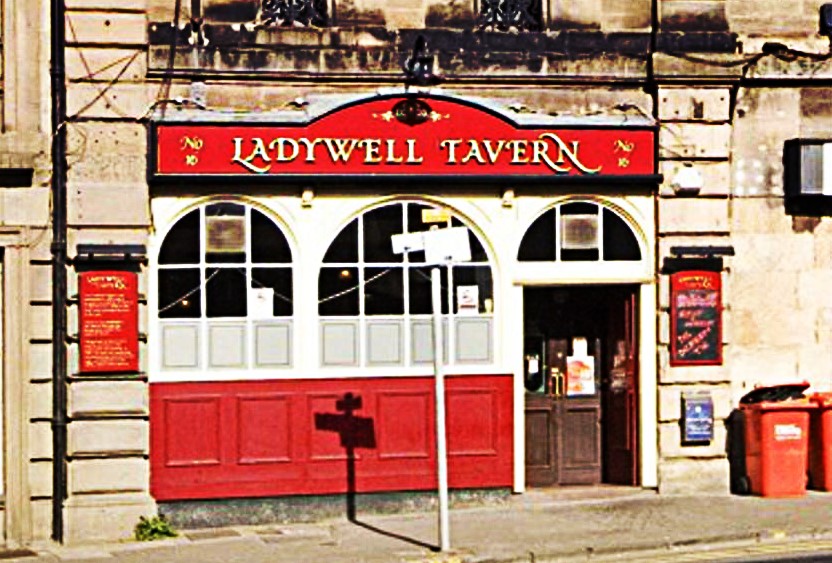
45. Lady Well, Dundee.  Perpetuated in the name of the pub Ladywell Tavern and in the Wellgate, Dundee.  ‘The Well of the Blessed Marie de Dundee’ was a holy site in the medieval burgh and was one of the primary water sources for the city until it was demolished on the construction of Victoria Road in 1872.

Ladywell Tavern Dundee, where many a thirst has been quenched.

46. Lady Well, Farnell.
47. Lady Well, Chapelton, Menmuir
[Note also the place-name Ladlewell, east of Forfar:  possibly a corruption of Lady Well?]
48. Lammer Well, St Vigeans.
49. Lanuner Well, by Newton Hill, near Arbroath.
50. [Logie-Pert*]  well in kirk-yard, used to treat sores.
51. Lunan Well, Lunanhead Forfar.
52. McComie’s Well*, Glen Isla.
53. Madie's Well, on the banks of the Lunan, Kinnell.  Nearby was Madie's Heugh.  Possibly a corruption of parish patron St Maelrubha (or other wise Magdalen?).
54. Maid’s Well,  Rescobie.  Any connection with St Triduana who once reputedly lived here?
55. Marywell, Craig parish (anciently Inchbrayoch), close to the coastal village of Usan.
56. Mary Well, Kirriemuir.  Recalled in the local name Marywell  Brae.
57. Mary’s Well, Edzell.
58. Mary’s Well, St Vigeans.
59. Matty’s Well, Panbride.
60. May’s Well, Dunnichen.
61. Medicine Well, Idvies, also known as Medicie Well.
62. Medicine Well, Montrose.  This was, for a short spell in the 18th century, a fashionable spa.
63. Meg Blair’s Well, Lochlee.
64. Monk’s Pool, Kirkton, Lochlee.
65. Monk’s Well, St Vigeans.
66. Naughty Well, Kinnell.  Is this a colloquial corruption of an older (Celtic?) name?  We would love to get to the bottom of this one. The well was close to the ancient chapel of Bolshan.
67. Neil's Well, near the kirk of Kingoldrum.
68. Nettle Well, near Edzell.
69. Nickie’s Well, Witchwood, St Vigeans.
70. Nine Maidens’ Well, Bracken Bruach, Auchterhouse.
71. Ninewells, Dundee.  Close to the River Tay, on the west of the city.  Now commemorated as the name of the largest hospital in the region.
72. Nine Wells, Finavon.  On the hill above the old kirk.  A burn trickles down from the spot.
73. Nine Maiden’s Well, Forfar.  Located in the vicinity of Craig O’ Loch Road.
74. Nine Maiden’s Well, Kirkton of Strathmartine.  Near the kirk, this is importantly in the vicinity of the folk-tale of Martin and the Nine Maidens.
75. Nine Maiden's Well, Cortachy.  Near the church.
76. Nine Wells, Glamis.  The supposed home of the Nine Maidens, in Glen Ogilvy, was located within Glamis parish.
77. Nine Wells, close to Peallock Quarry, Lunan.
78. Nine Wells, Oathlaw.

[Few other areas in Great Britain have so many Nine Wells/Nine Maiden’s Wells, which points to a significant  local cult in the area which became Angus.]

79. Pater Well, near Deerpark Cottage, Kinnaird.
80. Paterlochwell, near Cottarward, Dunnichen.
81. Peatmire Well, Black Wood, Arbirlot.
82. Purdie’s Well, near Ochterlony, Rescobie.
83. Queen’s Well*, Glenmark, Lochlee.  Re-named in honour of Queen Victoria, but originally named Tobar na clachan gualaich, the Well of the White Stone.
84. St  Aidan’s Well, Kirkton of Menmuir.
85. St  Andrew’s Well, Monikie.
86. St Andrew’s Well, Lintrathen.
87. St Anthony’s Well, Auchterhouse.  On Henderson Hill, marked as ‘disused’ on modern maps.
88. St Bride’s Well, Templeton, Nevay.
89. St Columba’s Well, Shielhill, Kirriemuir.
90. St Fergus Well*, Glamis.
91. St Innen’s Well, Fern.  Located in a place named Wellford.
92. St Iten’s Well, Menmuir.  The name is probably a corruption of Aidan, the patron of Memuir parish.  (Same as no. 83?)
93. St John’s Well, Guynd.
94. St Kane’s Well, Monifieth.
95. St Madden’s Well, Airlie.
96. St Martin’s Well, Bridgend, Lethnot.
97. St Martin’s Well, St Martin’s Den, Logie.  Famous for curing scurvy.
98. St Mary’s Well, Oathlaw.
99. St Mary’s Well, Rescobie.
100. St Murdoch’s Well, West Drum, Brechin.
101. St Ninian’s Well, Arbroath.
102. St Peter's Well, Tealing.
103. St Ringan’s Well, Arbirlot.
104. St Sinavy’s Well*, or Sunny Vie, near Mains Castle, Dundee.
105. St Trodlin’s Well, Rescobie.  Named after Triduana.
106. St Vivian’s Well, Fern.
107. Scots Well, Lochee.
108. Scotston Well, Auchterhouse.
109. Seggie Well, Carmylie.
110. Silver Hill, St Vigeans.
111. Sinruie Well, Kirkden. Possibly corrupted from St Maelrubha?
112. Sod’s Well, east of Grange of Conon, St Vigeans.
113. Tannie's Well, Kinnell.  Another well whose name may be a corruption of an older name.
114. Tothel Well, West Mill, Dunnichen.
115. The Tottler, Milto of Conon, Carmyllie.
116. Well of Bowhale, Glen Isla.
117. Whey Wells, Fern.
118.  Witch’s Pool, Kirriemuir.
119.  Wormiehills Well*.  Well and place-name near Arbroath.