Friday, 15 September 2017

Well - Tell Me More!

Water, as a symbolic, ephemeral element, is difficult to quantify in all its forms and meanings. Also difficult is trying to deduce the number of holy, healing and other wells in a particular area, plus all the traditions associated with these.  This is my fifth attempt and I am not satisfied that it is in any way definitive. (Previous posts are listed at the bottom of this entry.)  Wells and springs become lost, change their names, get filled in and covered over, forgotten, confused with each other.  But every now and then a little sparkling new information comes to light, and this is presented here – for your refreshment. At the end of the post there is an updated list of the wells and springs in the county, and before that information regarding wells in Auchterhouse, Dundee, and Arbroath.
   
   A new list of Angus wells will follow in the next post...

Well Rituals in Auchterhouse

   In Annals of an Angus Parish (Dundee, 1888), William Mason Inglis usefully provides extracts from the kirk-session of Auchterhouse which give rare evidence about the practice of going to wells for magical purposes:

May 2nd, 1652.- Mrs Robertson, in the Bonniton, was before the session for charming of her child, by going from the Bonniton to the Kirkton well and washing her daughter’s eyes there, and saying:-
Fish beare fin and full beare gall,All ye ill of my bairn’s eyen in ye wall fall.

The minister having heard her confession, found it necessary to take no action until he had brought her case before the Presbytery on the 22nd May.

   Mrs Robertson and Janet Fyffe, who had taught her how to charm the child, were appointed to sit on the stool of repentance, in sackcloth, ay till they be penitent.   July 18th, 1652.- Janet Fyffe made her public repentance before the pulpit for learning Mrs Robertson to charm her child, and whereas Mrs Robertson should have done the same, it pleased the Lord before that time to call upon her by death.

   Inglis goes on to comment that there was a ‘strong superstitious belief in the healing properties of the Lady Well near the village...The well was situated in the north-east corner of the glebe, and there still exists an excellent spring at the same spot.  It was alleged to have been much frequented in olden times by witches and charmers.’

   An interesting point is that both these wells were near the centre of the parish, under the noses of kirk officials, and yet continued to be regarded as magical for a considerable period.


The Urban Wells of Dundee

   One would expect the history of wells in urban landscapes to be free of the kind of residual superstitious associations found in rural areas and this is largely the case.  In medieval and early modern burghs the water supply was a crucial element in the well being of the inhabitants (pardon the pun) and the wells and springs had a dual identity as practical public utilities and holy places.  even the Reformation could not stop residual veneration or force name changes on sainted springs and it was only in the mid to late 19th century that the use of wells ceased.  

   The first major improvement was the supply of piped water from Monikie, in 1846, and this was followed three decades later by the major scheme to supply Dundee from Linlathen.  Before this modernization the demand for safe, clean water had led to water being imported into the burgh from sources such as the Logie Spout (in present Milnbank Road) and Invergowrie. During dry seasons water was carted four miles from Invergowrie into the burgh.

   Other early sources included Smellie's Well, on the Lochee Road, and, nearby, Blackness. There were public wells at the corner of Tally Street, near the Kirks; in St. Clements Lane; at the ancient site of Lady-well at the foot of the Hilltown; and at the Dogwell in the Murraygate. The town's  overused wells meant these outside sources were particularly exploited during summer months.  Water was even shipped into the burgh from the Tayfield Estate, Newport, by a business-man nicknamed 'Water Willie'.  No co-incidence that one sobriquet for Dundonians in the 19th century was 'Tay Water Willies'.

   Fierce competition ensued between the operators of Invergowrie and Logie (as reported in a previous blog post, 25th March 2016), with each firm driving barrels of their water through the streets and bellowing the benefits of their product.  One would shout:

                                  Invergowrie’s crystal spring
                                  for Tea surpasses everything!

    Their Logie rivals would retort with this doggerel:


                                  Of a’ the wells that’s here aboot
                                  there’s nane compar’d to Logie Spoot!


   According to the authors of Dundee and Its Textile Industry, 1850-1914 (Dundee, 1969, p. 9): 'Attempts to organise a regular supply of piped water met stiff opposition between 1868 and 1869 from householders who feared that the water company's rates would be unreasonable.19 Only in 1876 could the Chamber of Commerce claim that the town had a piped supply adequate for all domestic and industrial purposes.'


   Not only the wells vanished as the Victorian age progressed, but so did some of the running waterways which were major arteries for the town’s population and industry in its formative years.  The Scouring Burn and the Dens Burn have long since been driven underground (though the Dichty Burn survives).  The history of these streams and their associated industries merits a separate post, but before looking at the three major wells in Dundee I could not resist sneaking in the following rhyme about Dundee’s waterways which originates in the 1866 journal ‘The Piper O Dundee’ and was unearthed by the excellent blog In Ma Fair Toun

                                 The Scouring Burn and Dens Burn
                                 How many a wheel do they turn?
                                 Now I do believe that they
                                 Turn twice the number of the Tay.


The Holy Trinity of Dundee Wells

The Well of the Blessed Maria de Dundee, or the Lady Well, stood at the corner of the Hilltown and Lady Well Lane which is mentioned in a contract between the Constable of Dundee and Burgesses on 21st September 1409. In the 15th century this well was ducted and culverted to flow into the Scouringburn and remained the primary water source for the burgh’s water even as late as 1836.  It was in use until 1872, when it was demolished on the construction of Victoria Road in 1872. Its name is perpetuated in the name of the pub Ladywell Tavern and in the Wellgate, Dundee. 

   The author of Dundee Delineated (p. 21) states that the Cross Well was associated with the Market Cross of Dundee – ‘often the place of joy and amusement in holidays, when the town gave itself up to mirth and good humour’.  It was east of the Cross, near the junction of Peter Street with the Seagate, but in 1777 water was later diverted to St Clement’s Lane, behind the Town-house in the Marketgait.  In a grant of land by King Robert I in 1325 for the erection of the Tolbooth, the territory is described as being between a water conduit on the west and the Cross Well in the east.  Access to St Clement’s Well (also known as Bischop’s Well or Saint’s Well) was still used following the Reformation when a school was erected on part of the church lands, the well being in the kirkyyard.  Ownership of another part of the land was disputed by a mariner named Andro Renkyne (Andrew Rankine) who owned a house there (which survived into the 19th century).  This may have been an old ecclesiastical building and Andrew went to the town authorities in 1607 for permission to make a window in his house which would allow him to draw water from the well, ‘with this provision that he hald the windok continually close, except at sic time as the water is drawn thereat, and that he close up the windok with stane wark quhenever he beis requirit’ (Maxwell, The History of Old Dundee, p. 91.)  Maxwell notes:  ‘When the buildings were demolished a few years ago, the saint’s old well – its water yet pellucid and fresh – was discovered at the angle where the school joined Andro’s house.  Above it was the window which he struck furth for drawing water; but it had long before been built up and the purpose of it forgotten, and its curiously recessed position and uncouth masonry only served as a puzzle for ingenious antiquaries.’

    St Francis’ Well was situated ‘amid the sunny slopes of the Gray Friar’s meadows’ (History of Old Dundee, p. 166) and (Gray) Friar’s Well was its alternative name.  It was situated in the rising ground west of the site where Dundee High School was later built.  In March 1562-3, following the destruction of the Franciscan Monastery and gardens, a man named James Patrie was brought before the burgh authorities for casting down the well and ‘he confest and grantit that he took down the common well callit the Friar well, quhilk servit the hail town with guid and wholesome water, and [he was] referrit [to]...in the Bailies’ and Council’s will thereanent; and they being advisit with his offence, declarit that he sall pay for the reparation of the said well and common warks the soum of ten pounds; always, gif he big and repair the well as weill as it wes before with lime mortar, or Pasch next, this pain to be remitted; otherwise, the day past and the well nocht biggit, to pay the soum but favour.’  His motivation was perhaps religious zeal, but the council recognised that the purity of water supply overcame any Papist associations. 

                           
   A further notice gave Patrie another reminder, after which the work was evidently done.  But thirty years later the structure of the well was again ruinous.  In October 1591 the authorities resolved that the well ‘be of new biggit and made close, so that na common access be had thereto.’ The site of the well was later occupied by the United Presbyterian Church in Bell Street (and now by an office building) and the confusion about its exact location is noted by the CANMORE database which pertinently notes that even the Ordance Survey wrongly pinpointed its site.

St Ninian’s Well, Arbroath


   In contrast with the urban continuation of the usage of wells, those wells in less populated areas were also subject to changing fortunes, ending in neglect and loss of knowledge sometimes about their exact locations.  Such was the case with St Ninian’s Well at Arbroath.  It was located on the shore near a chapel dedicated to the saint, as described by David Miller (Arbroath and its Abbey, pp. 129-30):

Close to the promontory called Arbroath Ness...the Abbot and Convent of Arbroath founded a chapel...The site of this chapel is a pleasing spot, marked by a spring which bears the name of St Ninian’s or Ringan’s well.  In the Arbroath register the chapel is usually described as situated in the den or valley of Seaton.  St Ninian’s chapel and altar were consecrated by the Bishop of Dromore, on 24th August 1485...The field in which the chapel and burying-ground stood formed the glebe of the chaplain, and has been long known as St Ninian’s Croft... After the Reformation it seems to have fallen into the hands of the proprietors of Seaton, and still forms part of that estate.  All vestiges of the chapel have been removed, and the site subjected to the ploughshare. 

   Although current O.S. maps show St Ninian’s chapel and well near the shore, at the east end of what is now Victoria Park (which was opened in 1897), surveyors for the Place Name Book in 1859 were unable to identify the sites. Historically the site on the Seaton Cliffs was called either St Ninian’s Croft or St Ninian’s Heugh.   Several stone coffins were found in the area when a road was constructed here in the 18th century.  Further human remains were discovered in 2009 during the construction of a play park, prompting investigation by police and archaeologists.  The remains were recognised as two human bodies, obviously from a medieval cemetery.  Pottery from the 11th century was also uncovered.  But the site long predated the chapel and even the nearby abbey.  A skeleton uncovered 200 m away in 1988 proved to to from the late 6th or early 7th century.

   As for the well itself, it had dwindled to a mere trickle, sadly dripping from a stark metal pipe which pokes out of a stark stone slab.  It is reckoned that most of the water has been diverted to a nearby ‘Wishing Well’.  Although it has sadly changed, quite why it could not be found in 1859 is a bit of a mystery as George Hay in 1886 (Aberbrothock Illustrated, p. 46) referred to is as ‘a spring whose water percolates into a rock-basin beside the path’, and he quotes a couplet from local poet Alex Balfour:

                                  The banks are green, the flowers are fair,
                                  Around St Ringan’s crystal well.


Previous published posts on wells:


Further Reading

Colville, A., Dundee Delineated (Dundee, 1822).

Hainey, Sheila, ‘Arbroath – St Ninian’s Burials,’ The Pictish Arts Society Newsletter 55 (Summer 2010).

Hay, George, Aberbrothock Illustrated (Arbroath, 1886).

Lenman, Bruce, Lythe, Charlotte, and Gauldie, Enid, Dundee and Its Textile Industry, 1850-1914, Abertay Historical Society Publication No. 14 (Dundee, 1969).

Maxwell, Andrew, The History of Old Dundee (Edinburgh & Dundee, 1884).

Miller, David, Arbroath and its Abbey (Edinburgh, 1860).


Saturday, 9 September 2017

The Dundee Irish and the Other Catholics

There are some who would deny that Lochee, the western suburb of Dundee, at one time represented the most northerly Irish Catholic urban enclave in the British Isles.  This has always amused me, being a native of the place, and a descendant (on one side) of those very incomers.  History can be denied in the face of unimpeachable truths.  I remember sitting in one Lochee pub taking to an old friend – a Rangers supporter – who denied in great detail that there was ever a noticeable preponderance of  Irish in the area.  By that era, of course, the ethnic lines had blurred, the tenements and hovels had gone and the accents of all were indistinguishable from each other, whatever the surname was.  For me, the recognition of changing times came when I saw, in the early 1980s, a man walking boldly into a Lochee supermarket wearing a Rangers football top.

Lochee, with the massive Camperdown Works evident, from Balgay Hill.

   In the 19th century the incomers from Ireland were attracted to the booming jute mills of the city, many of which were thronged in the valley of the Scouringburn, an area between Lochee and Dundee.  A chillingly hostile picture of these newcomers is given by local author James Myles in his Rambles in Forfarshire (1850, p. 25).  He notes that, within living memory, the vicinity of Scouringburn had been entirely rural, but now the district contained more crammed inhabitants than the whole town possessed a century before.  A great proportion of those who lived here and worked in the local spinning mills were Irish:

and it is deeply to be lamented that the vast hordes who have migrated to the Scouringburn are composed of the most debased and ignorant of their countrymen.  Their vile slang and immoral habits have seriously injured the general character of the poor population of Dundee, and I believe throughout Scotland.   The low Irish are not a very improvable race.  They cling to their rags, their faith, and their filth with all the besottedness of perfect ignorance and stupidity.  They appear impenetrable lumps of humanity – quite impervious to the actions of external circumstances, - hence the poorer Scotch have become assimilated in manners and customs to them.  The customs now prevalent amongst the poorer classes on Sunday of standing in their every-day clothes in groups on the street – sitting on outside stairs, and smoking – carrying water from the wells – tippling at counters – and swearing by the name of our Saviour – are all derived from the examples of the vulgar Irish who within the last fifty years have, like the Goths and Vandals of old, deluged all the manufacturing towns of modern civilisation.

   The year after the publication of Rambles in Forfarshire, 18.9% of Dundonians were recorded as being Irish born, with only Liverpool having a higher percentage of Irish  inhabitants in the U.K.  (In Scotland, Dundee edged out Glasgow, which had 18.2% Irish in the same year.  Paisley had 12.7% Irish and Kilmarnock 12.1%.)  One estimate would suggest that 9% of Dundee’s population had been Irish in 1841, so that figure doubled in a decade.  In the 1830s a new Catholic church was constructed in the burgh, confidently able to take over a thousand people in its congregation.  An important comment came from the senior Catholic cleric in the town, Rev. John Macpherson, who stated in 1834 that there were only around 50 Catholics in Dundee two decades previously, but a moderate current estimate put that number:

upwards of three thousand souls, the annual number of baptisms being about one hundred and thirty.  This rapid increase is to be mainly attributed to the great influx of Irish Catholics, who, for want of employment in their native country, are obliged to look elsewhere for those means of support which they are unable to obtain at home. The flourishing state of trade in this town, and its increasing prosperity, has drawn to it great numbers of them, and enabled them to find constant employment in various branches of industry.

   Another estimate, in 1847, reckoned Catholics in Dundee numbered between 9,000 and 10,000.  An important point is that Macpherson and many Catholic priests were in fact native Scots who originated in Highland enclaves such as Banffshire and ‘holy’ Morar.  Richard McCready notes that the senior Catholic priest in Dundee as late as the 1930s was Monsignor John Turner, a native of the Enzie in Banffshire.  He points out that the majority of Scotland's Catholic bishops immediately after the restoration of the hierarchy in 1878 were Scots. In fact, no Irish-born bishop was appointed until 1985.  The interaction between native Scottish and Irish Catholics in places like Dundee is something of a hidden history.  On ground level, in the churches and schools, there was a heavy Irish influence.  As a personal aside, my mother in the 1930s remembered with some bafflement being made to wear green ribbons in her hair on St Patrick’s Day, resulting in animosity from Dundonian Protestants.  Her family came from North-East Highland stock.

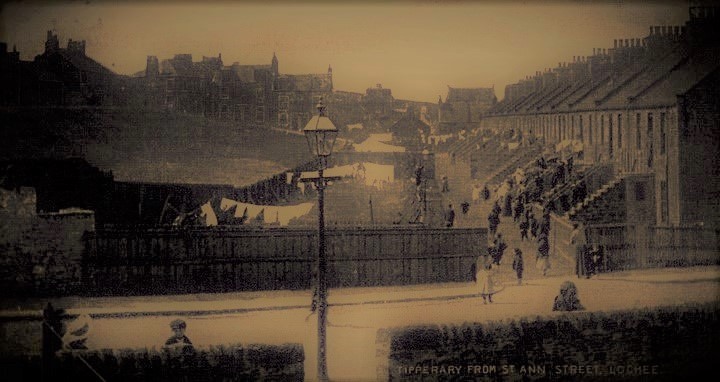
Tipperary, Lochee.

   Returning to James Myles, his account of the late 18th century Catholic community in Dundee is strangely in contrast with his virulent hatred of the contemporary Irish community.  The Catholic chapel in 1791 was in a building on the north side of Hawkhill:

It was a small apartment, so small that it is now used as a kitchen of a working-man’s house… and their clergyman…lived in the upper flat of the same humble building.  He preached every alternate Sunday, and his congregation consisted of eight individuals.  [Compare this figure with the 20 Catholics living in Glasgow in 1778.]  His other ministerial station was at Cobhall about half way between Perth and Dunkeld.  He was a tall fine looking man, and wore what was then called a three storey powdered wig, and when he appeared on the streets he carried in his hand a  staff nearly as long as himself, with its head thickly covered with gold.  Mr Pepper was his name, and the ignorant people then thought him a kind of evil spirit who received direct from the Pope a liberal salary for worshipping images! [Rambles in Forfarshire, pp.26-27.]

   Bailie Webster, Mr Pepper’s landlord, made the mistake (as he thought) of inviting both the Catholic and Rev Mr Raitt of the Cowgate kirk to dinner one evening.  But happily both got on extremely well at the meal.  As the community grew the place of Catholic worship moved from the Seagate to Medowside.  Lochee’s Catholic community, by contrast, appears to have got off to a slow start.  There were no Catholics apparently in the village before the 1830’s, at which time the settlement was part of Liff and Benvie parish.  But by 1847 there were in the region of 300 Catholics in Lochee who were obliged to march the road and (two) miles to Dundee to worship in the chapel in St Andrew’s, Nethergate, before they acquired a centre at Wellburn and finally a proper church, Our Lady of Immaculate Conception, in May 1866.

   There was of course animosity towards the Catholic Irish in Dundee as the 19th century progressed, but the phenomenon of sectarian strife, seen in the west of Scotland and in Liverpool never fully materialised. One reason for this was the preponderance of women among the immigrants (twice as many Irish women compared to men in Dundee in 1871), who arrived to work in the mills, and another was that the Orange Order, prominent elsewhere, was never a major factor in the social make up of Dundee.  There were odd break outs of communal violence, such as a riot in July 1830, bizarrely inspired by the defeat and death of a Scottish boxer named Alexander McKay by an Irish man named Simon Byrne.  There was a minor wave of suspicion against the Irish inspired by ‘Fenian’ incursions in north America and elsewhere in the 1860s.  But the tendency of Dundee Catholics to gravitate towards the Labour and trade union movement rather than militant nationalism mitigated against political and religious trouble.  It has also been noted however that the children and even the grandchildren of Irish immigrants in some parts of Scotland, Dundee included, became more consciously interested in their ethnic roots; the first wave being presumably more concerned with economic survival. 

   One such son of Irish immigrants was the Edinburgh born socialist activist James Connolly (1868-1916) who moved to Dundee temporarily in 1888 after leaving the British army. While in the city he wrote a letter to Lillie Reynolds in Perth, 17 April 1888, stating about Dundee:  'You could hear at once ... the brogue of every county in Ireland, for there is not a county in the Emerald Isle but what sent its representatives here. I should think Dundee has, in proportion a stronger Irish population than any other town in Great Britain.’  Connolly later died in the Easter Uprising in Dublin in 1916. 

James Connolly

    Despite efforts from outside to hardwire Dundee’s Irish Catholic  consciousness, there was never the level of support for militant Irish nationalism demonstrated elsewhere, though the feeling was certainly under the surface.  One such outside incursion occurred in 1921 when Archbishop Daniel Mannix visited the burgh and spoke out vociferously in favour of Irish freedom and denounced local M.P. Winston Churchill. The local Irish community kept their identity to some extent through activities like sport, with Dundee United F.C. beginning life as Dundee Hibernian in 1909.  In junior football there was the still proudly extant Lochee Harp, founded in 1904 (one of whose notable stars, Patsy Coleman, was my great-uncle). In terms of Catholic heritage more generally in the late 20th century, W. K. H. Turner states that, in 1963, 20.7% of marriages in the city were in Roman Catholic churches.


   Lochee, as it grew, certainly did become a microcosm of Ireland, with one area of housing known as Tipperary (and an adjacent place named Maloney’s Park).  The Irish increased in line with the expansion of the massive Camperdown jute works of Cox’s Brothers, most of whose Irish workers came initially from Ulster. It is a matter of debate about how ‘Irish’ Lochee can be deemed to be now.  I have not lived there myself for twenty years and I suspect that the answer may be, it depends who you may ask (or which pub you choose to drink in).

   Luckily Dundee did not suffer the level of sectarian hatred which proliferated in other places in Scotland as a result of Irish immigration, but there was some George Martin tells us that St Patrick's Day in the late 19th century was an excuse for violence between rival communities. A scurrilous rhyme was sung by some Protestants:

The Green, the Green, the dirty, dirty Green,
the Green, the Green that shall be torn;
the Blue, the Blue, the bonny, bonny Blue,
the Blue that shall be worn.

  Catholics, needless to say, swapped the words and the meaning around!


Selected Sources

Archibald, Malcolm, A Sink of Atrocity:  Crime in 19th Century Dundee (Edinburgh, 2012).

Gallagher, Tom, Glasgow, the Uneasy Peace:  Religious Tension in Modern Scotland (Manchester, 1988).

King, Brian, Undiscovered Dundee (Edinburgh, 2011).

McCready, Richard B., 'Irish Catholicism and Nationalism in Scotland:  the Dundee experience, 1850-1922, Irish Studies Review, 6.3, 245-252 (1998).

Martin, George, Dundee Worthies (Dundee, 1934).

Myles, James, Rambles in Forfarshire (Edinburgh, 1850).

Turner, W. K. H., 'The Growth of Dundee,' Scottish Geographical Magazine 84:2 (1968). 76-89.


Thursday, 31 August 2017

Sunnyside, Conan Doyle and the House of Madness

For those who do not know, Sunnyside is a name which perhaps conjures up a happy, warm place, basking in a content and peaceful location.  In fact, Sunnyside – near the village of Hillside - is a former mental hospital in north Angus, which closed its doors finally in December 2011.  The institution (and its predecessor) had been in operation for over 200 years.  As a personal aside, I can vaguely remember mention of the name from childhood, bandied about by adults in a black humoured context about certain acquaintances who had ended up there via a weakness involving drink.


Publicity surrounding the condition of Sunnyside Royal Hospital, the state of the complex and plans for redevelopment, brought it back into the minds of local people. Montrose Lunatic Asylum, Infirmary and Dispensary was the creation of Mrs Susan Carnegie of Charleton and was the first purpose built institution of its kind in Scotland. Before this foundation, unfortunate mental patients in the burgh were incarcerated in the tollbooth. Miss Charlton expressed the reasoning behind her civic benevolence (in a letter 16 July 1815):
My view in this undertaking was merely to rid the Town of Montrose of a nuisance – that of mad people being kept in prison in the middle of the street – and the hope that, by providing a quiet and convenient Asylum for them, by good treatment and medical aid, some of these unfortunate persons might be restored to society. 
 Ten years after its founding (in 1781) it was recorded there were 37 lunatics domiciled in the asylum, of which 12 belonged to the town an parish of Montrose. Some patients received free treatment, while offers were fee paying. (A report in December 1836 noted 67 patients, 10 of them free, while the others paid sums between £10 and £40 per year. This compares with 53 patients in 1818.)  
   Far from being a stigmatised institution, the asylum was looked on with pride by locals from the beginning, as evinced by the proud inclusion of the building on one side of an unofficial conder halfpenny minted in the town in 1799 (issued by the Montrose tobacconist Nichol):

Official reports also show that the institution was far from a grim place of confinement which popular imagination might suppose it being in early Victorian times.  The report in autumn 1832 states:
The Asylum at Montrose was clean and well-aired; and the Patients well attended to by the Superintendent and Matron, and those acting under them. The male patients were 37 in number, and the females 38. Six or eight of the males work constantly in the garden. A clergyman preaches weekly on Thursday, and says prayers on Monday, to a select number of the Patients, who listen attentively. On Friday a fiddler attends, and the Patients are allowed to dance – the males together and the females together. This is said to delight them very much, but has no permanent effect on them either to the better or the worse. The general state of health was good; and the Registers were accurately kept. [Memoranda Regarding the Royal Lunatic Asylum, Infirmary and Dispensary of Montrose, Richard Poole (Montrose, 1841), p. 55.]
   Three years later the visiting Sheriff witnessed a ‘religiously insane’ female  inmate who was in the habit of sternly denouncing visitors, bible in hand, was found to be happily participating in the revelry.  She came up to the Sheriff, ‘and made some observations as to turning their kirk into a ball-room, and laughed heartily’. 

   It was noted in several reports that idleness affected the patients badly and that separation from the surrounding scenery of the countryside was not beneficial.  This was taken into consideration by the late 1830s and patients were allowed out to places such as Dunninald Woods, and were allowed to spectate at ship launches in Montrose.  Despite this the authorities were frustrated by lacking leisure activities to distract patients:  A difficulty is often experienced in devising means of re-educating the obscured or barren mind – means which shall be sufficiently attractive to create an interest, and yet so little exciting as to be compatible with perfect serenity and equanimity.   In 1835 it was advised:  'No visitors, whose motive is curiosity, are allowed to see the Patients.  The public have a right to know whether such an establishment be conducted on principle of justice and benevolence, and the law has provided that this right should be duly exercised.'  [Memoranda, p. 128]
   From the initial site on Montrose Links, the hospital moved to Sunnyside farm in 1858 following a nationwide review three years earlier by the Scottish Lunacy Commission. There was a growing site for patients on the new site, leading to the provision of a new facility for private patients named Carnegie House, which opened in 1899.  Howden Villa and Northesk Villa opening in 1901 and 1904 to house non-paying patients.  Angus House, an annex for dementia patients, was built 40 years later.  Around this time, in 1940, patient numbers reached  the maximum recorded, 1052.  But pressure on the hospital’s resources had levelled off, in terms of inpatient need, throughout the 1950s and 1960s because of new drugs and improved treatments.  In 1962 the institution was renamed Sunnyside Royal Hospital and came under the jurisdiction of new management. Sunnyside Royal Hospital celebrated its bicentenary in 1981, at which time the number of patients was nearly 400. 
   Following the transfer of services to the new £20 million Susan Carnegie Centre at Stracathro in 2011, Sunnyside site was declared surplus and was empty and in limbo for four years until it was put on the market by NHS Tayside.  A victim of changing times and perceptions, the hospital buildings soon fell into disrepair and dereliction, like that other major mental facility, Strathmartine Hospital, just north of Dundee.  Collections from the on-site museum and archive were split between Montrose Museum and Dundee University. Exhibits included nursing uniforms, lantern slides, straigh jackets, and – most poignantly – crafts completed by long gone patients, including some Victorian paintings.   In common with other abandoned buildings the complex became the target of criminals and much copper and other material was robbed from the upper floors.  The place also attracted other unauthorised visitors, including various official and amateur investigators who heard that the hospital was haunted.  Whether this rumour of haunting was inspired by its history or dereliction, at least one ex patient advised the place was haunted by the sound of female footsteps.  One Arbroath based paranormal team, Afterdark, were refused permission to enter when they asked, on the basis that the buildings were too rundown to ensure physical safety.  The site was eventually sold in 2016 to an Edinburgh-Montrose business partnership and plans were drawn up to rejuvenate the site as a ‘development of distinction’, a process which is still in the pipeline.  Memories of the institution are preserved not only in the archives, but in a good website devoted to the place: Memories of Sunnyside


  Sunnyside’s most famous inmate was the father of author Arthur Conan Doyle.  Born and raised in England, though from an Irish family, Charles Altamont Doyle (1832-1893), was an artist who moved to Edinburgh in 1849.  Struggling with depression and alcoholism he was dismissed from his employment at the Office of Works, with a pension, in June 1876. The extent to which drink got a grip of him is described in a letter by his wife Mary:   ‘He would strip himself of all his underclothes, take the very bed linen, climb down the water spout at risk of his life, break open the children’s money boxes. He even drank furniture varnish.’  Five years later he was sent to the nursing home of Blairerno House at Drumlithie in the Mearns, and shortly afterwards he developed epilepsy.  Following a violent attempt to escape he was sent to Sunnyside on 26 May 1885, where he remained for some years.  At that time, Doyle was one of 500 patients at Sunnyside.

   His mental state on arrival was perilous, with Doyle telling staff that he was receiving messages from the unseen world.  He then accused staff of being devils and refused to speak to them.  But by the summer he was more calm, though he later had recurring delusions that he was going to die.  Doyle, the doctors noted, was always drawing and sketching while at Sunnyside, though his talents almost entirely drained away towards the latter part of his incarceration there.  A record art, completed between March and July 1889, while he was a patient at Montrose Royal Asylum, was eventually published in 1978 as The Doyle Diary.  Doyle’s work combines fantastical images of animals and imaginary creatures.  ‘The Spirits of the Prisoners,’ a picture now in Australia, shows those creatures swooping and circling around the asylum.  The image, whether intended as symbolic or real, brings to mind Arthur Conan Doyle’s later fascination with the spirit world, and perhaps unfairly those infamous Cottingley Fairies he believed in (which were actually a photographic hoax by two schoolgirls).
   Some of Charles Doyle’s work also reflects more placid times at Sunnyside.  Doyle was described by his famous son in his autobiography: 
full of the tragedy of unfulfilled powers and of underdeveloped gifts. He had his weaknesses, as all of us have ours, but he had also some very remarkable and outstanding virtues. A tall man, long-bearded, and elegant, he had a charm of manner and a courtesy of bearing which I have seldom seen equalled. His wit was quick and playful. He possessed, also, a remarkable delicacy of mind which would give him moral courage enough to rise and leave any company which talked in a manner which was coarse… He was unworldly and unpractical and his family suffered for it.
   In January 1891  he was transferred to Edinburgh Royal Infirmary and died in the Crichton Royal Institution in Dumfries in 1893.  Doyle junior organised an exhibition of his father’s work in 1924.


Sunday, 27 August 2017

Some Ghosts to Keep You Going

In between some weightier historical posts, please find below an assortment of ghostly doings to fill the gap.  Perhaps I should have hoarded these for Halloween of Christmas, but the segregation of the actively deceased to certain times of the year smacks of discrimination in this day and age.

Big Hoose Ghaists

Castles and mansions seems to favour larger properties, as if spirits develop an inexplicable sense of snobbery after death.  The House of Dun in the north-east of the county, was built in the Georgian era for the Erskine family who lived here into the 20th century.  The house can be said, without exageration, to be fully infested with ghosts.  The House of Dun probably first came to national prominence after its inclusion in Catherine Crowe’s classic compendium The Night Side of Nature (1848):
Not very long since, a gentleman set out, one fine midsummer’s evening, when it is light all night in Scotland, to walk from Montrose to Brechin.  As he approached a place called Dunn, he observed a lady walking on before, which, from the lateness of the hour, somewhat surprised him. Sometime afterwards, he was found by the early labourers lying on the ground, near the churchyard, in a state of insensibility.  All that he could tell them was that he had followed this lady till she had turned her head and looked round at him, when seized with horror, he had fainted.  “Oh,” said they, “you have seen the lady of Dunn.”  What the legend attached to this lady of Dunn is, I do not know. [The Night Side of Nature, 226.]
  This ghost cannot be definitely identified, but in more recent times there have been sightings of an woman riding a horse through the grounds; unusually, she is facing backwards on her horse. Other ghosts on the estate include a headless horseman, plus – near a certain yew tree -  the spirit of a knight killed after he returned here from the east and found his lover had betrayed him. In recent years voices have been heard inside the house, plus the sound of a crying baby and an invisible harpist.  More bizarrely, a phone has been heard ringing in a part of the house where there was no actual physical telephone.  Diverse other phenomena include:  unseen dogs,  a dress floating around without a body inside, plus an array of spirits both male and female, some of whom resented modern, living intruders. 


   Letham Grange is a well known golf and leisure complex near Arbroath and although the main house was only built in 1830 the amalgamated estate represents old church lands associated with the Abbey of Arbroath. The house was requisitioned by the forces during World War Two. The ballroom was used as a dormitory by a party of WRENS and during their stay strange things happened. Several of them were woken at night by the presence of a shimmering grey figure of a man with thin cheeks and sunken eyes. He was wearing old fashioned clothes with a high collar and a wide brimmed hat. The bottom half of him was indistinct. When Letham’s owners were consulted they informed the WRENs that the spectre would not harm them, but they would be better off moving their sleeping quarters to another section of the house. Letham Grange also had a resident Green Lady whose name and origins are unknown. Other Green Ladies haunt Ethie Castle (see my previous post

Haunted Kirks and Manses

Relatively few religious buildings in the county have the reputation of being haunted.  There are insubstantial stories about ghosts at Arbroath Abbey and one or two other places, such as ancient Restenneth Abbey.  But such traditions as exist speak more about strange atmosphere rather than reporting real stories which would give credence to hauntings. It might be expected that cemeteries and kirkyards would be hotspots for paranormal anomalies, but in fact there are few reports of incidents throught the county.  Kirriemuir ghost investigator Isaac Stewart states that Newmonthill Cemetery in Forfar is a conspicuously haunted place. One of the most haunted buildings associated with the kirk in Lunan Lodge, a former manse (built in 1789) which operated as a B&B until recently. With a canny eye on marketing, the owners claimed the building housed a nearly unsupportable 43 ghosts. One of the most active was a spuirit nicknamed ‘George’.  Another is a Victorian maid, and the most conspicuous was the so-called ‘Shouty Man’ who behaved as his name suggests and seemed to particularly object to females invading his space.  Yet another, but more passive presence was a six year old child named Amy who sadly died of diptheria.

Ootdoors Ghaists and Beasties

There is a theory among those who favour the idea that ghosts are primarily residual recordings of actual events that there are a prevalence of sightings in the vicinity of water, for some reason.  Forfar Loch, on the rare occasions when it freezes over, is said to be haunted by an unknown party of men, visible only from the waist up and apparently struggling to free themselves. This tradition is probably not linked to the equally shadowy tradition that the supposed assassins of King Malcolm II fled to the loch and perished here following his death in 1034, a tale which has all the hallmarks of late invention.

   Unusual apparitions which occur in open countryside can be harder to identify or even speculate about than those linked to a specific building. Identification is even harder if the form is vague or incomplete. Such is the case of a ghost which was seen annually in fields on a farm at Newtyle.  The figure seen was a decapitated woman who walked on the evening of 2nd June each year. No story says who she was, but she is seen no more as housing has now covered her place of haunting.

   There is a case to be made that sightings of figures seen from cars may be dubious, as the high speed of modern traffic means that things on the wayside are never seen in detail or for long. One figure was seen fleetingly on the A92 road, approaching Arbroath, when a driver and her son spotted a woman standing at the roadside. No ordinary woman either, for the area was absolutely unlit, yet the lady’s face was fleetingly illuminated as if by a lantern.

   Certain wild or sparsely inhabited areas often have an uncanny aura, but finding stories or even clues to justified reputed reasons for this is rare. The mountain Mayarwhich towers 928 metres above Glen Clova, has – or once did have – an eerie reputation. There has never been a satisfactory explanation of this, to my knowledge.


In the same area, Jock’s Road is periodically haunted. A frustratingly anonymous (and anomalous) figure in winter clothes was seen here in 1993. Some strange creatures seen are even more difficult to explain. Around ten years ago two walkers in Glen Prosen heard a loud scream and turned around to encounter, on a wooded hill, a black cat. But the beast was at least four feet long and it vanished after a moment. Its presence was evidently sensed by dogs in the neighbourhood, for there was barking from several different areas of the glen. Was this an actual escaped large cat, a hallucination, or something else entirely? Further south, in countryside near Arbroath in 1989, a mother and daughter watched in disbelief as a large white cat crossed their line of sight and then vanished. Even more disturbing, possibly, are those sightings which bear little resemblance to actual physical creatures. Close to a disused quarry in Carmyllie in the early 1980s a woman walking her dog unexpectedly came across a huge, 7 foot high creature with broad shoulders but, alarmingly, no head. Her dog bolted at once. She screamed and followed it. As has been noted previously in this blog, Carmyllie was (for reasons unknown) quite a notable supernatural hotspot in this past. Odd beings, however, are known from elsewhere.

    Parks are places where there re few recorded ghosts, despite them being a feature of towns are cities for a considerable time. Perhaps the reason for this is that parks are places where people resort to for leisure, exercise and contemplation, and therefore unlikely one supposes to be scenes where strong emotion has imprinted itself upon the atmosphere. However, the green space near Mains Castle in the north of Dundee was invaded in 1960 by a vision of the past.  A couple witnessed a blatantly Victorian garbed gent and his lady pushing an old fashioned perambulator in the Den o Mains

   At this point I will sneak in of a story which did not happen in Angus, but it did happen to a Montrose man, albeit he was adrift from home somewhere in the Highlands.  The tale was related by the prolific ghost hunter and author Elliot O’Donnell in his Haunted Waters (1957) (pp.134-7).  

The Montrose man was fishing in a remote landscape and was trudging through a bleak ravine towards a small tarn where he wanted to fish. The enclosed ravine was unnaturally cold and still, with an odd oppressive atmosphere that made his accompanying dog nervous and stick close to him as they walked. Suddenly a wave of nauseous dread made him stop and he was too unaccountably terrified to proceed. He huddled against the sheer cliff wall on one side of the ravine. When he recovered somewhat he went back rather shamefully to his hotel where he learned that the tarn was reputedly haunted and several guests had returned in the same state that the Montrose man did. The conversation between landlord and guest was overheard by another man, a Londoner, who scoffed at the superstition. Soon the Scot found that he had accepted a wager to return to the haunted place in the dead of night. Next night, near midnight, he found himself in the pitch dark ravine, which now was alive with all sorts of nocturnal sounds which made him nervous. As soon as he reached the same spot as before, there was that familiar wave of awed dread. He had to struggle very slowly on until he reached the shore of the tarn. There, lying on the shore, was a white figure. He nearly ran, but instead he bent over and was astonished to see his cockney tormentor unconscious, wrapped in a sheet. When the man recovered after a minute of two he confessed that he had intended to scare the other, but he had seen something terrifying come out of the dark water and collapsed. The Montrose man had at first felt like beating up the Londoner, but he took pity on him when it was evident he was telling the truth. The Londoner would not reveal what he had witnessed, but he paid the guinea wager money next day.

Not Quite Spectres?
Those who will not countenance the reality of any psychic phenomena can cleanse their mental palates with this post script detailing ghosts which almost definitely have a mortal hand behind them. From The Scotsman’s Library by James Mitchell (1825) comes the following anecdote (p. 472):


A white ghost having appeared at Dundee several nights, and terrified many people, a gentleman fell on a mode of laying to rest this perturbed spirit. He sent round the town-drummer, with a notice that he should be out with a great dog to hunt the ghost, when he next appeared, and the consequence was, that this spirit was not seen after.


   A final story, drawn again from Crowe's Night Side of Nature, is set in Monifieth, and may have actually happened in the late 18th century, though it contains folklore elements and is similar to other 'true stories' collected elsewhere in Scotland:
The following very singular circumstance occurred in this country towards the latter end of the last century, and excited, at the time, considerable attention; the more so, as it was asserted by everybody acquainted with the people and the locality, that the removal of the body was impossible by any recognised means; besides, that no one would have had the hardihood to attempt such a feat. ‘Mr William Craighead, author of a popular system of arithmetic, was parish schoolmaster of Monifieth…It would appear that Mr Craighead was then a young man, fond of frolic, without being very scrupulous about the means, or calculating the consequences. There being a lykewake in the neighbourhood, according the custom of the times, attended by a number of his acquaintance, Craighead procured a confederate, with whom he concerted a plan to draw the watchers from the house, or at least from the room where the corpse lay. Having succeeded in this, he dexterously removed the dead body to an outer house, while his companion occupied the place of the corpse in the bed where it had lain. It was agreed upon between the confederates that when the company were reassembled, Craighead was to join them, and, at a concerted signal, the imposter was to rise, shrouded like a dead man, while the two were to enjoy the terror and alarm of their companions. Mr Craighead came in, and, after being some time seated, the signal was made, but met no attention; he was rather surprised; it was repeated, and still neglected. Mr Craighead, in his turn, now became alarmed; for he conceived it impossible that his companion could have fallen asleep in that situation his uneasiness became insupportable; he went to the bed, and found his friend lifeless! Mr Craighead’s feelings, as may well be imagined, now entirely overpowered him, and the dreadful fact was disclosed. Their agitation was extreme, and it was far from being alleviated when every attempt to restore animation to the thoughtless young man proved abortive. As soon as their confusion would permit, an enquiry was made after the original corpse, and Mr Craighead and another went to fetch it in, but it was not to be found. The alarm and consternation of the company were now redoubled; for some time a few suspected that some hardy fellow among them had been attempting a Rowland for an Oliver, but when every knowledge of it was most solemnly denied by all present, their situation can be more easily imagined than described; that of Mr Craighead was little short of distraction. Daylight came without relieving their agitation; no trace of the corpse could be discovered, and Mr Craighead was accused as the primum mobile of all that had happened. He was incapable of sleeping, and wandered several days and nights in search of the body, which was at least discovered in the parish of Tealing, deposited in a field, about six miles distant from the place whence it was removed. ‘ “It is related that this extraordinary affair had a strong and lasting effect upon Mr Craighead’s mind and conduct, that he immediately became serious and thoughtful, and ever after conducted himself with great prudence and sobriety.”’