![]() |
| The best hill in the world?... Probably. |
Wednesday, 29 November 2017
The Twa Phantoms - of Balgay Hill and The Law!
I must have had a precognitive moment when I wrote a previous post bemoaning the lack of supernatural legend associated with one of Dundee's premier hills: Balgay - Too Few Ghosts. Now I have thankfully found evidence of ghosts - albeit fictions, poetic ones - associated with Balgay Hill and its sister, the Law. The poem appears in the possibly pseudonymous Poems and Rimes by Robin. (It is also found in George Martin's Dundee Worthies (1934), pp. 113-118.) The poem also strongly features my favourite Dundee place - Logie Graveyard.
Monday, 13 November 2017
An English Vicar Entertains – Travels in Georgian Angus
A Slander on Dundee?
In Dundee, it has been remarked, there are more dwarfish, decrepit, and deformed people, and fewer that arrive at old age, than in any other town of equal size in Scotland. [Travels in Scotland by an Unusual Route, London, 1807, p. 273.]
Who
was responsible for this incendiary remark? It is found in
the entertaining travel writings of Rev.
James Hall (1754-1844) of Chestnut Walk, Walthamstow, who came to Scotland
early in the 19th century. Not
sure where he got that Dundee information though, or what it means. Surely the turn of the 19th
century was too early for the effects of the mills and mass industrialism to
deform Dundonians en masse?
That aside, Hall gives a unique picture of the county in his day. Not unnaturally he pays close attention to
religious matters and was interested in the Glasite sect which he found
flourishing in Dundee. (I will save the Glasites for a future post, along with
his description of Auchmithie.) But his
encounters with strange characters and eye for strange events and for keenly
noticing the manners and behaviour of people he met. At Panmure he overheard ‘two tolerably well
dressed men’ in a heated discussion about one of their mutual friends. This man of property had a sick wife, whose
sister came to look after her. When the
wife died, the man became close to the sister and sought to marry her. But minister, presbytery and then synod
forbade it. One of the men had been
present at the church courts and vehemently disagreed with the clerical
authorities and volubly cited a panoply of biblical parallels to show that
there was permissible examples of marriage between relations. The English vicar was even more impressed
when the man – who was a kirk elder – dredged up further examples from secular
ancient history. How different from
conversations likely to be found in a modern pub.
Never Trust an Actor (in Montrose)
Following a trip to Arbroath the clergyman went on to Montrose, a town
he was much taken with. After some observations
about religious observance in the burgh, Hall relates the story of a well-bred
young Aberdeenshire lady who sadly fell in love with a member of a group of
travelling players. She crept out of her
father’s house and was smuggled away to Montrose by the actor’s friend. But the friend also fell in love with her on
their flight south and the two men fell to blows in Montrose:
The young man with whom she fell in love... received, in the presence of the young lady, a cut with a clasped knife across the belly, from the person that conducted her thither, that laid his bowels open. The person who had done the deed, upon the cry of murder, was instantly seized. However dreadful, the wound happened not to be mortal, the vitals being injured, but not quite cut through. Dr Bate, being fortunately at hand, the bowels were examined and put in, and the gash sewed up. And when the wound was healed, which was not for several months, they were married: but having no independent fortune, and he parents utterly abandoning her, she and her husband are, at this day, and have been ever since this foolish step, the constant companions of poverty and want.
So,
all was well that ended well... or not quite.
Hall moves on to tell the story of a Montrose gent who fell in love with
a performer he saw at Arbroath because of her lovely singing voice. The singer also reciprocated his emotions,
for obvious reasons: ‘As the gentleman
was not thirty years of age, and had landed property, free from incumbrance,
and more than a thousand pounds a year...’
She married the man and moved into her house, along with her mother and
a boy she initially claimed to be her brother, but who was actually her son. When her husband’s younger brother visited,
he and the wife recognised each other, due to the fact they had secretly lived
with each other the previous year at Perth.
Having heard this tale, the vicar called upon the unknowing gentleman
one later afternoon and found himself immediately uncomfortable due to his
knowledge about the gent’s domestic background and his strange behaviour. For a start, despite the fact it was only 5
in the afternoon, the squire had just gone to bed and came down in only his
shirt. He insisted however on plying his
visitor with rum and the clergyman’s befuddlement intensified when the squire
insisted on calling down his wife.
| Trouserless in Montrose. |
As Hall uncomfortably recalled:
In less than a minute, an elegantly dressed lady made her appearance, highly powdered, and, having a train near two yards long, sweeping the floor behind her. Dropping a curtsey, she approached us. How I looked I know not, but I felt extremely uneasy... Not having occasion to speak, as the squire said every thing, I was extremely glad. He told me he never rose till about ten in the morning; that he he could not move till he got a glass or two of rum, or brandy, as his hand always shook much in the morning; that he could eat nothing but a small bit of salt ham, fish, or something tasty... he generally walked a little in the forenoon, dined about three, got drunk about four, and went to bed about five in the evening; that his lady was extremely kind to him, giving him the rum and brandy in the morning, before he moved from his bed, and that he believed without this kindness of hers, he should have been in his grave sometime ago.
Another element in the reverend’s discomfort was the rude strangeness of his host’s conversation, which was: ‘extremely eccentric, nay, even blamsphemous; for he swore by the ninth curl of Moses’s wig, the great God’s tobacco-box, &c.’ The Rev Hall could not escape without the gentleman giving him the gift of a book, which he did not want, and he commented, ‘I was glad when I got out of the house, having never been so disagreeably situated before.’ He lamented that the man’s indolence landed him into such ‘sensuality and debauchery’. Then he proceeded to show that eccentricity were common within the squire’s family. A relative of his tried to condition his infant child to a glorious future in the British Army by firing his pistols close by the baby’s head at regular intervals. Not surprisingly, his young wife soon ran off with another man.
Sunday, 5 November 2017
More Lost Treasures of Angus
In previous posts I have detailed some of the historical treasures associated with the county of Angus which have gone astray over the course of the centuries. Premier among these must be those extremely rare Pictish relics, such as the bronze plaque found at the hill of Laws, Monifieth, uniquely carved with Viking runes naming its owner as Grimkitil. The object itself was lost in the 18th century, although drawings of it survive. Rather more dubious is the alleged Pictish crown found and broken up in Arbirlot in the 18th century.
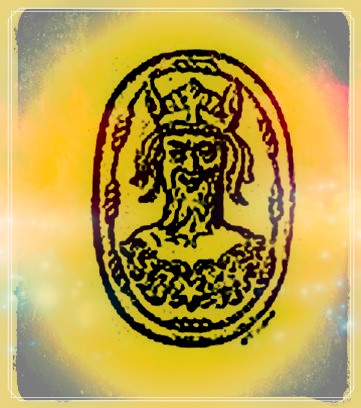
Later in time was the medieval ring lost near the Hawkhill in Dundee, the illustration on which is given below. The ring is supposed by some to have been given by King William the Lion to the ancestor of the Durwards of Lundie at the end of the 12th century.
There seems to have been a minor industry in constructing dodgy artefacts in Arbroath during the Victorian age. J. M. McBain in Arbroath Past and Present (1887) relates how another custodian of the abbey, Deacon Elshender together with his wife Forbes Valentine, were conspicuous show people (p. 8):
Later in time was the medieval ring lost near the Hawkhill in Dundee, the illustration on which is given below. The ring is supposed by some to have been given by King William the Lion to the ancestor of the Durwards of Lundie at the end of the 12th century.
The Remains of the Lion King
Following the death of King William the Lion in 1214, he was buried before the high altar of Arbroath Abbey. His remains were allegedly uncovered in a stone coffin here in 1814,
workmen found a stone coffin containing the bones of a large man. The bones of the supposed king were put on display until
they were reburied just prior to World War Two. The author of A Series of Excursions... Around Dundee in the 19th century however repeated the rumour that these remains might not be all they were reported to be (p. 95):
Cynical persons have cast doubts on the antiquity of these mouldy bones, and some declared that the keeper [of the Abbey] picked them up in the kirkyard, and supplied fresh ones when required... The former keeper - Mr D. Peters - was a man of resource. In his museum of curiosities he used to exhibit a lump of some black substance which, to the untrained eye, resembled 'smiddy danders.' In a mysterious tone he would ask the visitor if he could guess what that was. Of course you gave it up, and then he gravely informed you that he found that in the stone coffin, and curious to ascertain what it was he sent a portion to Dr Christison of Edinburgh for analysis. The opinion of the learned Doctor, he said, was that the substance was that the substance was composed in great part of the material of which the human brain was formed, and hence the worthy keeper concluded it could be nothing more nor less than the brains of King William the Lion, of blessed memory, solidified into a hard and stony mass. The idea was enough to drive antiquarians into fits - the brains of a king preserved in a lump for the edification of future generations. But with Mr Peter's regime this interesting relic has disappeared.
There seems to have been a minor industry in constructing dodgy artefacts in Arbroath during the Victorian age. J. M. McBain in Arbroath Past and Present (1887) relates how another custodian of the abbey, Deacon Elshender together with his wife Forbes Valentine, were conspicuous show people (p. 8):
[Forbes] made a trade of exhibiting to the visitors a bone, which told them was that of Earl Gilchrist, or some other distinguished personage, real or imaginary, whose grave she pretended to show, and then, after enjoining secrecy, she would offer to part with the relic for a small pecuniary consideration. She not infrequently found dupes, and in this way, she managed to dispose of many a basketful of bones, which she had gathered promiscuously from the neighbouring graves, as they were opened to receive the newly dead. On being remonstrated with by a distinguished clergyman, then resident here, she coolly remarked that 'it pleased the folk that bought them, and helped her to eke out her income, and did naebody ony harm.'
So, without extensive archaeological investigation, the jury must remain out on the remains of the brain of William the Lion.
The Colossus of Dundee
With the recent riverside development, Dundee is finally coming to terms with the loss of much of its historic buildings in the post war period. But, despite incredible new buildings like the V&A Museum, there will always be some Dundonians who cast a sorrowful eye back at what has gone. Some of these buildings merited preservation, while others of course did not. I have always found the regret lavished on the demolition of the Royal Arch (in my mind a Victorian monstrosity) non-comprehensible. Dundee's castle is of course long gone, perhaps vanishing during the Wars of Independence in the early 14th century. But few people know that Castle Hill in the 17th century boasted an enormous statue of the god Apollo. In all likelihood the statue did not achieve anything like the scale of that lost wonder of the world, the statue of Helios better known as the Colossus of Rhodes. Dundee's version was still substantial though and was used as a landmark in the Tay estuary. What happened to the statue, and when it was destroyed, is something of a mystery. There may well be fragments of the monument lurking in odd corners of the city. If the waterfront developers are looking for something even more eye-catching to erect on the shore, they might do worse than this... (can I apply for a grant please?):
The Indestructible Holy Cross of St Vigeans
The last in this latest instalment of lost treasures is a miraculous Christian monument which stood in the kirkyard of St Vigeans. Although this site is the locus of very many Pictish monuments, this particular Celtic cross was even more unique, according to the Aberdonian writer Thomas Dempster.
Writing in his work Menologium Scottorum in 1622, Dempster avers that there was a wooden cross near St Vigeans which defied all attempts at desecration. As a fervent Catholic his mind was probably thinking of the Protestant reformers who had zealously destroyed nearby Arbroath Abbey, as well as many other places. Heretics had tried to burn the cross, but it was invulnerable. He repeated the notice of this miracle several years later, saying that attempts to destroy the cross with fire and iron had miserably failed. What became of this cross, or whether it actually existed, must still be classified as a mystery. The story may contain the wispy memory of an actual wooden cross dedicated to St Fechin of Fore on this site. That said, Dempster had a reputation of being sadly unreliable. One authority cites another of his works as 'one of the most discredited works ever written in the field of Scottish history,' and that's saying something. Consider also Dempster's own avowed tendency to tell lies about himself, such as the claim that, at the age of three, he completely mastered the whole alphabet by himself in the space of a single hour.
Previous Related Posts
Saturday, 28 October 2017
The Drosten Stone and St Vigeans
It's not often that we get the privilege and pleasure of receiving a major monograph focused on a place in Angus, but a new academic study centred around the Pictish stones and significance of the early Christian site of St Vigeans answers that need magnificently. Edited and largely written by Jane Geddes, currently of Aberdeen University, Hunting Picts: Medieval Sculpture at St Vigeans is published by Historic Environment Scotland.* Because of the complexity of the site and its physical remains, and also because its contains papers by various authors, there is no answer as to the exact meaning and significance of the site. Conclusions which I would take from the work include the following: that St Vigeans was a site of religious significance from the Pictish era, linked possibly with the harassment of Irish monastic settlements by Vikings in Ireland. Just as Columba's relics were transported deep into Pictland at Dunkeld in response to heathen desecration in Ireland, there may have been similar movement of other relics to the east, including at St Vigeans.
* A lecture by Professor Geddes on St Vigeans is available on YouTube:
https://www.youtube.com/watch?v=NgL-8DU11AQ
Fechin the saint is said to have died of the plague in 665 and it is reckoned that the spelling of the place-name reflects the Pictish version of his name, and therefore 9th century at the latest. Although Fechin's monastery of Fore in Ireland was recorded as being burnt in 750, this is too early for Viking incursions, which are more likely to have prompted movement of relics in the early 9th century.
Also of particular interest in the work is the possibility of placing St Vigeans in the wider context of Angus and bringing Angus itself into a historical perspective with suggestions of possible events. Near St Vigeans is Kinblethmont, site of an early Pictish stone, which may possibly be the site of one of a flurry of battles in the early 8th century which was conducted between four royal competitors. According to the Annals of Tigernach, in the year 729:
The battle of Druimm-Derg- Blathung [took place] between Picts, namely Drust and Angus, the king of the Picts; and Drust was killed there, on the twelfth day of the month of August.This Angus is of course the renowned Angus (I) mac Fergus, who ruled until the year 761, and may be the person who gave his name to the county. He was alleged to have belonged to an Irish kindred named the Eoghanachta Magh Geirginn, whose name perpetuates the province of Circinn, later Angus and the Mearns.
Much in the comprehensive book fascinates, especially the analysis of church settlement in south and east Angus. One can only hope that the other crucial Pictish clerical site at Meigle gets similar academic analysis before too long. (Slightly off topic, my wished-for academic study would be a work on the place-names of the entire county.)
The only extremely pedantic criticism which might be fairly levelled at the work is its physical production. A single, hardback volume might have been preferred to two flimsy paperbacks, but then the cost might have been exorbitant.
One thing that the book does not definitively solve, or try to solve, is the meaning of the celebrated inscription low down on the side of the Drosten Stone. The inscription remains beguiling to the extent that it cannot be agreed which language, or mix of languages, the inscription is written in. Contained in the carving may be the names Drosten, Uuoret and Forcus, which would theoretically nicely equate with the saints Drostan and Fergus, supposed to have been resident for a time at Glen Esk and Glamis respectively. One version of the inscription - favoured by the scholar Elisabeth Okasha - reads as follows:
DROSTEN:
IREUORET
[E ]TTFOR
CUS
IREUORET
[E ]TTFOR
CUS
The third name is possibly Uurad, equated by some as one of the last reigning Picish kings in the 9th century. This king, alternatively named Ferat or Feradach, son of Bargoit, reigned between 839 and 842. He is notably mentioned in a note about the early Legend of St Andrews, which states there was a scribe named Thana son of Dudabrach in his reign, living at Meigle in his reign. If it is this king mentioned on the stone it would be an extreme rarity as the only other monarch mentioned in an inscription is Caustantin son of Fergus. If this king is associated with both Meigle and St Vigeans it would neatly identify his sphere of influence or core lordship as the territory later identified as Angus.
What the various authors in the new book surprisingly do not go into any depth about the alleged presence of the churchmen Drostan and Fergus or any possible connection the two men had. Fergus may possibly be equated with the Fergustus Pictus described as bishop of Scotia at a council in Rome in 721. Cults to both Fergus and Drostan undoubtedly thrived for a considerable period after their deaths and one theory links the inscription to a translation of some relics associated with the clerics. Both nothing about reading the stone is clear cut (pardon the pun). Thomas Owen Clancy speculates that the stone mixes Gaelic and Latin, indicating an early Irish influence within the east coast Church, which however was placed in a strongly native Pictish society.* He concludes that the stone was erected at the behest of the ruler Uurad and that 'The two further names [Drostan, Fergus] may belong to either deceased and commemorated persons (abbots?), saints, or craftsmen.' Another possibility, not mentioned, is that this Fergus and Drostan may be clerics named after, or monks who have adopted the names of, two highly venerated locally renowned saints.
There is more surely to be found concerning the Drosten's Stone and other monuments at St Vigeans. Many of the stones, or fragments thereof, were incorporated into the structure of the kirk in the post medieval period and many may still be contained and hidden deep in the fabric, or otherwise buried on the mound on which the church stands. A full archaeological investigation still awaits. Meanwhile the fate of the Drosten Stone asserts itself in strange ways in the modern world. I would love to know what particularly prompted the Washington D. C. brewer DC Brau to name one of its products after the monument.
| Detail from the Drosten Stone showing Pictish crossbow man targeting a boar. |
Brau's Stone of Arbroath beer, launched in 2015, is a Scottish wee heavy, described as having a 'nose... light but complex, led by a sweet malt character of toast, chocolate and caramel. Dark stone fruit like plums follow, joined by a hint of banana ester.'
Another recent production is a book (which I have not read) by A. L. Kennedy, The Drosten's Curse, which draws the ancient monument enticingly into the universe of Doctor Who.
Friday, 13 October 2017
The Slippery World of Superstition
Superstitions
are distorting, fluid things, whose meaning cannot often be grasped in the decades after
they may have been recorded. Unlike the
folk tale, the ghost tale, or the historical tradition, which may be dissected
and broken down into core elements and motifs, there is no dissecting the
simplest of superstitions. Others are of course more complex, readable. Some may be unique to one particular area,
some are local representatives of a widespread belief, but most are intriguing.
Death naturally has its shadow army of
associated beliefs. Andrew Jervise noted
the following superstition in Murroes
in his Epitaphs of North-East Scotland
(vol. 1, p. 126):
Not long ago, when the body of a suicide was found in the parish, it was buried in the clothes in which it was discovered, and upon the north, or shady side of the kirk, which was long believed to be the peculiar property of his Satanic Majesty! When the grave of the unfortunate man was opened, his snuff-mull, and the sum of 6s 6d in silver, and a penny in copper, were found in it. These had been buried along with the body; and as it was conveyed to the kirk-yard in the parish hearse, the feeling was carried to such a height that the hearse was never again used, but allowed to stand in a shed and rot!
Another superstition associated with death
was noted by Andrew Macgregor who pointed out the large numbers of knaps, or
mounds, in the coastal parish of Lunan. It
was the habit of bereaved members of a household to carry the chaff and straw
from a dead relative’s last bed, on the day after the funeral, to the knap
nearest their house and there set it on fire.
This superstition was common in many parts of Scotland. Warding off evil was the motive behind the
actions and this was also behind the more general evil kept at bay by one Angus
farmer who always wore a flat oval stone on a red thread around his neck.
Superstitions By the Sea
In a previous post I ran through some
superstitions which were rife in the various fisher communities along the Angus
coast Angus Fisher Folk(lore). To summarise, I reported the 18th
century belief that the people of Arbirlot considered seagulls ominous and the
fear of fishermen in Arbroath and Auchmithie about close contact with pigs or
their meat. Ferryden fishermen in the
Victorian era had an unaccountable aversion to the humble pigeon, while it was
reported that Angus fishermen would adamantly refuse to go to sea if a hare
happened to cross their path while they were on their way to their boats. These
strange beliefs, often connected with animals, are widespread in Scotland and
indeed Britain as a whole. D. H. Edwards
mentions an anecdote about a defamation case between two women from Usan which
came to court. While the accusation
centred around the alleged theft of an item of clothing, one of the women
pointed to the fact she was being targeted by seeing a key revolve around a
bible three times.
The Cauld Stane o Carmyllie
Carmyllie is another place I have mentioned
before. The source of superstition here
was described several times, in an unromantic fashion, such as the Rev. George
Anderson who told the Committee on Boulders the object of awe was merely a
Granite or gneiss boulder,
from 7 to 10 tons. Differs from rocks
near it. It lies on a height. Called “The Cold Stone of the Crofts.”
Supposed to have come from hills thirty miles to north.
The Cauld
Stane – a large glacial erratic to geologists - allegedly marked the
boundary between the parishes of Carmyllie and St Vigeans, though the current
border is around 340m east-north-east.
This boulder, as I have elsewhere stated, may be the Grey Stone
mentioned in records around 1280. Its popular name is said to derive from the
legend that it turns itself around three times at cock crow to welcome the
rising sun. The stone is said to have
been accidentally dropped by a flying witch (or the Devil).
So
much for the legend. But did the story
come from the name and the name derive from more general usage? George Hay informs us that the whole of Carmyllie parish was popularly
style Cauld Carmyllie because of its
relatively elevated position and exposure to the elements.
On
Carmyllie Hill there was an unattainable crock of gold, sometimes glimpsed but
ever grasped and in 1838 a 'fairy
hillock' was excavated on the hill. A huge, two ton boulder was
unearthed, along with some metal rings. The underside of the stone had an
imprint on it shaped like a foot mark, which locals took as evidence that
fairies inhabited the hill. Since then, many 'footprints' have been
found in quarries north of the hill. The
Rev William Robertson, in the New Statistical Account, noted the number of
fossils preserved in the local rocks and said the marks were sometimes called Kelpie’s Foot. He stated that there were few surviving
relics of superstition in his parish, although he acknowledged neighbouring
parishes once thought Carmyllie odd and old fashioned: its inhabitants were disparaged as the
‘Bodies o Carmyllie’. A few generations
before, superstition was indeed very rife in the area. Church records show that a ‘reputed wizard’
was resorted to in 1743 by locals who used his services to supernaturally
locate lost goods. Carmyllie’s quarries provided high quality
roof slates and paving stones, reaching peak production in the 1870s before
dwindling away to nothing and closing in 1953.
Sources
Daniels,
Cora Lyn and Stevens, C. M., Encyclopedia of Superstitions, Folklore and the
Occult Sciences, volume 2 (Detroit, 1903).
Edwards,
D. H., Around the Ancient City (Brechin 1904).
First Report by the
Committee on Boulders appointed by the Royal Society of Edinburgh in April
1871, from the proceedings of the Royal Society of Edinburgh,
Vol VII, 1871-72.
Hay,
George, Aberbrothock Illustrated
(Arbroath, 1886).
Jervise,
Andrew, Epitaphs and Inscriptions From Burial Grounds and Old Buildings in North East Scotland (Edinburgh, 1875).
Macgregor,
Andrew, Highland Superstitions (Stirling, 1901).
The
New Statistical Account (1845).
Sunday, 1 October 2017
The Angus Calendar - Revised List of Fairs & Markets
Most
additional information here is derived from List of Fairs and Markets Now and Formerly Held in Scotland (Glasgow,1890). A note on original sources is at the end of
the list.
April
First Tuesday: Crosstown of Aberlemno. Act of Parliament
of Scotland in 1705 authorised Sir Alexander Murray of Melgum to hold this fair
and fair in September. Weekly market on Wednesday, granted 1707.
Second Tuesday: Brechin (At one time the Trinity
Tryst cattle market was held on the third Wednesday.)
First Thursday before Easter: Coupar
Angus.
Last Tuesday: Carmyllie
(Other sources state 1st Tuesday. The New Statistical Account (1845) states
that the annual market, chiefly for cattle, was held towards the end of
April. Alternatively stated as being
held on the third Thursday of April, Old Style, but later changed to the day
before the Glasterlaw fair, which was held on the last Wednesday.)
Last Friday: Cullow
(Sheep market. One of two markets at Cullow
or Collow Farm in Cortachy noted in the New
Statistical Account (1845). The
October market was established first.)
Second Wednesday: Forfar
(Pasch cattle market.)
First Wednesday: Glamis
(Cattle. King James IV granted a charter
in 1491 to John Lord Glamis, erecting Glamis into a burgh of barony, with power
to the inhabitants to buy and sell, and have a market cross and a weekly market
on Friday. An annual fair was granted on
St Fergus’ Day in winter, which also encompassed four succeeding days. An Act of the Parliament of Scotland in 1669
set forth that there was no weekly market and only one fair, that of St Fergus,
kept on the first Wednesday after Martinmas.
The Earl of Kinghorne was permitted to hold a weekly fair on Wednesday
and another fair on the first Tuesday after Whitsunday. A charter by King Charles II in 1672
confirmed two weekly markets, Wednesday and Friday, and an annual fair on the
first Wednesday after Whitsunday, with the continuance of the fair of St
Fergus. The New Statistical Account noted (in 1845) that there were three
cattle and sheep markets each year.)
Last Wednesday: Glasterlaw
(Kinnell parish. Cattle market. At one
time fairs were held in April, the forth Wednesday in June, the third Wednesday
in August, and the Monday after Falkirk in October. See entries below.)
Last Wednesday: Kirriemuir
(Some sources state first Friday after Good Friday.)
First Friday after Good Friday: Letham
(Some sources state first Thursday, or May, see below.)
Friday after Whitsunday: Montrose (Noted in New Statistical Account (1845).
Possibly replacing earlier fairs.)
May
First Tuesday: Milton of Glenesk (Act of Parliament in 1672 granted David Lindsay of Edzell
the right to hold two free annual fairs: on the first Tuesday in May and 13th
July.)
Third Tuesday (Old Style): Coupar
Angus (At one time, first Thursday after 26th.)
First Thursday: Drumscairn
(near Arbroath)
Day before Forfar: Dun’s
Muir (Cattle market. An Act of
Parliament in 1669 authorised David Erskine of Dun to have a free yearly fair
on the second Wednesday after Whitsunday.
The New Statistical Account
(1845) states that two fairs used to be held here: on the Tuesday before the first Wednesday of
May, Old Style, and on the third Wednesday of June, but was removed in 1844 to
a piece of ground to the north, in the parish of Logie Pert. A report to the Convention of Burghs in 1692
noted a nearby, unauthorized fair held at the North Water Bridge. )
First Monday: Edzell
(Sheep and cattle. A report to the Convention of Burghs in 1692 states the
Edzell held a weekly market on Wednesdays and a yearly fair, called St Laurence
Fair, at the time of the common fairs of Brechin. The New
Statistical Account (1845) advised of three annual fairs: August (long established, but on the wane),
plus newer ones established by Lord Panmure, on the first Monday in May and the
other in October. A further source
states five fairs: third Thursday of
February, first Monday of May, the Friday after Old Deer in July, the Wednesday
after 26th August, the Friday before Kirriemuir. Feeing fairs were at one time held on the
26th May and the 22nd November, but if either of those dates fell on a weekend
the fairs were held on the following Monday.)
First Wednesday (Old Style): Forfar
(Cattle market.)
First Wednesday and Wednesday after the
26th: Glamis (See note in April, above.)
First Wednesday after Glamis: Kirriemuir
(In 1670 an Act of Parliament granted James Marquis of Douglas the right to
hold three new fairs: Tuesday before
Whitsunday, 1st September, Tuesday before Martinmas, each for four days.)
First Tuesday (Old Style): Montrose
(the Rood Fair). (A report to the
Convention of Burghs in 1692 stated there were two fairs in Montrose, one in
May and the other in July.)
Second Tuesday: Petterden.
Second Tuesday: Inverkeilor (An Act of Parliament in 1698 granted David the Earl of
Northesk the right to hold a weekly market on Thursday and two yearly
fairs: the second Tuesday of May and
first Tuesday of August.)
26th May:
Letham (List of Fairs and
Markets states if that fell on a Saturday or Sunday it was held on the
following Monday. But see April entry above.)
Formerly cattle market, but later became a feeing market.
26th May:
Froickheim. Held on this date only if a Thursday; if not,
on Thursday after.
May or June: Finavon,
Oathlaw parish. (An Act of Parliament in
1686 granted Sir James Carnegie of Finavon the privilege to have a weekly
market and two free fairs on the second Wednesday after Trinity Sunday and on
the first Wednesday after Lammas, each lasting three days. The New
Statistical Account (1845) noted that the fairs had ceased to be held.)
26th May:
Arbroath. Feeing market.
26th May:
Dundee. Feeing market. (Held if this date was Tuesday
or Friday; if not it was held on Tuesday or Friday following.)
Saturday after 26th May: Forfar. Feeing market.
Tuesday after Whitsunday: Newtyle. Charter by Charles II, 1682, granting Sir
George Mackenzie of Rosehaugh the right to hold fairs and markets in the newly
created burgh of barony of Newtyle. The
weekly market was on Saturday and the two free fairs could extend for four
days. The second annual fair was on the
first Tuesday after Latter Mary Day.
Both fairs extinct in the 19th century.)
First Wednesday after Trinity Sunday: Arbroath,
St Ninian’s Fair.
June
First Tuesday: Dundee (Authorised by Act of
Parliament, 1696.)
Second Tuesday: Cortachy (An Act of Parliament in 1681
allowed the Earl of Airlie to hold two yearly fairs: this one in June and the other in September,
each to last four days. The right
further included holding a weekly market at the Kirktown of Cortachy on
Thursdays.)
Third Tuesday: Ruthven (This may represent Symaloug’s
Fair (St Molouag, whose feast day was 25th June) which was moved to
Alyth in the 18th century. No
fairs or markets here by end of the 19th century.)
Third Wednesday: St Ninian’s (or Ringan’s) Fair, Arbroath (Some
time before the late 18th century it was held on the first
Wednesday after Trinity Sunday. The birth-date of St John the Baptist was
24th June, and Sir James Balfour Paul notes a market in
Arbroath at this date in 1599. Also, anciently at Arbroath, St John’s Day in
June? ). Displaced in 19th
century by a Whitsunday feeing fair.
Second Wednesday (sheep);
second Thursday (cattle);
second Friday (horses): Trinity
Market, Brechin.
Second Wednesday: Baldoukie Muir, Tannadice.
Third Thursday: Dun’s Muir (Cattle market. See notes in May and July.)
26th: Forfar (At one time it was the day
after the second Wednesday.)
Last Wednesday: Glasterlaw (Cattle market. See entry in April above and below. The New Statistical Account (1845) states
that four cattle markets were held here every year.)
First Wednesday after Glamis (?): Kirriemuir (Cattle market. See note in April, above. The New Statistical Account (1845) states
that, in addition to fairs held on the hill of Kirriemuir in July and October,
there were smaller fairs held in the same place in June and December. The Lists of Fairs and Markets (1890) gives
the following list: fairs on the first
Monday of January, February, March; on the second Friday of March; on the first
Monday of April and May; on the Wednesday after Glamis in
June; on 24th July if a Wednesday, or the following Wednesday
(and for sheep the day before; on the Wednesday after 18th October,
and the day before; the Wednesday after Glamis in November. ‘Some of these
fairs,’ it states, ‘are now practically in abeyance, in consequence of the
establishment of auction sales in Forfar and other places.’)
Friday after the Third Thursday: Forfar (19th century.)
26th: Lundie (The
New Statistical Account (1845) states
there were two fairs in Lundie, in June and August, for the sale of stock, but
were in decline. Defunct before the end
of the century.)
Third Thursday: Letham.
Second Tuesday after the 11th: Monifieth (In 1669 the Parliament of Scotland granted
to George Earl of Panmure the right of two free yearly fairs, in June and October.)
August
First
Tuesday: Inverkeilor (An Act of Parliament in 1698
granted David the Earl of Northesk the right to hold a weekly market on
Thursday and two yearly fairs: the second Tuesday of May and first
Tuesday in August.)
First
Tuesday after Mary Day: Newtyle (see above.)
First
Tuesday: Forfar (Or Wednesday after the first
Tuesday. At one time St James’ market for sheep was on the first Tuesday;
cattle first Wednesday; horses first Thursday.)
First
Tuesday (Old Style): Lundie (The New Statistical
Account (1845) states there were two fairs in Lundie, in June and
August, for the sale of stock, but were in decline. Defunct before the
end of the century.)
First
Wednesday (Old Style): Kirkton of Glenisla (Mainly sheep
and cattle. This is noticed, along with fair in March, by the New Statistical
Account (1845). Both had ceased by the end of the 19th century.
First
Wednesday after 12th: Brechin (Lammas market
for cattle, at one point held on the second Thursday.)
15th: Dundee (A
cattle market held in the 19th century on the 26th,
if this date was
a Saturday or a Sunday or Monday, and Tuesday afterwards.)
First
Wednesday after 26th: ‘Auld Eagil’s Market’, Edzell (Sheep
and cattle. See note in May.)
Second
Wednesday: Glasterlaw (Some sources state third
Wednesday. Four fairs held here every year, see entries above. The
Eastern Forfarshire Agricultural Association held their Lammas meeting here for
the show of cattle, horses, and other animals.)
The
day after Glasterlaw: Letham.
Tuesday
before Dundee: Petterden.
26th:
Mains and Strathmartine (see note above. The New
Statistical Account (1845) states that fairs were held on 26th August
and 15th August.)
August: Finavon,
Oathlaw parish. (An Act of Parliament in 1686 granted Sir James Carnegie
of Finavon the privilege to have a weekly market and two free fairs on the
second Wednesday after Trinity Sunday and on the first Wednesday after Lammas,
each lasting three days. The New Statistical Account (1845)
noted that the fairs had ceased
to be held.)
Wednesday
after Lammas, Old Style: Baldoukie Muir, Tannadice.
October
First Tuesday: Coupar Angus (Cattle market.)
Monday before Kirriemuir (or fourth
Monday): Cullow,
Cortachy (Sheep market.)
Last Thursday: Drumscairn.
22nd: Mains and Strathmartine, near Dundee
(An Act of Parliament in 1669 authorised an additional fair on the first
Tuesday of October and the first Tuesday of July, each lasting for eight days.
In the 19th century a feeing fair, known as Bell’s Fair, held on the
first Friday in October. Other sources state first Friday in October. One of
four fairs held annually.)
Friday before Kirriemuir: Edzell (Sheep and cattle.)
29th: Forfar (St
Margaret’s, once held for cattle on second Wednesday.)
12th or Wednesday after: Glasterlaw (Cattle market. See notes above. )
19th, or Wednesday after: Kirriemuir (Cattle
and horses, once held on the 18th or the first Wednesday after.
In a charter of 1602 James VI granted William Earl of Angus the right to
hold annual fairs on 23rd July and 9th October and a
weekly market on Saturday.)
Second Tuesday after 11th: Monifieth (Feast
day of St Rule or Regulus was 21st October. Two fairs, this and one in June, granted by
Parliament in 1669 to George Earl of Panmure.
The New Statistical Account
(1845) states that a half-yearly market for cattle, horses, etc., used to be
held at Monifieth. ‘Within these 30 years it was of considerable importance;
but of late it has dwindled to
nothing’.)
Third Tuesday: Petterden.
8th October: ? Rescobie (The
New Statistical Account (1845) states
that the fair here was called St Triduane’s or St Trodlin’s, but had been
transferred to Forfar.)
18th
October: Kirriemuir (An Act of
Parliament in 1686 granted to the Marquess of Douglas two weekly fairs; the
first to begin 18th October, and to be held weekly every Tuesday
till 25th December, to be called Croft Fair, and the second to begin
on Fasterns eve, and to be kept weekly every Wednesday till April. In the late 18th
century the Old Statistical Account
noted two fairs, in July and October.)
November
Second Tuesday (Old Style): Arbirlot (At one time second Wednesday.)
First Tuesday after 21st: Brechin.
First Thursday after 21st: Coupar
Angus.
23rd: Dundee (St Clement;
this fair granted by charter of King James IV 20th October 1491, replacing fair
on 13th November. Charter of
James II (1430-60) permitted a fair on 13th November, the Feast of
the Assumption.)
First Wednesday: St Ethernan’s, Forfar.
First Wednesday after 22nd: Glamis (Feast
day of St Fergus was 18th November. See note in April, above.)
14th November: Milton of Glenesk (St Devenick. See notes in May and
July above. the New Statistical Account (1845) gives two fairs, in May and this one
names after Dennick or St Devenick in November, noting that the latter was of
great antiquity.)
Second Tuesday after Martinmas (Old
Style): Kirriemuir (At one time first Wednesday after Glamis. In 1670 an Act of Parliament
granted James Marquis of Douglas the right to hold three new fairs: Tuesday before Whitsunday, 1st
September, Tuesday before Martinmas, each for four days. In the 19th and 20 centuries there
was a feeing market on the Friday after the 28th
November.)
First Thursday: Letham (List of Fairs and Markets states date as 23rd
November, but if that fell on a Saturday or Sunday it was held on the following
Monday.)
The day after Glamis: Monikie.
Friday after Martinmas: Montrose (Noted in New Statistical Account (1845), replacing earlier fairs?)
22nd November: Froickheim
(held only if a Thursday; if not, held on the Thursday after.)
22nd
November: Arbroath. Feeing market.
Saturday after 22nd: Forfar. Feeing Market.
22nd November: Dundee. Feeing market. (19th
century. Held on this date if a Tuesday
or Friday; if not, on Tuesday or Friday following.)
A Note on Sources
As can be seen in the notes above, particularly in
such places as Edzell and Glamis, there was considerable change in the dates of
annual fairs and weekly markets, which makes an adequate listing very
difficult. Not all dates on list are
concurrent and the list is not comprehensive. Sources for dates include
the following works:
Dundee
Delineated (1822)
The Dundee
Directory for 1818
New
Statistical Account,
Arbroath, Dun, Dunnichen, Edzell, Glenisla, Kinnell, Kinnettles, Rescobie,
Strathmartine, Old Statistical
Account, Forfar, St Vigeans
‘The
Incidence of Saints’ Names in Relation to Scottish Fairs,’
Sir James Balfour Paul.
Subscribe to:
Posts (Atom)