Monday, 29 October 2018

Logie in Angus - Three Places, One Name


The Three Logies of Angus


There are three places in Angus which bear the name Logie. Two of these are - or were at one time - parishes, located at opposite ends of the county.  The northerly Logie is 5 miles north-west of Montrose, and indeed was originally known as Logie-Montrose.  This parish (which borders the Mearns) subsumed the neighbouring parish of Pert around the year 1610 and became Logie-Pert.  Another former designation of Logie was Over Inchbrayock.  However, its very earliest designation was Ecclesia de login cuthel.  Thomas Owen Clancy (cited below), tentatively links this second element with Gaelic còmhdhal/Scots couthal ‘open air court’.


Logie Pert


   Logie House, Kirriemuir, is a modified 16th century tower house, which I suppose just falls short of designation as a castle.  The laird's house, a little to the south of the town, has an 18th century walled garden which contains a herb garden, and is open to the public.  The estate was, for centuries, a property of the family of Kinloch.

   According to the Rev J. G. Mc Pherson in Strathmore, Past and Present (Perth, 1885. p. 225):

The family of Kinloch of Logie may be traced to the twelfth, if not to the ninth, century. There is a charter extant which was confirmed by William the Lion to Sir John de Kinloch. One of the family was raised to the high position of physician to King James the Sixth. The baronetcy was forfeited after the battle of Culloden. On the passing of the General Police Act, Colonel Kinloch of Logie was appointed the first Inspector of that force in the counties and burghs in Scotland. The house of Logie stands about a mile south of the town. It is surrounded by the largest trees in the parish. One ash-tree measures twenty-one feet in circumference. Irrigation was very' extensively and successfully practised by Mr. Kinloch in 1770.
Logie House, Kirriemuir


The Place-name - Ancient Church Sites


The name Logie was generally believed to be Gaelic and appears to connote 'hollow' or low-lying ground', probably deriving from Logaigh, later Lagaigh. The situation of the church of Logie (Pert) suits this, sitting in a conclavity near the River North Esk. However, Thomas Owen Clancy in a recent article ('Logie: an ecclesiastical place-name element in eastern Scotland,' The Journal of Scottish Name Studies, 10, 2016) convincingly argues that 'the term which actually underlies
some of the eastern logie names was *login ‘ecclesiastical site, church’, a productive and hitherto undetected ecclesiastical place-name element in eastern Scotland'. This seems particularly significant where the name is cognate with recognisable ancient parishes. It has a connection with the Latin locus, signifying 'holy place'.

   In the case of Logie-Dundee, the heart of the parish was a dell which now forms the route of Lochee Road, between the rising ground on either side which culminates in the hills of Balgay and the Law.  The parish church, however, which may be a very ancient Christian site, is situated on  a small but prominent hill on one side of the low lying road.  Here we may have an unrecognised, very early Pictish Christian settlement.  Topographic and other studies might in  time relate this place possibly with the supposed Pictish foundation at Dargie (Invergowrie) on the north coast of the River Tay, several miles to the south-west.  In the same way the northern Logie (Pert) may be linked in the sacral landscape to the nearby, attested church site on Inchbrayock.  It is unfortunate that neither of the Angus Logie parishes have yielded up archaeological confirmation of early Church activity (though some carved stones were found at Logie and were subsequently lost).

Logie-Dundee


 The most southerly Logie is Angus is now firmly incorporated within the city of Dundee, but was a separate parish before being incorporated in the parish of Liff, to the west, and then part of Liff and Benvie, before being added to Dundee.  It was first mentioned in the records of the Abbey of Scone, between 1165 and 1178, when ecclesia de Logyn Dundho was confirmed as a possession of that abbey by the Bishop of St Andrews.  

   The following is taken from my previous post about Logie in Dundee (Dundee's Oldest Suburb (and its fleeting ghost).  The final word about this lost parish is still to be written.  In the meantime, the post following this one will direct the reader's attention to the mysterious legend of The Dark Lady of Logie.  

Some years ago I read a debate in a local paper about what was Dundee's earliest suburb. I seem to remember the journalist said it was the Magdalen Green, which would have been to the west of the medieval town, adjacent to the River Tay. But there was no doubt in my mind that the earliest satellite settlement was probably Logie, on the north-west road out of the burgh. Did pre-industrial up and comers migrate here to escape the sewage filled vennels of Dundee? No, it was likely an independent, adjacent settlement that in time became incorporated into the town, never quite blossoming into full identity on its own. Despite the fact that the place-name Logie seems to derive from the Gaelic word for hollow, the most prominent feature in the area is the mound which overlooks Lochee Road, and around which the latter curves around. Once the site of an old kirk, the green hill is now a forlorn graveyard stranded in an urban settling. But the landscape, a holy site on a hill once crowned by a church, gives the clue that we have here a candidate for an ancient Celtic church. Artificial mounds and small hillocks (think of St Vigeans near Arbroath) were once favoured by early ecclesiastical builders in our area. The church and lands of Logie-Dundee were gifted to the Abbey of Scone by Alexander I in the early 12th century. But little more is heard of it until it is mentioned in the Pontifical Offices of St Andrews under the year 1243. On the 11th September, 1243, Bishop David of Birnam travelled here from Benvie to the west and dedicated the kirk anew. It was part of a grand tour, a rolling programme of the bishop re-dedicating existing, ancient places of worship in the east of Scotland. (Many other Angus churches had been visited and re-dedicated in the previous year).


Saturday, 13 October 2018

Blood in the Fields and Burghs: Seventeenth Century Violence

I have always been uneasy about 17th century Scottish history.  Not one of my favourite national periods.  Part of that must come down to personal preference, but for me, the tales of Covenanters and Royalists, the civil wars which swept across Britain, and all the rest, makes me feel rather chilly.  Why?  It may be my false perception, but it seems to my way of thinking that this was the century when Scotland, for want of a better phrase, 'lost the plot' and did so big time.  Too much fundamentalism in politics and religion on all sides.  Exhaustive rounds of internecine fighting sapped the spirit and intelligence of the whole country and led to the further erosion of national identity.

   But enough of that analysis.  On the local front, beyond the periodic spasms of violence which saw Cromwellian and other forces invade the land, there has been little attention paid to individual incidents of violence which appear in the local records.  Another mis-perception of mine perhaps is the notion that the Kirk (capital K) had annihilated all opposition and infiltrated every level of life to the extent that the whole land was blanketed by a conformist control which ensured that everyone and everything remained tightly controlled.  Even if this isn't true, there is little interest in published accounts of the dark side of behaviour in Angus in this period, so what follows is a sample of crime in the 17th century.

   The first example concerns a supplication to the Privy Council in 1630 made by Patrick Lyn, son of deceased Fergus Lyn, a burgess and litster (that is, dyer), of Dundee.  During the previous January he had killed another litster named John Auchinleck in the burgh and was apprehended by the provost and magistrates and confined in the tolbooth.  But this was not simple murder.  The associates of the slain man considered that the slaughter 'wes committed be the supplicant in his awin defence, farre beside his intention and no wayes of purpose of forethought fellonie'.  Therefore they granted to him a letter of slains, renouncing all legal procedure against him for the act, on condition that within twenty days after his freedon he will depart 'furth of this kingdome and never returne againe within the same during his naturall lyffe'. If he failed to do so he would be liable to pay 20,000 merks.  But the provost and bailies of Dundee refused to ratify this agreement and refused to release Lyn within direct authorisation from Edinburgh.  The Privy Council agreed to let Patrick Lyn go; what became of him, I do not know.
 
Dundee in the 1830s


   Another tragedy, with details even more unguessable, is contained in the Privy Council records in 1627, recording an incident at Montrose.  A servant named Isobell Tod had been arraigned by the town authorities, for an act the previous July, whereby she 'most cruellie and unnaturallie murdreat and slew his awne barne procreat in fornicatioun, quhilk scho thairefter buryed in the Linkis of Tyok'.  Again, her ultimate fate eludes me and is possibly unknown to history.

Montrose


   A more substantially recorded (but still puzzling) act of violence happened at Arbroath.  On 5th July 1627:

John Hamiltoun, Chamberlane of Arbroth, come to the said William Buchane, when as he wes going doun the Hie Street of Arbroth in a peaceable maner for doing of his laughfull effaires and thair chaised the said Williame with a chairgit pistollett in his hand throw James Guthreis barn and barnyaird of purpose to have shott and slaine him with the said pistollett, wer not by the providence of God he wes withholdin and stayed be some of the nighbours of the toun.  Thairafter the said compleaner haveing gone to the shoare for lossing of some geir, the said Johne upoun knowledge thairof follwoed him to the shore with the said pistolett and thair of new presented the same unto him to have shott him thairwith, and so hardlie persewed him thairwith that he wes forced to flee aff the shoare to ane cockeboate and to goe to the sea till the said Johne went away; and the said Johne, maligning that he had mist the compleaner at that tyme, he cryed out and avowed with manie fearefull and execrable oaths that afoir he went hame to his awin hous he sould have the compleaneris lyffe altho all the Erles and Lords in Scotland would take his pairt. 
And siclyke upoun the _  day of July instant the compleaner haveing come into the dwelling hous of Johne Wallace in Arbroth whair the said Johne without his knowledge happenned to be for the tyme and the said Johne, perceaveing him comming throw the rowne whair he wes, he or even the compleaner wer aware of him or knew he wes thair, violentlie threw ane pynt stoup at him and almost feld him thairwith, thereafter pulled forth ane whingear and preassed to have stricken him thairwith wer not he wes witholdin and stayed.  And not content heerewith he thairafter come to the compleaners buith and searched and sought him thaire to have bereft him of his lyffe, swearing and avowing that he sould never ceasse, nor meate nor drinke sould never doe him good, till he had the compleaners lyffe, and he sould take him out of his awin hous aganis all that would take his pairt.  Sua that the said compleaner wes forced to come awy quyetlie in the night for meaning of himselffe to his Majesteis Counsell, and darre not as yitt returne hame for feare of his lyffe, to the great neglect and hinder of his effaires.  

   At trial, both parties were heard and it was decided that John Hamilton be fined 40 merks, find caution in 500 merks, and to pay compensation of £4 for every witness who was a horseman and 40s for every pedestrian witness, and he was naturally forbidden to go armed in public again. 


   What spurred this leven of agression is unknown- and the sustained hatred seemed to leap out of the records.  In the end, we do not know - yet again - what happened to the players in this drama of violence.

Nineteenth Century Arbroath from the book Aberbrothock Illustrated


Tuesday, 9 October 2018

Away to the East - Angus Connections in the Baltic, Scandinavia and Russia


   In a previous post (The Ogilvy Name, Near and Far) I skipped through a few instances of the descendants of one Angus  kindred appearing in eastern Europe and Scandinavia.  But the trade and contact between Scotland and this region was so longstanding that there is scope to have a look at the connection again.  In that previous post there was mention of a George Ogilvy who had a career as a military man in Scandinavia and then Russia. There is an intriguing record of him recruiting his fellow countrymen -   'ydlle and maisterlesse men' - in Dundee in 1627:  young adventurers who fancied making a go of it in far flung fields.

   There was another George Ogilvy active in the same region in the early 18th century.  He was the son of George Baron Ogilvy, Governor of Spielberg in Moravia (a son of Patrick Ogilvy of Muirtoun, and grandson of James, Lord Ogilvy of Airlie).  When the tsar Peter the Great visited Vienna in 1698 he was much struck by the young Ogilvy and took him into his service.  He later became Field Marshal and reorganised the Russian army according to German principals.  After being decorated by the King of Poland, he settled in the country, buying an estate at Sauershau.  He died at Danzig in 1710, aged 62.

The Paths of Trade, Places of Settlement


   James Mackinnon advises that there were between twenty and thirty Dundee trading vessels active in the Baltic Sea in the 16th century, importing commodities such as timber, flour, grain, wax, iron. The trade of Montrose with the Baltic is reckoned to have been insignificant in the same century, but it grew significantly in the 17th century. Incoming traders from Scandinavians came in significant numbers to Norway and Sweden in late spring and early summer.  According to James Low:


When a Swede arrived in the harbour, his first action was to seek out the dean of guild, who always was entitled to the first chance of the cargo. Should that official consider that the burgh had plenty of timber in store, it was then offered by public roup. The bellman was sent through the town intimating that  Osmond Haversons, skipper of Christiansand, would offer his loading of timber by public roup on the following terms :—1. The buyer should pay their Magistrates' custom duties and all charges. 2. The skipper obliges himself that if he buy any victual that he should buy it from the merchant that gets his loading of timber. 3.That he will freight with none but him, providing he gives him as much as he can get from any merchant in this place.  4. That he will have no goods but what is in this place.
   The privilege, of being allowed to buy the timber generally took place in the council house before the merchants and guildry; and on the occasion of one of their meetings in 1692, the sum of twenty-four dollars was accepted by the guildry from George Ouchterlony for the privilege of securing the cargo of wood. The. Norwegians not only brought wood, but many other items for domestic use, as appears by a note of hand, of date May 1693. James Peterson, master of a Norwegian vessel, offered for sale fourteen hundred skows, twelve hundred spoons, a hundred and twenty ladles, at six shillings per dozen. Upon this occasion, on the goods being offered for sale, no offers were forthcoming, and the dean of guild was instructed to make a bargain for them himself.

  Sea borne trade accessed to the lands near the Baltic doubtless originated at a very early date and went on at a relatively small scale for centuries.  Dundee (along with Leith and Aberdeen) is recorded as having a trade connection with Danzig in 1492.  Settlement by Scots in Poland and adjacent lands is a well-studied and fascinating social phenomenom and, here and there, Angus people and their descendants can be seen peeking out of the continental records.  I would like to know the background story behind the following record.  In 1475 there was a legal agreement recorded between Wylm (William) Watson and Zander (Alexander) Gustis 'on account of a wound given by Zander to the aforesaid Wylm'.  The dispute was settled by Zander having to make a pilgrimage in atonement to the Holy Blood (at Aix la Chapelle) and the give to the Altar of the Scots at the Schwarzmönchenkirche, Church of the Black Monks, at Danzig two marks, and likewise two marks to the Church of Our Lady in Dundee.  These actions would end the men's dispute forever and ever, geendet unde gelendet.


Danzig, where many Scots settled


  Scots in these territories often kept company together and certainly had an ongoing awareness of their heritage, which sometimes meant they were accepted by the local host communities, yet only to a certain extent.  Another Dundonian in Danzig, Thomas Smart, was legally accepted as a citizen of that place in 1639, 'but he is to refrain from buying up noblemen's estates'.  One tactic by incomers was changing their name to something more local.  This was done at Danzig by Thomas Gellatlay of Dundee (who was related to the notable Weddernburn family), who started to call himself Gellentin, possibly also because locals struggled with his Scots surname.  He soon integrated, marrying Christine, daughter of local town councillor Daniel Czierenberg.  One of his grandchildren, from a second marriage, became burgomaster of Danzig.  

   At Mecklenberg there was an immigrant family who came to be called the Gertners.  In origin they were Gardiners from Brechin.  John Gardiner from Brechin was made a burgess of Schwerin on 19 July 1623.  His son was elevated to the position of rathsherr, councillor, in the middle of the century.  Other families spread far and wide.  The Simpsons from Coupar Angus settled originally at Heiligen Aa and then lived at nearby Memel and all over Prussia in the 17th century.

  Fischer advises that there were two routes for a Scottish settler and others to access full rights in Prussian territories:

One was the birth-brief which was issued in the town of his birth, signed by one or more of the magistrates and duly sealed; another was the oral declaration of legitimate birth. It was accepted instead of a birth-brief.  Two friends of the person concerned had to declare on oath before the magistrates of the German town...that they knew him (or her)to be the legitimate son (or daughter)of so-and-so, and his wife in Scotland.  Either of tehse proofs was needed for the acquisition of civil rights and in cases of succession.
   From the state records of Danzig the following people of Angus origin can be identified:

Elisabeth and Agneta Blair, of Dundee, 1603.
David Demster, son of Geo. Demster and Isabella, from Brechin, 1631.
Thomas Smart, from Dundee.  Son of David Smart and Elizabeth Smith.  Witnesses:  Geo. Brown and Mallisson from Königsberg, 1639.
Jacob Smith, son of James Smith, at Dundee and of Marg. Gillin.  Witnesses:  Robert Lessli, burgess of Dundee, and John Cargill, clerk in D. 1664.
A number of Scots became burgesses at Danzig, including a notable number of Dundonians, who remarkable maintained influence there for well over a century:
1531.  Thomas Gilzet, from Dundee.1563.  -? Butchart, from Dundee.1567.  Andr. Bruin, from Dundee.1582.  Hans Gelletlie, from Dundee.1587.  Andr. Hardy from Dundee.1587.  James Gelletlie, from Dundee.1598.  Peter Blair, from Dundee.1598.  Thos. Blair, from Dundee.1616.  Alex. Demster, from Brechin.1632.  Jas. Man, from Dundee.1662.  Robt. Guthrie, from Minus (Momus), near Forfar.1668.  W. Brown, from Dundee.
   I have not come across any comparative evidence for the composition of Scots in various places in eastern Europe which would give us an idea where particular people from specific Scottish places ended up, but I would guess that Dundonians, at least, comprised a high percentage of those Scots resident and settled at Danzig.  This can be compared to Cracow, where Dundonians only accounted for 7.5% of the Scots there.

    Kowalski gives a list of Scots accepted into the Cracow Urban Community and there are noticably fewer people from our part of the world:

Hercules Renth, Arbroath, 24 Oct 1579.  John Morcha (? Letham), 30 April 1580.  John Sterlin, Dundee, 5 April 1591. David Ledel, Brechin, 21 February 1592.  James Morisson, Dundee, 1609. David Strachan, Dundee, 9 March 1624.  James Carmichael, Dundee, 10 December 1625.  James Carmichael, Dundee, 25 September, 1643.


Far Flung Sons


   To what extent the descendants of Scots overseas felt a connection to their ancestral homeland is debatable.  But some of them remembered the link certainly.  One of these was Robert Lichton (1631–1692), who was born in what is now Finland, but then under Swedish rule.  His father was Colonel John Lichton of Usan on the Angus coast, who emigrated to Sweden and served as a soldier.  The move abroad was motivated by family circumstances:  John Lichtoun had to sell his family's estate to the Carnegies to cover his own father's debt and may have had little option but to seek a better life for himself in Scandinavia.  Robert rose to the rank of colonel in the Swedish army and became a baron and governor of Estonia.  Later he was made a lietenant general and also appinted president of the Superior Court of Justice.  He was said to have been proud of his origins across the sea and petitioned the Lord Lyon in Edinburgh to recognise a change in his family's arms.


Robert Lichton


  Another native associated with high office in Sweden was Montrose man Richard Clark.  The church in Montrose used to have an ornate brass chandalier consisiting of a large globe and shaft surrounded by a moulding of an angel resting on a dolphin.  This object was gifted to the kirk in 1623 when Clark was Vice-Admiral to the King of Sweden.

    In the case of Major-General Ouchterlony of the Russian army, who fell at the battle of Inkermann on 5th November, 1854, there may have been very little residual Scottishness about him, barring his surname.  He was a descendant of Prince Rupert and also (more importantly for our purposes) John  Ouchterlony of Montrose.  The latter's father, settled in Russia in 1794, and he was the father of the great Russian hero.


Selected Sources Consulted


T. A. Fischer, The Scots in Eastern and Western Prussia (Edinburgh, 1903).

Waldemar Kowalski, The Great Immigration, Scots in Cracow and Little Poland, Circa 1500-1660 (Leiden, 2015).

James G. Low, Notes on the Coutts Family (Montrose, 1892).

James Mackinnon, The Social and Industrial History of Scotland (Glasgow, 1920).

Alexander McBain,  Eminent Arbroathians (Arbroath, 1897).

A. Francis Steuart, Scottish Influences in Russian History (Glasgow, 1913).

Monday, 1 October 2018

Wild, Wild Woods: Angus Forests

When is a forest not a forest?  When it's a Scottish forest, or course, for in Scotland the term not only applied to heavily wooded areas, but to open, uncultivated ground which was given over to hunting wild creatures and governed carefully to maintain its .  With that in mind, we can look at where the forested areas of Angus were in ancient times.  There is a conception also that the whole land may have been luxuriously carpeted by trees in ancient times before primitive may became wise (or unwise) and chopped them all down.  Typie of this unwooded forest was the Deer Forest in Lochlee.

   A fair reckoning of wooded areas can be garnered by place-names, though the evidence here is patchy.  There are two places named Ardler in Angus.  The first in now a northern suburb of Dundee (once notable for high-rise blocks of flats) and the other is in the Newtyle-Meigle area of Strathmore (and has now strayed into Perthshire since re-organisation).  Some authorities derive the name here from Gaelic àird chuill làrach, 'farm/house/ruin in the high wood'.  But it is worth saying that neither location is in an elevated situation.  Elswhere we have Edzell, possibly named after the aspen tree, and Aberlemno, which signifies an elm-wood.  Inverkeilor may signify something like 'wood by the river'.  The low lying, coastal area of Barry takes its name from Gaelic barrach, 'brushwood, birch', and there may be confirmation that it retained some of this original cover in later centuries as there is a written record that Balmerino Abbey in Fife had in possession the 'forest' of Barry.


Templeton Woods, near Dundee

The Great Forests

     The following details are summarised from volume one of Warden's Angus or Forfarshire.  Situated primarily in the parish of Rescobie was the forest of Drimmie.  According to Warden, the old castle of Drimmie stood on the banks of Rescobie Loch and here it was that the ousted king Donald Bane was imprisoned and blinded, possibly even murdered.  In the 14th century King David II granted the territory to the sheriff of Aberdeenshire, Sir Walter Mogyne. The forest lands here were in the ownership of Coupar Angus Abbey.  In 1549, James Hering with his two sons received the
'forestership and keeping of the woods of Drymmie.' The role entailed that he should 'keip the samyn fra thameself, servands, and tenantis, and fra all vtheris at thai may stop at thair vter powar, exceptand to the vphald of the said grund alanerlie, vnder the pane of ane vnlaw of grene wod.' It was further required that they should faithfully discharge their duties to the 'Lady-priest of Bennathy,' and the River Isla boatman. The hereditory keeper-ship would seem then to give noble families a source of revenue, but those on the ground who lived and worked in the forest were burdened by duties, not all of them restricted to traditional woodman's work.  The forester of Glenbrichty in Glen Isla was bound in 1558 (by the authority of Coupar Abbey again) to keep and tend as many sheep as the abbot burdened him with.  Besides this he paid a monthly rent and was only allowed to keep a set number of cattle, over which he had to share in equal measure with the abbey.

 In the south of Angus, and owned by the Celtic Earls of Angus, was the forest of Kingennie, though Warden admits he doesn't know the extent of the hunting ground.  More information is known about Kilgary, in the northern parish of Menmuir.  The forest lands here are mentioned in charters in the early 14th century and Warden adds:

On 29th November, 1454, Hugh Cumynth, the Hermit of the Chapel of St Mary, of the forest of Kilgary...appointed David Crichton his procurator for resigning his hermitage of the said chapel into the hands of the King.  The chapel was resigned into the King's hands by the procurator, and the King granted the same to Alexander of Fullerton, his special esquire...Along with the chapel, the green, and three acres of land in connection therewith were included.

   Most of the lands later came into the hands of a local family named Symmer and Warden further states: 'No vestige of the Royal castle remains, and its site is only conjectured.  Much of what was the forestof Kilgary has been long in cultivation... '  Otherwise known as Kilgerry, this forest covered the hills of Caterthun and Lundie.  (See Appendix 2 below for list of foresters here.)

   Another northern Angus forest was Kingoldrum, which belonged to Arbroath Abbey, which may have marched with the wooded areas of Glen Isla and Glen Prosen to the north and west. To the south of Kingoldrum was the forest of  Lisden or Lyffeden, divided between the parishes of Kirriemuir and Glamis (also long gone).  Another forested area not far away in Strathmore was Alyth Forest, some of which was in Perthshire, but also encompassing parts of Ruthven in Angus.


An area which is still largely uncultivated, however, is Montreathmont, which historically would have comprised the same mix of moor land and woods as it has today.  The Tullochs were hereditery foresters here from the 14th century, but the office passed to the Woods later by marriage.  King James VI hunted at Montreatmont when he stayed at Kinnaird Castle in 1617.  A second, planned visit in 1621 did not occur.

   Perhaps the forest which looms largest in Angus's past is Platane, also called the Forest of Plater.  It covered at one time much of the parish of Finavon and extended eastwards to the Hill of Kirriemuir.  It was fully seven miles in length, though variable in width, and Alexander Warden asserts that it was so dense that a wild cat could traverse it, leaping from tree to tree.  Alexander, Justiciar of Scotland (d. 1288), is the earliest known Forester of Platane.  Later, King Alexander III granted to the Prior and Canons of Restenneth Priory a right to a tenth of the hay grown in the meadows of the forest of Plater.  The author of the Old Statistical Account of Oathlaw mis-names the forst as Claton, but points out the ancient names in the locality which were indicative of its uncultivated state once:  Birkenbush, Forester Seat, King's Seat, Wolf Law.

   A notable later character associated with the woodland was Philip the Forester, whose exploits in the Wars of Independence - salughtering the English garrison of Forfar Castle - feature in The Brus by John Barbour:


The castell off Forfayr wes then Stuffyt all with Inglismen,
 Bot Philip the Forestar of Platane
 Has off his freyndis with him tane
 And with leddrys all prevely
 Till the castell he gan him hy
 And clam up our the wall off stane
 And swagate has the castell tane
 Throu faute off wach with litill pane,
 And syne all that he fand has slayne
 Syne yauld the castell to the king
 That maid him rycht gud rewarding,
 And syne gert brek doun the wall
 And fordyd well and castell all.

   No more, unfortunately, is heard about this bold woodsman.  There is another tradition that the great hero Sir Andrew Moray, counterpart of Wallace, hid in the woods here for the length of one winter and then emerged like a raging lion, slaughtering 4,000 men in the vicinity of Panmure, including Lord Henry Mountfort.  But the story is likely bogus.

   The subsequent history of the forest , focusing on its ownership and rights of exploitation, was divided between nobles and the Church.  King Robert Bruce gave the monks of Restenneth the right to gather forest wood  and the teinds of the king's horses and a third of the hay of the forest.  That grant was in 1317 and, five years later, he granted the lands of Finavon and the adjoining lands of Carsegownie to his son, Sir Robert Bruce, who died at the Battle of Dupplin in 1332; after which these lands passed to Hew Polayne.  Eventually the lands and position of forester passed to the powerful Lindsay family.  They maintained a hunting lodge in the greenwood, whose traces could still be made out in the 19th century, known as Lindsay Hall.


Later Centuries


One of the earliest historians of Angus, Robert Edward, who wrote his A New Description of Angus in 1678 says that in Angus there was 'abundance of timber for labouring utensils, and for the houses of the common people: but for the houses in towns, and those of gentlemen in the country, timber is brought from Norway; not because Scotland does not afford wood sufficient to supply the whole kingdom, but because rugged and impassable rocks prevent it being transported from those places where it grows'.

  The planting of timber in a planned fashion began in the later 18th century.  According the the Rev. James Headrick (General View of the Agriculture of the County of Angusm, or Forfarshire, 1813), Ainslie's map in 1792 showed that there were 15,764 acres in plantation in the county.  He adds, 'Since that time , ther cannot be less than 5000 additional acres planted...That brings the whole plantations of the county to 20, 764 acres, which are annually increasing.'


Appendix 1

The Breaking Up of the Forest of Plater


  The following story - reprehensibly unhistorical - appears in Wilson's Tales of the Borders, volume 3, and is placed here as a curiosity rather than a 'genuine' specimen of tradition.


  The breaking up of the old forests of Scotland was, perhaps, the first important step that was made towards its civilization. Prior to the reign of David II.—and, indeed, long after that period—the whole face of the country presented an appearance not much different from that, at this day, exhibited by the wooded parts of America. The number of extensive forests then existing has been given by historians; and, though many of them extended over whole counties, their names are not now to be traced in the local designations which point out the praedial divisions of the space they once occupied.

  Amongst the most extensive of these forests, and, perhaps, the first that was broken up, was the forest of Plater, in the county of Angus. Its extent was so great that a very large proportion of that county was covered by it; and, bordering as it did upon the lower end of the Grampians, it was much infested by the wolves of those heights, which came down to commit ravages on its inhabitants, whether wild or domestic. As the first of the forests that resounded to the sound of the axe, and, by its destruction leading the way to others, opened up Scotland to the ameliorating and civilizing effects of the plough, its limits have been attempted to be traced by antiquaries; but with no great success. The circumstances, however, which led to the first grant of its cleared soil are known, and, being curious, deserve notice, as well from their own nature as the fact of their signalizing the dawn of Scottish civilization.

   David II. was, for a considerable period, a captive in England—a circumstance adequately impressed on the memories of the already oppressed inhabitants, by the immense sum of ransom they had to pay for the liberation of a king who rewarded his faithful country by afterwards endeavouring to betray it—by attempting to alter the order of succession of its kings in favour of an English prince. He also resided for a time in France, where he, in all likelihood, acquired that effeminacy of character and love of unlawful pleasures which unfitted him both in a physical and moral point of view, for being the king of a barbarous, though true-hearted people.

   After the death of his Queen Joanna, David began his intercourse with the famous beauty, Margaret Logy, supposed to be the daughter of Sir John de Logy, who resided, at that period, in Angus, and close by the Forest of Plater. In addition to the other circumstances which render this forest memorable, its umbrageous retreat was selected by the royal lover as the place of his interviews with his fair mistress. Coming from Scone or Falkland, by short journeys, he continued to feed his passion by frequent interviews with the fair Margaret, at a part of the forest called, as many other wild places were then denominated, the Wolf’s Glen. Having met her first when he wore, as he often did, the dress of a French knight, he, for a long time, kept up that character in the estimation of his mistress, whose vanity was fed by the fulsome style of gallantry which her lover had imported from that country, and applied to her in its most inflated form. The King’s imitation of French customs and dress was, indeed, carried much farther than suited the national prejudices of his people, however much it may have been relished by Margaret Logy. The broad silk sash which occupied the place of the leather belt, and white kid gloves superseding, with strange contrast, the buckram glaives of the hardy warriors of Scotland, had peculiar charms for the eye of a female, which a kilted katheran might not have been able to discover.

   Not far distant from the glen where David was in the habit of meeting and wooing his mistress, there was a small forest hut, occupied by a hind, of the name of Murdoch Rhind, who had a wife and a large family of children. Rhind, in consequence of having previously seen King David on some public occasion, knew who the French knight was, that so often met Sir John Logy’s daughter in the forest, and was not without an expectation that he might in some way benefit himself and his family, by the knowledge he had thus, by mere chance, come to be possessed of. After revolving in his mind various schemes, comprehending a projected discovery to the damsel’s father, a secret intimation to the King, accompanied by a hint to be paid for his secresy, and others equally feasible and equally fruitless, he resolved upon trusting to chance, to present to him an occasion for making his knowledge available, which he would not fail to take advantage of, and turn to the best account. This occasion was afforded him sooner than he expected.

   One night, when Rhind was passing the Wolf’s Glen, with the view of bringing home some wood, which he had, for the use of his cottage, cut in the fore part of the day, he heard the sound of voices in the lovers’ favourite retreat, and did not doubt that they were those of the King and his mistress. Curiosity to hear a royal courtship was stronger than the wish to obey the command of his wife, who wanted the faggots for the purpose of preparing their supper; and, stealing behind a bracken bush, which concealed him from the lovers, he sat down very much at his ease, though in the presence of royalty, to hear a courtship which he shrewdly suspected must differ considerably from the mode of wooing he had adopted, in winning the heart and hand of Peggy Hamilton, who was now waiting for the faggots, unconscious that her husband, Murdoch, was in the presence of King David of Scotland.

   "And is France so very different," said the fair damsel, in continuation, no doubt, of the prior discourse, "from our own country? Such is the effect of habit, that I could not form an idea of a country, the greater part of which is without trees. Neither hunting nor wooing can thrive in a bare land; and what is any country without these? I love the French gallantry and their exquisite fabrics—their taffeta, and brocades, and soft gloves, which last, of all the parts of a knight’s apparel, indicate, with greatest certainty, the gentleman. But where does gallantry shew so well, and where do these articles of dress so nobly embellish beauty and grace, as in the still umbrageous wood, with the green leaves as your canopy, and the tuneful inhabitants your companions? Believe me, Sir Knight, I would have the men, and the manners, and the fabrics of France imported into Scotland."

  "Thou hast said nothing of the ladies of France," said David, with his accustomed gallantry. "Wouldst thou leave them in the mateless condition of the ancient Amazons, without a single lover to console them for the loss of their silks?"

   "The exception, good Sir Knight," replied Margaret, blushing, "is a woman’s who could not bear competition for the heart of her lover. Thou knowest that, among French beauties, poor Margaret Logy would have small chance of retaining thy affections."

   "Humble wood-nymph," said David, clasping her hand, "I would not exchange thee, in thy dress of linsey-woolsey, for all the fair damsels of Paris, dressed in silk and sey. But, in thy sweet prattle, thou hast approached a subject which our King, who loves the French and their subtle inventions, would do well to consider. We can enjoy none of the envied productions of the useful arts which thou hast been so much applauding, at the same time that we retain these mighty drawing-rooms of nemoral gallantry thou wert now describing with the fervour which our presence in one of them at this moment has produced. The one might be made the cause of the production of the other. Were I King David, as I am only Sir Philip Nemours of Lorraine, I would portion out a great part of the forests of Scotland, beginning with Plater, to feuars taking them bound to deliver to me yearly, as the condition of their grant, a piece of silk, or a pair of gloves, or some other article of manufacture, which might be introduce into Scotland; and thus at once bribe and oblige the inhabitants to become manufacturers, at the same time that they were learning the art of husbandry."

   "Thy gloves would be better covering thy mouth, Sir Knight, than thy hand," said Margaret "if thou art to fill a maiden’s ears with a discourse on manufactures, in place of the soft accents of love. What careth a damsel for the loom or the loom-weaver that produces her silks, or the skin of the goat that furnishes her with soft hand-shoes, as they call gloves in the Pictish counties of Scotland? What hath become of my knight’s gallantry, now that he is, in imagination, a manufacturing king?"

   "The mercy of a beautiful woman comes quick upon the repentance of her lover," said David, smiling—"especially when his error is a mere continuation of one committed by the lady herself. Thou forgettest, fair Margaret, that thou didst originate this discussion, by expressing a wish to get the French gentlemen, manners, and fabrics, imported into Scotland, while I only suggested a mode of doing without them; and, upon my honour, were I King David, I would put it into execution."

   The lovers were surprised by the sudden appearance of Murdoch Rhind, who stood before them.

   "Your Majesty," said he, stepping up and whispering these two words, which contained the whole secret, into the King’s ear, and then continuing the rest of his speech in an audible tone—"the King" (pausing and eyeing David with a sly Scotch eye) "couldna do better than begin with the Forest o’ Plater; and wha has a better right to the first grant than Murdoch Rhind, wha has wrought his bairns’ mittens an’ his wife’s Sabbath glaives sin’ the Eve o’ St. John, fifteen years back. I cam to warn ye that there’s a wolf at the back o’ yon bracken bush."

   "Thanks to thee, sir," replied David, eyeing Murdoch. carefully, and seeing at once where the game lay. "Thou art a very discreet fellow; and the discretion of the tongue, which is of more service than that of the hand, deserves its reward. Where is thy cottage?"

   "In the mud there," replied Murdoch—"twa casts east frae the Glen. I will be at hame the morn frae matins to vespers, waitin for a visit frae"—(a pause)—"Sir Philip Nemours."

   "I will call for thee, Murdoch," said David, "and reward thee for thy timeous intimation—Let us go, dear Margaret! I hope that next time we meet, there may be no wolves in the Glen."

   "Murdoch Rhind will tak guid care o’ that, your Honour," cried Murdoch after the lovers, as they departed.

   Murdoch went leisurely and tied up his faggots. When he got home, the poor husband received for his pains the customary tribute due to disobedient consorts, who choose, foolishly and rebelliously, to act upon the verdicts of their own wittol judgments, when they should quietly follow the course pointed out by their wives. The time necessary for going, and tying up the faggots, and returning, was calculated to a minute; and all that was beyond that was to be accounted for with the fidelity of a treasurer. It did not, however, at that time, suit the husband’s notions of marital obedience, to render this strict accounting. Unwilling to tell a lie—for, though poor, he was honest and true—he contented himself with evasive answers, adroitly turning the tables on his wife, and alleging that the last time she went to the fair of Forfar she staid three hours beyond her time, a period which had not been accounted for to that day, The effect of carrying the war into the enemy’s country was soon apparent. Peggy became silent: but managed, according to the tact of her sex, to cover her retreat, by keeping her mouth in such continual occupation with the affair of the supper, that she had, apparently, neither time nor room for farther words of objurgation.

   Next morning Murdoch told Peggy that a gentleman was to call upon him during the day, requesting her not to be alarmed at his silken sash, or his other insignia of knighthood. The good woman inquired the object of the visit, and was surprised that her husband observed the same silence on that subject as he had so unaccountably exhibited on the previous night. Fear took possession of her, and she pictured to herself an officer of the law coming to apprehend her husband for some misdemeanor committed in the forest. This feeling was not much assuaged by the appearance of the stranger himself, who called faithfully about the hour of twelve, and had an interview with Murdoch.

   "How many ox-gangs wouldst thou require of the Forest of Plater?" inquired David.

   "Four, an’ please your Majesty," replied Murdoch.

   "And wilt thou undertake," added the King, "to render to me yearly, in name of feu-duty, a pair of white kid gloves of thy own manufacture?"

   "I will work my way to France," replied Murdoch, "for the very purpose o’ learning the secret o’ this trade, and will undertake to perform the service yearly, on pain o’ losing my grant, wi’ a’ meliorations."

   "Thou shalt have thy grant," said David; "but upon this other condition—which, however," (he added, smiling,) "doth not enter the writ—that thou keepest the secret of my personality. Thou understandest me?’

   "Brawly, your Majesty," answered Murdoch. "There will be nae mair wolves i’ the Wolf’s Glen; whilk, indeed, craving your Majesty’s pardon, is mair fitted, fra its great beauty, for makin a pairt o’ my four ox-gangs—that is, after your Majesty nae mair requires it for wooing—than for a lair to wild beasts."

   "The place shall be added to thy ox-gangs," said the Monarch, laughing; "but always with my right of servitude of making love among its birken bushes."

   The grant was afterwards made out, of four ox-gangs of Plater Forest, in favour of Murdoch Rhind, for the strange reddendo of a pair of white kid gloves yearly. This was the first breaking up of the ancient forests of Scotland, and the fact, which is historical, of the yearly rendering of the gloves, forms a curious contrast with the act of which it was made a condition. David, as is well known, afterwards married Margaret Logy. Her subsequent divorce, and application to the Pope, are matters of history.


Appendix 2

Keepers of the Forest of Kilgary

1318 - Peter de Spalding
1445 - John Smyth
1455 - Alexander of Fowlartone
1461 - William Somyr of Balzeordie
1470 - George Somyr of Balzeordie
1488 - Thomas de Collace - half the foggage in
the Forest of Kilgery.
1494 - Cristiane Guthrie, widow of George Somyr. The succession broke down in the mid 18th century.
ca. 1750 - Alexander Carnegie of Balnamoon & wife Margaret Graham


Friday, 31 August 2018

Old Times Schools

   It is a hard fact that sometimes children don't love their teachers, no matter how lovable they are.  Just read the 'Bash Street Kids' in the Beano.  But life was not always fair on the teacher either. Mostly known as the dominie in past centuries, life teaching recalcitrant children in the centuries after the Reformation was likely to be ill-paid and pressurised perhaps by constant scrutiny by the kirk session which appointed teachers and scrutinised their performance.

   The heritor and the minister imposed strict rules for the schoolmaster in each parish.  Among the rules recorded as given to new schoolmaster of Tannadice, Mr William Herald (formerly assistant teacher at Kirriemuir), at a meeting on 24th January 1824 were the following:

   Second:  No cockfighting to be permitted in the schoolroom, under any pretence, under the penalty of two pounds to the poor of the Parish, to be prosecuted for by the Kirk Treasurer;-
   Third:  That he shall assist the Minister of the Parish, or any other in teaching any Sabbath School, the latter may institute...

   The Presbytery of Forfar required that Mr Herald was able to teach English, book-keeping, practical mathematics, land surveying, plus Latin.

   Cock-fighting seems to have been sadly endemic in country schools nearly into the 19th century.  A man informs James Mylne, author of Rambles in Forfarshire (1875):

On the morning of Shrove Tuesday or Candlemas, old style, there was a grand cock fight! at almost every school in the country.  Each of the scholars came to the school with a cock under his arm; a circle was formed by the boys, the master standing in the group to see fair play, and if one of them refused to fight it was called a 'foogie,' and was claimed by the teacher.  If a contest took place, the victor was set aside, and the vanquished, if killed, likewise became the property of the master...Pair after pair were made to fight, and the victors of successive rounds were set aside and made to re-fight with each other until all were defeated or killed but two.  The remaining pair were hailed by the juveniles as heroes of the day, and the teacher at once named one of them the 'king,' and suspended round his neck a small blue ribbon, to which was attached a bell, as a symbol of royalty.  The other he proclaimed the 'prince'...The proprietors of the feathered conquerers gained only honour by their success, as they...had to contribute, for the king 5s, and the prince 2s d.  The sum was spent in purchasing sweetmeats...

   Sometimes a brawl would break out between the owner of a slain fowl and the owner of its winning opponent.  The fact that the teacher gained a meal out of the animal cruelty further darkens the shade of the custom.


Newbigging School and Schoolhouse


   In fact, many of these old country teachers were highly erudite, as exampled by lamented 17th century teacher at Monifieth, John Urquhart, whose own tombstone boasts his merits:

The monument of Mr John Urquhart, a most faithful teacher of the Parish of" Monifieth, which his most loving wife, Janet Morum, caused to be erected. He died I6th June, l664, in his 32nd year. Stop, Traveller! in this tomb, alas! lies gifted Urquhart, who swayed the sceptre of scholastic rule. To children no Orbilius was he, but like a loving nurse, he fed their infant minds with tender care. As offering to his manes, then, pour out a fervent prayer that from the tomb that covers him the fragrance of the Corycian crocus forth may breathe.
   Mr Urquhart was appointed to his post at a meeting on 6th February 1663, at which the payments due to him were detailed, drawn from the who parish:

  That euerie ploughe within the parishe should pay two markes zeirlie vnto him, the one
halfe yreof was to be given presentlie vnto him, the other halfe at the first of August nixt, & in all tymes coming at two termes in ye zeir Candlemas & Lambm'as, everie ploughe thirteenth shilling four pennies...
   Forty-seven ploughs of Monifieth contributed to his income, and his stipend was further bolstered by four marks yearly from the minister.  Parents contributed also, according to their means.  Gentlemen in the parish paid 30 shillings a quarter for each child; husbandmen paid 20 shillings (if they were able to); while other persons of good quality and mark were charged 24 shillings.  Those of 'meaner quality', or less able to pay, were charged 18 pence at the time of their weddings.  Strangers were also called to contribute, post mortem, if they wanted to be buried within the kirk yard and there was also a levie paid at each baptism.

   At the same meeting it was agreed to erect a new schoolhouse, with a dwelling for the teacher, 'as neere the mids of the parishe as could be convenientlie vpon the charges of ye parishoners'. Parents were asked to supply school and master with peats and coal.  Sadly, Mr Urquhart did not live long enough to see many of these benefits.


   Some Angus burghs had schools which had a long and continuous history* Montrose Academy had its roots in a 16th century grammar school, with educational establishments being evident in the town as far back as 1329.  A new fee-paying school was erected in 1815.  Not long before this time a certain James Norval was one of the teachers at Montrose (teaching reading, grammar, geography).  Supposedly an adept at astronomy, he also turned his hand to drama and his play The Generous Chief: A Tragedy was produced in the Theatre Royal.  His play was printed in 1792 and was reviewed in the Annals of Literature in London, where it was said to be a play derived from the history of the Highlands:

There is much fighting, much love, and no little absurdity in the conduct of the whole.  A spark from Ossian occasionally animates the language, and sometimes renders the poverty of the other parts more conspicuous.  In short, it should never have strayed from Montrose, where the story would gain it favour, the Scotticisms never obscure the language, nor the absurdities disgust.
   For all his accomplishments, Mr Norval was not universally popular.  His teaching methods were criticised, not just in town, but by the poet Alexander Smart.  He apparently did not like change and penned a number of lessons attacking educational change in the Montrose Review, 1827-29.  He also seems to have been unpopular on a personal level, as evidenced by this rhyme, probably written by a pupil, which details his violent habits and brings in his dwelling place at the Cottage of Repose (opposite and east of the toll-house at the junction of the Hillside and Charlton), just in case anyone wanted to find him to seek revenge:


Cockie Norval of Montrose
Lives at the Cottage of Repose;
He whips his scholars every day,
But takes good care of the quarter’s pay.


* A further post will examine the general history of schools and the education system in Angus through the centuries.

Sunday, 19 August 2018

Is Angus Part of "Ballad Land"?

   The ballad tradition in Scotland in one of the jewels in the national culture and flourised mostly in two areas, the borders and the north-east, which means in this context Aberdeenshire and Moray and Banff.  Any geographical definition of North-East Scotland usually excludes Angus, which sometimes (uneasily?) sits in geographical designations such as 'North East Central Scotland'.  There are relatively few ballads which can conclusively be proven to have Angus as their setting, which is not to say there were not songs and ballads ascribed to particular authors of the 19th century and before which passed from person to person and may have entered oral tradition to some extent.

   Considered here are certain ballads which may have Angus as a backdrop, though the claim can be contested.  At the end of the article I could not resist adding another variant of 'The Bonnie Hoose o Airlie', whose location of course is not in dispute.


Young Reiden


   The redoubtable Andrew Jervise states in Memorials of Angus and the Mearns (1861, vol I, pp. 85-8) that this ballad has been placed by some in the parish of Farnell.

At Red Den, on the west side of the parish...the spring called Reiden's Well is locally described as the scene of the tragedy of 'Young Reiden,' celebrated in the ballad of that name.  This idea, except in the third line of the opening stanza of the ballad as rehearsed by the old people of Farnell, is not borne out by the context, and it appears to have originated in the peculiarity of the name, and in the freak of some local rhymster, who (although he preserves 'Clyde water' and other associations of the older ballad) makes his version open prosily thus:—

Young Reiden was a gentleman,
A gentleman of fame ;
An' he 's awa' to East Fithie,
To see his comely dame.

Fithie had a castle, the remains of which form the back wall of a cottar house; and upon an adjoining knoll to the east, popular story avers that the 'lady fair' was burnt for themurder of young Reiden. The lands of Fithie gave surname to a family that held a respectable position in the county from about the middle of the thirteenth century until within these two hundred years. These lands also paid feu-duties to the Bishop of Brechin, and probably the De Fithies were vassals of the Bishops down to the year 1457, as at that time George Leslie, the first Earl of Rothes, had a grant of Easter Fithies, and this was confirmed by charter, under the Great Seal, to the third Earl in 1511. In little more than a century afterwards the property came intothe hands of Sir Robert Carnegie of Kinnaird. At one time


View towards Greenlaw, Farnell


Leezie Lindsay


   Like may traditional ballads, 'Leezie Lindsay' is frustratingly short of internal detail which would help the reader/hearer know who the characters are or where the scene of the narrative was set.  According to Robert Ford's Vagabond Songs and Ballads of Scotland (1901), the main female character was known in the common tradition of the Mearns to be one of the Lindsay family's branch from Edzell in Angus.


Will ye gang wi me, Leezie Lindsay?
Will ye gang tae the Highlands wi' me?
Will ye gang wi me, Leezie Lindsay?
My bride and my darling tae be?

Tae gang tae the Highlands wi you, sir.
I dinna ken how that can be.
For I ken na the land that ye live in,
Nor ken I the lad I'm gae wi'.

O Leezie, lass, ye maun ken little
If sae be ye dinna ken me,
For my name is Lord Ronald McDonald,
A chieftain o' high degree.

She has kilted up her skirts o' green satin,
She has kilted them up to her knee,
And she's aff wi' Lord Ronald McDonald,
His bride and his darlin' tae be.


Sir James the Rose

   In a previous post (More On The Lindsays and the Families of Stirling and Auchterhouse Castle)
 I noted that the historian of Auchterhouse parish, Rev. James Inglis, tried his best to prove that the ballad called 'Sir James the Ross' has its setting locally.  According to him, the ballad relates of the deadly rivalry between Sir James Ross and Sir John Graeme, both suitors of Matilda, daughter of the Earl of Buchan.  It only remains to be added that no other written authorities (that I can find anyway) give any credence for stating that the story had its origins here.  There are few modern academics who seem to be attempting to discover the 'truth' or otherwise of the border and north-east ballads.  In the the Edwardian age) Fitzwilliam Elliot devoted much energy in this area in his work The Trustworthiness of Border Ballads (published in 190), but it was perhaps an impossible task.


The Bonnie Hoose o Airlie

   As I said above, I will finish with another version of 'The Bonnie Hoose o Airlie'.  No need here to go into the backstory of the ballad.  But an interesting aside is provided by Robert Bond's Vagabond Songs and Ballads of  Scotland (1901), which shines a light on the latter days of ballad performance in an urban setting:


Thirty and odd years ago there was a decrepit old man who used to haunt the Nethergate and Perth Road of Dundee who sang nothing else, and his rendition was so singularly absurd that he had many mock imitators among the younger generations thereaway, who knew the old vocalist only by the self-created name of  'Leddy Ogilby.' 

It fell upon a day, and a bonnie summer day,
When the aits grew green and the barley,
That there fell out a great dispute
Between Argyle and Airlie.

The Duke o' Montrose has written to Argyle
To come in the morning early;
And he's up and awa' by the back o' Dunkeld,
To plunder the bonnie House o' Airlie.
Lady Ogilvie look'd ower frae her high Castle wa'.
And O, but she sigh'd sairly,
When she saw Argyle wi' a hunder o' his men.
Come to plunder the bonnie House o' Airlie.
'Come down, come down, Lady Ogilvie,' he says,
'Come down, and kiss me fairly;
Or I swear by the sword that hangs in my hand,
I winna leave a stannin' stane in Airlie.
'I'm no come down to thee, proud Argyle,
Nor wad I kiss thee fairly;
I'll no come down thou fause, fause lord,
Tho' thou shouldna leave a stannin' stane in Airlie.
If my gude lord had been at hame,
As he's awa' wi' Charlie,
There durstna a Campbell in a' Argyle,
Set a fit upon the bonnie green o' Airlie.
'If my gude lord were here this nicht,
As he is wi' King Charlie,
The dearest blude o' a' thy kin,
Wad slocken the burnin' o' Airlie.
'O, I ha'e borne him seven bonnie sons.
The youngest ne'er saw his daddie,
And though I had as mony ower again,
I wad gi'e them a' to Prince Charlie.'
Argyle in a rage attacked the bonnie ha'.
And he's to the plundering fairly;
And tears tho' he saw, like dewdrops fa'.
In a lowe he set the bonnie House o' Airlie !
'What lowe is yon ?' quo' the gude Lochiel,
'That loups ower the hilltaps clearly ?'
'By the God of my kin !'" cried the young Ogilvie,
'It's my ain dear bonnie House o' Airlie !
'It's no the bonnie house, nor the lands a' reft.
That grieves my heart sae sairly;
But O, the winsome dame and the sweet babes I left.
They'll be smoor'd in the black reek o' Airlie.'
'Draw your dirks ! draw your dirks ! " cried the brave
Lochiel;
'Unsheath your swords !' cried Charlie,
'And we'll kindle a lowe round the fause Argyle,
And licht it wi' a spark out o' Airlie.'


Sunday, 12 August 2018

Humour in the Bygone Kirk

   Forthcoming posts on this site will jot down shadier aspects of bygone life associated with religion, such as violence at the Reformation and afterwards, Protestant and Catholic martyrdom, and other dark morsels.  But to ease us all in gently, here are a few anecdotes of times when the Kirk was the centre of the universe, around which all else orbited. These snippets on the lighter side of religion come either from the Rev Dr Charles Rogers or Robert Chambers.  While some of the anecdotes are difficult to either find amusing or to make sense of (being from a vanished age), they do open the window on the past a chink.


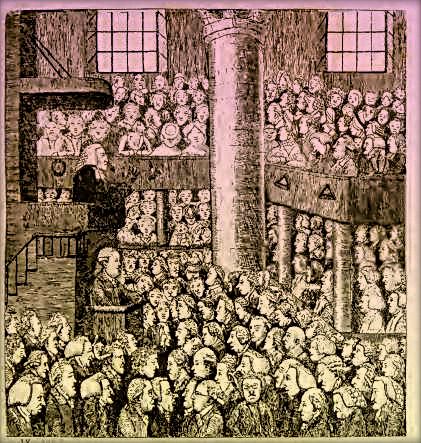
John Kay caricature of a distracted congregation


Not that all the stories are entirely light hearted when you dig beneath them. Dr Rogers tells the tale of a local farmer hauled before the Presbytery of Brechin, to give evidence concerning the Rev. John Gillanders, minister of Fearn, who was accused of drunkenness. The lawyer who conducted the prosecution asked the witness if he had heard Mr. Gillanders acknowledge that he had been in the habit of drinking to excess.

   'I never heard him say that,' the farmer said carefully, then added, 'But I have often heard him say that he was not.'

   John Gillanders was born in Aberdeenshire in 1757.  After being a schoolmaster at Tannadice he was ordained on 7th June 1786.  He died unmarried in 1802, and no details have come my way to confirm or counteract the slander of alcoholism brought against him.

   Many ministers at the past had the provervial gift of the gab, loquaciousness being a requirement of the calling, so to speak.  In the late 18th century there were two particularly talkative ministers in charge of neighbouring parishes.  When they were both at any gathering they competed to see who could monopolise the conversation the best, at the expense of all others.  Once the two divines happened to be having breakfast together and one of them launched on an immense and unending story which went well beyond any of his previous storytelling exploits.  So engrossed was he is his own oratory that he overfilled the teapot and did not even notice when it overspilled, first onto the table and then down on to the floor.  When at last he paused in his monologue, announcing that he was near the end, his guest sourly remarked:

   'Aye, ye may stop noo - it's rinnin oot the door!'

   It was a common jibe against ministers that they spoke so much that they sometimes spoke nonsense, or at least got muddled in their speaking.  The Rev. Alexander Imlach of Murroes (born 1727) was one such imprecise speaker, but the sole surviving instance of his verbal muddledness is no mild as to be near insensible.  When he was preaching one day he loftily invoked an old saying and stated, 'O Lord, bless all ranks and degrees of persons, from the king on the dunghill to the beggar on the throne.'  Then he corrected himself:  I mean, from the beggar on the throne to the king on the dunghill!'

   But other times it was the congregation who got misled by the speeches of the preachers, either through their own failings or because the ministers were too high falluting in their speeches.  Until the time of the French Revolution it was a widespread tendency among the ministry to make constant mention of the Antichrist in their preaching, by which they meant the Pope of Rome.  Times change, even in the kirk, and soon a milder exhortation to pray for the altar and the throne.

   Some time after this change an old parishoner approached the Rev Mr M- of Montrose and asked him earnestly:

   'Sir, I hae something to speir at ye, but ye maunna tak it ill.'

   'Na,na,' assured the minister.  'I'll no tak it ill.'

   'Ou, dear me,' said the auld wife.  'Is yon Annie Christie deid, or is she better, that ye prayed sae lang aboot, for I ne'er hear ye speak aboot her noo?'

   the minister alluded to here may be the Rev James Mitchell (1763-1835), who was a tutor and  close friend to Walter Scott, who described their association:


He was a young man of excellent disposition and a laborious student. From him I learned writing and arithmetic. I repeated to him my French lessons, and studied with him my themes in the classics. I also acquired by disputing with him (for this he readily permitted) some knowledge of school - divinity andchurch history, and a great acquaintance n particular with the old books describing the early history of the Church of Scotland, the wars and sufferings of the Covenanters, and so forth. I, with a head on fire for chivalry, was a Cavalier, my friend was a Roundhead ; I was a Tory, and he was a Whig. I hated Presbyterians, and admired Montrose with his victorious Highlanders ; he liked the Presbyterian Ulysses, the dark and politic Argyle, so that we never wanted subjects of dispute...

   Mitchell left his charge at Montrose in 1805 because of local difficulties, chief of which was 'because he could not persuade the mariners of the guilt of setting sail of a Sabbath'.


   Long ago, a newly appointed minister in Angus was coached about the character of his parishoners by a knowing elder:

   'When you ca on John Ramage o the Hillfoot, sir, ye maun speak aboot anything except plooin and sawin.'

   Why was that, the minister asked?

   'John, ye see, sir,' replied the elder,' is sure tae notice your deficiency in thae matters; and if he should find oot that ye dinna ken aboot plooing an sawin, he'll no gie ye credit for kenning onything else.'


   A different tale type is represented by the following story.  Late one Saturday night an old and rather lame Angus minister asked a servant to fetch the pulpit bible from the kirk as he was anxious to consult it for something.  The servant as first declined, saying he was too afraid to venture alone through the dark kirk-yard alone.  A conversation ensued and a compromise was reached.  The minister would accompany him, but as he couldn't walk his man would have to give him a cuddy-back.  John grumbled and mumbled, but agreed to carry the minister and fetch the bible.  On the way back, with the minister on his shoulders and large bible beneath his arm, he was alarmed to hear a voice ask from beneath a tombstone:

   'Is he fat?'

   Believing that the lurking ghost or bogle was querying his mortal burden (possibly with the purpose of devouring him),he discarded the minister and yelled,

   'Tak him as he is!' and ran away.

    Somehow the minister struggled back to the manse first.  What he said to John is not recorded.  Next day it was explained that two sheep stealers were in the area.  While one of them kept watch behind a gravestone, the other was on the look out for a beast to steal.  The overheard remark was actually a comment from the first about the size of the sheep his comrade had got hold of!