Showing posts sorted by relevance for query auchterhouse. Sort by date Show all posts

Saturday, 19 September 2015

More On The Lindsays and the Families of Stirling and Auchterhouse Castle

Something has already been written previously about the prominent Lindsay family, who were for a number of centuries one of the most important and numerous ruling families in Angus and, on and off, deadly enemies of the Ogilvys.  One of the Lindsay's proudest castles, Edzell, was actually built by the Stirling family and passed to Sir Alexander Lindsay when he married Catherine, daughter of John Stirling around 1357.  Their son, Sir David Lindsay, became the first Earl of Crawford.

   Catherine Stirling was co-heiress with her sister, but local lore added a brother, Jackie Stirling.  Small and deformed though he was, Jackie was well liked in the neighbourhood.  When he made a match with the daughter of a local laird, Catherine and her scheming husband realised that this threatened their inheritance.  They hired an assassin to kill poor Jackie as he took his regular evening stroll near Edzell Castle.  Thus Edzell passed in a bloody fashion to the Lindsays.

   Sir David Lindsay cannily married a daughter of King Robert II and became High Chancellor of Scotland.  One of his friends was John Lyon of Glamis Castle, secretary to the king.  But when Lyon was promoted to Great Chamberlain, Lindsay became jealous , believing that his friend's advancement was at the expense of his own.  The two men fought a duel on the Moss of Balhall, in Menmuir parish.  Glamis was slain and Lindsay was forced into exile in England in 1382.

   After he returned to Scotland, Sir David fought bravely at the battles of Otterburn and Homildon.  He earned wider fame by fighting in single combat on London Bridge in May 1390.  His opponent was the English champion, Lord Wells.  Twice the mounted men charged at each other without advantage and on the third charge the Englishman was unseated.  The spectators yelled out that Lindsay had cheated by tying himself to his saddle.  Sir David promptly rode up to the royal pavilion, jumped out of his saddle, then vaulted back into it.  The fight recommenced on foot and ended with the Scot throwing his opponent to the ground.  King Richard II gave him permission to kill Lord Wells if he wished, but Lindsay gallantly refused.  The monarch was impressed and gave Sir David the hospitality of his court for three months.

   In 1392 Lindsay was one of sixty Angus men under the command of Sir Walter Ogilvy of Auchterhouse, Sheriff of Angus, was fought at the Battle of Glasclune.  Their opponents were a band of here hundred Highland marauders, mostly Robertsons, led by Duncan Stewart, a son of the notorious Wolf of Badenoch.  After ravaging the Braes of Angus the invaders were tracked west to Glasclune in Perthshire.  Ogilvy, his brother and many others were slain early in combat.  Lindsay managed to pierce one Highlander with his lance, driving it into the ground.  But the dying man lifted himself up and caught Lindsay with his broadsword, cutting through his stirrup leather and steel boot right to the bone.  Sir David was nearly killed, but survived to found the great dynasty of Angus.  It seems ironic that Lindsay nearly lost his life supporting Ogilvy, for a generation later the two families were deadly enemies.

   Auchterhouse had become an Ogilvy property through marriage and changed hands again in 1446, passing to James Stewart, Earl of Buchan.  According to the Rev. James Inglis the ballad of 'Sir John the Rose' had its original setting at Auchterhouse (though extant versions of the poem do not set it in Angus).  The ballad relates the rivalry of two suitors, Sir James Ross and Sir John Graeme, competing for the hand of Matilda, daughter of the Earl of Buchan.  Ross and Matilda met each night beneath a large saugh tree in the garden.  But Lord Buchan favoured Graeme and forbade his daughter meeting Ross.  At their final meeting they were spied by Graeme's brother.  Ross slew him and prepared to flee, but Sir James Graeme found out and rode swiftly to Auchterhouse.  Following a fight, Ross was fatally wounded , tough with a final effort he stabbed Graeme through the heart.  Matilda was grief stricken and killed herself with the sword which had slain her lover.
   Auchterhouse was an unhappy place for the Buchan women.  In 1665, Marjory Ramsay, Countess of Buchan, was charged by the Presbytery of Dundee with having fornicated with her chaplain, James Campbell.  He was absolved after 'being thrice in the pillare' at Auchterhouse, wile the countess had to perform public repentance in the kirk.


                                  SIR JAMES THE ROSE


Oh have you heard Sir James the Rose,

The young heir of Loch Laggan?

For he has killed a gallant squire

And his friends are out to take him.

And he's gone to the House of Mar,

The Nurse there did befriend him.

And he has gone upon his knees

And begged for her to hide him.

“Where're you going Sir James?” she said,

“Where now are you riding?”

“Oh I am bound to a foreign land

But now I'm under hiding.”

Where shall I go?

Where shall I run?

Where shall I go for to hide me?

For I have killed a gallant squire

And they're seeking for to slay me.

Then he's turned him right and round about

And rolled him in the bracken,

And he has gone to take a sleep

In the lowlands of Loch Laggan.

He had not well gone out of sight

Nor was he past Milstrethen

When four and twenty belted knights

Came riding o'er the leathen.

“Have you seen Sir James the Rose,

The young heir of Loch Laggan?

For he has killed a gallant squire,

And we're sent out to take him.”


“You'll see the bank above the mill

In the lowlands of Loch Laggan,

And there you'll find Sir James the Rose

Sleeping in the bracken.”

“You must not wake him out of sleep,

Nor yet must you afright him,

Just run a dart right through his heart

And through the body pierce him.”

They sought the bank above the mill

In the lowlands of Loch Laggan,

And there they found Sir James the Rose

Sleeping in the bracken.


Then up and spake Sir John the Graeme

Who had the charge a-keeping,

“It'll never be said, dear gentlemen,

We killed him while he's sleeping.”

They seized his broadsword and his targe

And closely him surrounded,

And when he woke out of his sleep

His senses were confounded.

Now they have taken out his heart

And stuck it on a spear,

They took it to the House of Mar

And gave it to his dear.

Sunday, 15 December 2019

David Ramsay - The Royal Clock-maker, Inventor, Mystic?

   There is a question mark in the title both because I am not absolutely sure that the subject of this article was a native of Angus and also because his whole surviving legacy is a matter of intrigue. We can begin with a bit of definite fiction. Sir Walter Scott's novel The Fortunes of Nigel, published 1822, is set two hundred years earlier. Early in the book we encounter a watchmaker near Temple Bar, London, David Ramsay, who lives there with his daughter, Margaret. Ramsay is described as 'an ingenious, but whimsical and self-opinionated mechanic, much devoted to abstract studies'. He was clock-maker to the king, James I (and VI), and a native of Dalkeith, near Edinburgh.


Clocks, Inventions, Occult Treasure-Seeking 


   The royal clockmaker Ramsay was a real figure, A Scot resident in London, though he was almost certainly not from Dalkeith. The Dalkieth connection was invented by Scot to link the character with the eminent Ramsays of Dalhousie. More likely by far is that this Scottish craftsman was a scion of the family who had connections in Dundee and Auchterhouse. Richard Bissell Prosser's article in the Dictionary of National Biography perpetuates the spurious Dalhousie connection but contains much of interest. John Smith's book Old Scottish Clockmakers (1921) confirms that the London Ramsay was a Dundonian.

   David Ramsay was royal clockmaker to kings James I and Charles I in succession and was also page of the bedchamber and groom of the privy chamber, and so a man of some standing in court circles as well as a 'mere' master craftsman. His interests in science apparently spread far and wide. Between 1618 and 1638 David obtained eight patents for various inventions related to ploughing soil, fertilising the earth, raising water by fire, refining metals, propelling ships, plus other things.


    Even more fascinating is his connection with the darker sciences.  The astrologer William Lilly (1602-1681), who seems to have been a kindred spirit, relates in his posthumously published Life and Times (1715) that Ramsay and others conducted an investigation in Westminster Abbey in 1634, using a diving rod to search for concealed treasure. Ramsay actually got permission for his exploration of the abbey from Dean Witham (who was also Bishop of Lincoln at the time.)The supernatural efforts were aided by the use of 'Mosaical' (divining) rods, employed by a person named John Scott. One of the participants described the event:


I was desired to join with him [Ramsay], unto which I consented.  One winter's night, Davy Ramsay, with several gentlemen, myself, and Scott, entered the cloisters.  We played the hazel-rods round about the cloisters.  Upon the west end of the cloisters the rods turned one over another, an argument that the treasure was there.  The labourers digged at least six feet deep, and then we met with a coffin; but which, in regard it was not heavy, we did not open, which we afterwards much repented.

From the cloisters we went into the abbey church, where upon a sudden (there being no wind when we began), so fierce and so high, so blustering  and loud a wind did rise, that we nearly believed the west end of the church would have fallen upon us.  Our rods would not move at all; the candles and torches also, but one, were extinguished, or burned very dimly.  John Scott, my partner, was amazed, looked pale, knew not what to think or do, until I gave directions and command to dismiss the demons; which, when done, all was quiet again, and each man returned to his lodging late, about twelve o' clock at night.  I could never since be induced to join with any such like actions.
The true miscarriage of the business was by reason of so many people being present at the operation; for there was about thirty, some laughing, others deriding us; so that, if we had not dismissed the demons, I believe the lost part of the abbey church would have been blown down.  Secrecy and intelligent operators, with a strong confidence and knowledge of what they are doing, are best for the work.

 Ramsay was not put off.  The state papers in the following year mention his treasure seeking proclivities (and there is an earlier mention in 1628 also).  The politician and lawyer Sir Edward Coke also humorously mentioned the Scot seeking the Philosopher's Stone in a letter to Secretary of State Windebanke.


William Lilly. Public Domain, https://commons.wikimedia.org/w/index.php?curid=914262

  Despite his status Ramsay fell into poverty and, in 1641 was, was in prison for debt.  This difficulty is referred to by his son William Ramsay at the beginning of his book Vox Stellarum ('The Voice of the Stars'):
It's true your carelessness in laying up while the sun shone for the tempests of a stormy day hath given occasion to some inferior-spirited people not to value you according to what you are by nature and in yourself, for such look not on a man longer than he is in prosperity, esteeming none but for their wealth, nor wisdom, power, nor virtue.  
   It appears that the elder Ramsay was still alive on 17th January 1653 for his son wrote the postscript of his book 'from my study in my father's house in Holburn, within two doors of the Wounded Hart, near the King's Gate'. David Ramsay may have died shortly afterwards.


Other Ramsays in Dundee, Auchterhouse and Tealing


   Andrew Jervise (Memorials of Angus and the Mearns, vol. 2, p. 122) pointed out that the Ramsays were first noted in Lothian during the reign of King David I in the early 12th century.  William Ramsay of London, whom we shall encounter again below,  stated in his book Astrologia Restorata (1653) that the Auchterhouse Ramsays, his own branch, was the oldest of the name and that they 'flourished in great glory for fifteen hundred years, till these later days,' adding that they came to this country from Egypt, where the word Ramsay signifies joy and delight.   The first record we have of Angus members of the family is in 1296 when a Thomas de Rammseye of Forfarshire paid homage to King Edward I in Berwick-upon-Tweed.

   Next mentioned is Sir John Ramsay of Auchterhouse who is mentioned as an ally of Sir William Wallace when the latter landed back in Scotland at Montrose.  Ramsays owned Auchterhouse until the early part of the 15th century.  Sir Malcom Ramsay was hereditary Sheriff of Forfarshire and his only child Isabella married Walter Ogilvy and brought the lands into that family.  


   Of the Dundee Ramsays, one conspicuous member was Patrick Ramsay, burgess of Dundee, executed in Edinburgh in 1567 for importing false money. It is recorded that his 'heid, armis and leggis' were carried by a boy from Edinburgh for display in Dundee and other burghs, for which the laddie received 24 shillings.

   His namesake and probable relative Patrick Ramsay, 
smith and gun-maker, was given charge of the town clock of Dundee in the church of St Mary in 1588 and had his stipend enlarged to £20 in 1604; it was later doubled from this amount. After a period away from the burgh he wrote to the burgh council on 27th June 1609:
Unto your worships humblie meanis your daylie servitour Patrick Ramsay, Smith. 
That quhair it is not unknown to your worships that I, after returning to this town when it pleased  God to withdraw his visiting hand [a reference to the plague in the town] therefrom, at your worship's desire, was moved to undertake my auld service in attending upon the knok, at which times your worships promised to have an consideration of my great pains quhilk I was to sustain in the frequent visiting of the said knok and continued reparation of her, seeing now she is all broken and worn and decayed in all the pairts thereof. Upon expectation thereof I have continually attended with my sons and servants since, and thereby have been abstracted from my labour which I should sustain my wife and bairns.
Therefore, now, I have taken occasion to remember your worships humbly, that order may be taken how I may be payed for my bypast service, and in time coming, gif your worships will give me reasonable augmentation to my former fee, I will bind and obligemyself to sustain the said knok and preserve her from decay and mend and repair her upon my own expense during my life, quhilk will be no little profit to the commoun weill.


   Of the two sons of this Patrick, Silvester Ramsay was first a teacher in the grammar school, but then probably followed the family trade. His brother, John Ramsay, certainly did and in 1646 stepped down as the keeper of the clock due to infirmity in old age.

   The historian Andrew Jervise (Epitaphs in the North-East of Scotland, I, p. 341) believed he may have found a member of the craftsman branch of the Ramsays via a much defaced epitaph in the Howff graveyard in Dundee. The inscription was to a goldsmith who died, aged around 70, in the year 1603. Only the last two letters of the surname - AY - were visible, though Jervise made out an eagle on the stone, which bird had an association with the Ramsay family.

https://canmore.org.uk/collection/789850

   The watchmaker connection of the Ramsay family is evidenced much later in Angus in a tombstone in Inverarity.  Here there is a gravestone dated 1772, with the name Margaret Ramsay.  The stone contains a shield which has details of tools belonging to the watchmaker trade. The stone has the following inscription:


This stone was erected by DAVID/RAMSAY Watchmaker in Forfar in/Memory of his sister MARGARET/RAMSAY who died the twentieth/Day of January one 1000 seven/hundred and seventy two years/aged twenty one year two months/and two weeks/The good thou hast a mind to do/Let it be quickly done/We every day example see/How soon our glass is run'.

   A prominent non clock-making Ramsay was Archdeacon John Ramsay (1569- 1618), who became minister at Tealing in 1590. His splendid tomb survives in the kirk there, depicting him as a bearded ecclesiastic (half-life size) reading at a desk or lectern. It was erected by his widow, Elizabeth Kinloch.


The Auld Steeple, St Mary's, Dundee, whose 'knok' or clock was in the care of the Ramsay family for a time.

Further Reading


Andrew Jervise, Epitaphs and Inscriptions from Burial Grounds and Old Buildings in the North-East of Scotland (Edinburgh, 1875).


Wednesday, 1 April 2015

Early Records of Witchcraft

One of the earliest records of witchcraft in Angus comes from Arbroath and gives an insight into the motivation of those who accused others of abusing supernatural powers.  On 26 November 1563 it was recorded that:

                            The qlk day it is found by the buileyeis and court that Richart Brown sall
                             pass to the chapel the morne, and ask Jonat Cary and Jhon Ramsay her
                             son forgyffnes for calling her ane shoe witch, and him ane he witch; and
                             the said Jhon Ramsay sall ask the said Richart forgyffnes for calling him
                             thief carll.

   Another case of probable neighbourly bickering and slander was noted here on 28 July 1564, when George Hallis appeared before the local authorities and  said 'gif there was ony sic thing as ane witch Jonat Lam was ane, and James Davis affirmit the samin'. The matter was passed to an assize due to convene fifteen days later, but there is no surviving record of that meeting.

   The Protestant Parliament of 1563 decided to take more severe action against witches and those who consulted them, so witches now faced the death penalty.  When the Regent of Scotland, the Earl of Moray, visited Dundee in July 1569 he 'causit burn ane company of witches'.  John Erskine of Dun, religious superintendent of Angus, led a witch hunt through the county and neighbouring Mearns  in 1568-9, leading to at least forty accusations.

   Witchcraft accusations increased dramatically in  the 17th century.  Around 1630 several Monifieth women were excommunicated and punished from the parish for 'charming and witchcrafte'.  During the next decade Auchterhouse kirk session noted 'the pregnant scandal of witches in this part of the land', and 'supplicat the Lord therefore that he would enlighten and enclyne ministers and people, and enflame their hearts with more zeal to God and love his truth...'  In Auchterhouse there was another case of domestic, dangerous slander when, on 27 September  1646, Isabel Gall of Leoch declared that a woman named Janet Thomson (who was a servant of Robert Turnbull) had slandered her by calling her a witch and a thief.

   In 1649 local ministers attended 'the committee appointed by the provisional assemblie for the trial of witches and charmers'.  The perceived problem of witchcraft was obviously gathering momentum again.  In this same year the Presbytery of Brechin dealt with a number of male diviners from Glen Esk.  One was the charmer John Donaldson, who had already been punished by Lochlee kirk session.  Called to give evidence he admitted 'charming in casting the Shemfur', which was possibly a form of divination employing shears and a sieve.  Donaldson named others who also used this method:  John Crystison, Thomas Bowman, Johns Shanks, Alexander Davidson.  The Presbytery was unhappy with the depth and quality of his confession, 'because it is not so ample as that given his minister'.

   On 6 June 1650 the 'Lochlie Charmers; Crystison, Shanks and Thomas Kyneir were sharply reprimanded for casting the Shemfur.  They were ordered to appear in sackcloth before the congregation of Lochlee until the minister was satisfied that they had repented.'
   Meanwhile, Auchterhouse continued to root out offenders.  On 2 July 1650:

                                Janet Fyffe  made her public repentance before the pulpit for
                                learning Mrs Robertson to charm her child, and whereas Mrs
                                Mrs Robertson to charm her child, and whereas Mrs Robertson
                                should have done the same, it pleased the Lord before that time to
                                call upon her by death.

   The above action may have been the result of the minister's previous plea, on 6 January 1650, when he asked members of his session 'to make a search everywhere in their own quarters if they know any witches or charmers...and delate them to the next session'.

Saturday, 4 April 2015

William Wallace Was A Dundee Schoolboy

    Or was he?

    The poet Blind Harry said that the young, future rebel Wallace went to grammar school in Dundee (probably around the year 1291) while he was living with his mother and uncle at Kilspindie in the Carse of Gowrie.  One day the foppish son of the town's English governor Selbie accosted young Wallace outside Dundee castle and mocked his suit of 'gemming green'.  When he then demanded that the young Scot hand over his knife, William refused.  Selbie grabbed his collar and shook him violently, whereupon Wallace stabbed him dead.  He fled west out of town on 'cleanly clever heels', hotly pursued by Selbie's associates.  He sat down to rest on a stone meal-kist at Longforgan and was taken in by the inhabitants of a cottage, a couple named Smith.  When some English troopers burst into the house they found an outlandish, apparently female, figure busy at the spinning wheel, all covered in fluff.  When they left William Wallace threw off his disguise and fled to his uncle's house at Kilspindie.
    This story was recorded in the 19th century by James Cox, Provost of Dundee, who heard it from Rachel Smith, a descendant of the Longforgan couple.  After her family left the village in 1862 the meal-kist was given to the owner of Castle Huntly and later ended up in Dundee Museum.

    Despite the original literary provenance of the association with Dundee, Wallace was a west coast boy, and it seems slightly doubtful that he would have relocated to Dundee.  But the story lingered in the area and was elaborated through the years.  The folk hero apparently left behind his name at Wallace's Trenches, on Clatto Hill, supposed site of the hero's encampment which he used before besieging Dundee Castle.
    A mile to the north is Fallow's Mill, where a local rhyme remembered him securing provisions:

                                     Wallace pitched his camp on Clatto Hill,
                                      and ground his corn at Philaw's Mill.

    A short distance away was Auchterhouse Castle, which was home in 1296 to Wallace's ally Sir John Ramsay.  Ramsay captured Perth from the English in the Wars of Independence and slaughtered two thousand of its English garrison.  Sir John met Wallace when he returned from exile in Europe.  Embaring at Montrose, Wallace accompanied Ramsay back to Auchterhouse, then they went on to capture Perth for a second time.  In the grounds of the present house at Auchterhouse is the ruin of an old building called Wallace's Tower.


Monday, 15 December 2014

Place Rivalries (Part One)

In the days before mechanised transport, when travel was difficult, the nearest rural communities often rubbed each other up the wrong way.  Part of this was economic competition, but the inbred suspicion of strangers, albeit strangers who lived just over the next hill or a few fields away seems to have been deep seated.  Most of the rivalries between small towns and villages have been long forgotten, so it is hard to judge now how jocular or serious these rivalries were generations ago.  The Rev W, Mason Inglis gives a light hearted example of friendly rivalry between the parish of Auchterhouse and its neighbour Tealing in An Angus Parish in the Eighteenth Century (1904).  When an Auchterhouse man suggested that it only took an S before is neighbour's parish name to turn it into something slanderous, his friend pointed out that SL before the name Auchterhouse would similarly transform it!

   One verse, attributed to the seer True Thomas hints at destruction due to several times and suggests he was more favourable to some places in Angus more than others:

                                  Bonny Montrose will be a moss;
                                  Dundee will be dung doun;
                                  Forfar will be Forfar still;
                                  And Brechin a braw burrows-toun [burgh town].

   Fishing communities in Angus maintained a healthy disdain for each other, obviously inspired by competition for catches.  When Broughty Ferry was still a fisher toun the people there took umbrage at their easterly neighbours in East and West Haven regularly raiding their mussel beds in Monifieth:

                                  East Ha'en stinkers
                                  and West Ha'en gull maws
                                  come and sweep our sand awa.

   Further up the coast, there is Fishtown of Usan, now a deserted ghost village.  The people there maintained a rivalry with their northerly neighbours in Ferryden, with Usan residents calling them assertive and grasping.  Ferryden folk in turn accused Usan villagers of being canny and dull witted.

Old Brechin


   Bigger communities were no less petty in their attitudes.  Brechin was rarely on good terms with Montrose and was also an enemy of Forfar.  Montrose people were (perhaps scornfully) termed Gable Enders (or Endies) because many of their old houses were built side-on to the street.  Brechiners were derided as Creeshy Wyvers (Greasy Weavers) because of their staple hand loom industry.  When Brechin folk resorted to the country, local folk would rush out to gather in their washing from the line, with a warning cry to neighbours:

                                  Tak in yer sarks, guidwives, for here come the Brechiners!

   The implication that people from Brechin were prone to theft has never been satisfactorily proven. Another derisive name for people from Brechin, as given in Montrose, was Torn Hatties, allegedly because of their ragged appearance.

   Enmity between Brechin and Montrose dates back at least to the thirteenth century when Montrose had a monopoly on local trade, so Brechiners had to travel to its market.  In 1396  Brechin set up its own market cross, but the Sheriff of Angus promptly knocked down this symbol of economic independence.

   Brechin got its own back on Montrose with a dig at the often foul smelling tidal basin:

                                 Here's the basin, there's Montrose,
                                 Shut yer e'en an haud yer nose.

   When some men from Brechin and Montrose met together once, one of the latter made a disparaging remark about Brechin.  A Brechiner angrily asked the man:  'Do you mean, sir, that there are nae honest men in Brechin?'
   The man replied:  'Weel, sir, I'll no be sayin that...but it's michty far atween their doors.'

   Whether or not this resulted in a pitched battle is not recorded.


                                                                 Montrose Basin


Friday, 15 September 2017

Well - Tell Me More!

Water, as a symbolic, ephemeral element, is difficult to quantify in all its forms and meanings. Also difficult is trying to deduce the number of holy, healing and other wells in a particular area, plus all the traditions associated with these.  This is my fifth attempt and I am not satisfied that it is in any way definitive. (Previous posts are listed at the bottom of this entry.)  Wells and springs become lost, change their names, get filled in and covered over, forgotten, confused with each other.  But every now and then a little sparkling new information comes to light, and this is presented here – for your refreshment. At the end of the post there is an updated list of the wells and springs in the county, and before that information regarding wells in Auchterhouse, Dundee, and Arbroath.
   
   A new list of Angus wells will follow in the next post...

Well Rituals in Auchterhouse

   In Annals of an Angus Parish (Dundee, 1888), William Mason Inglis usefully provides extracts from the kirk-session of Auchterhouse which give rare evidence about the practice of going to wells for magical purposes:

May 2nd, 1652.- Mrs Robertson, in the Bonniton, was before the session for charming of her child, by going from the Bonniton to the Kirkton well and washing her daughter’s eyes there, and saying:-
Fish beare fin and full beare gall,All ye ill of my bairn’s eyen in ye wall fall.

The minister having heard her confession, found it necessary to take no action until he had brought her case before the Presbytery on the 22nd May.

   Mrs Robertson and Janet Fyffe, who had taught her how to charm the child, were appointed to sit on the stool of repentance, in sackcloth, ay till they be penitent.   July 18th, 1652.- Janet Fyffe made her public repentance before the pulpit for learning Mrs Robertson to charm her child, and whereas Mrs Robertson should have done the same, it pleased the Lord before that time to call upon her by death.

   Inglis goes on to comment that there was a ‘strong superstitious belief in the healing properties of the Lady Well near the village...The well was situated in the north-east corner of the glebe, and there still exists an excellent spring at the same spot.  It was alleged to have been much frequented in olden times by witches and charmers.’

   An interesting point is that both these wells were near the centre of the parish, under the noses of kirk officials, and yet continued to be regarded as magical for a considerable period.


The Urban Wells of Dundee

   One would expect the history of wells in urban landscapes to be free of the kind of residual superstitious associations found in rural areas and this is largely the case.  In medieval and early modern burghs the water supply was a crucial element in the well being of the inhabitants (pardon the pun) and the wells and springs had a dual identity as practical public utilities and holy places.  even the Reformation could not stop residual veneration or force name changes on sainted springs and it was only in the mid to late 19th century that the use of wells ceased.  

   The first major improvement was the supply of piped water from Monikie, in 1846, and this was followed three decades later by the major scheme to supply Dundee from Linlathen.  Before this modernization the demand for safe, clean water had led to water being imported into the burgh from sources such as the Logie Spout (in present Milnbank Road) and Invergowrie. During dry seasons water was carted four miles from Invergowrie into the burgh.

   Other early sources included Smellie's Well, on the Lochee Road, and, nearby, Blackness. There were public wells at the corner of Tally Street, near the Kirks; in St. Clements Lane; at the ancient site of Lady-well at the foot of the Hilltown; and at the Dogwell in the Murraygate. The town's  overused wells meant these outside sources were particularly exploited during summer months.  Water was even shipped into the burgh from the Tayfield Estate, Newport, by a business-man nicknamed 'Water Willie'.  No co-incidence that one sobriquet for Dundonians in the 19th century was 'Tay Water Willies'.

   Fierce competition ensued between the operators of Invergowrie and Logie (as reported in a previous blog post, 25th March 2016), with each firm driving barrels of their water through the streets and bellowing the benefits of their product.  One would shout:

                                  Invergowrie’s crystal spring
                                  for Tea surpasses everything!

    Their Logie rivals would retort with this doggerel:


                                  Of a’ the wells that’s here aboot
                                  there’s nane compar’d to Logie Spoot!


   According to the authors of Dundee and Its Textile Industry, 1850-1914 (Dundee, 1969, p. 9): 'Attempts to organise a regular supply of piped water met stiff opposition between 1868 and 1869 from householders who feared that the water company's rates would be unreasonable.19 Only in 1876 could the Chamber of Commerce claim that the town had a piped supply adequate for all domestic and industrial purposes.'


   Not only the wells vanished as the Victorian age progressed, but so did some of the running waterways which were major arteries for the town’s population and industry in its formative years.  The Scouring Burn and the Dens Burn have long since been driven underground (though the Dichty Burn survives).  The history of these streams and their associated industries merits a separate post, but before looking at the three major wells in Dundee I could not resist sneaking in the following rhyme about Dundee’s waterways which originates in the 1866 journal ‘The Piper O Dundee’ and was unearthed by the excellent blog In Ma Fair Toun

                                 The Scouring Burn and Dens Burn
                                 How many a wheel do they turn?
                                 Now I do believe that they
                                 Turn twice the number of the Tay.


The Holy Trinity of Dundee Wells

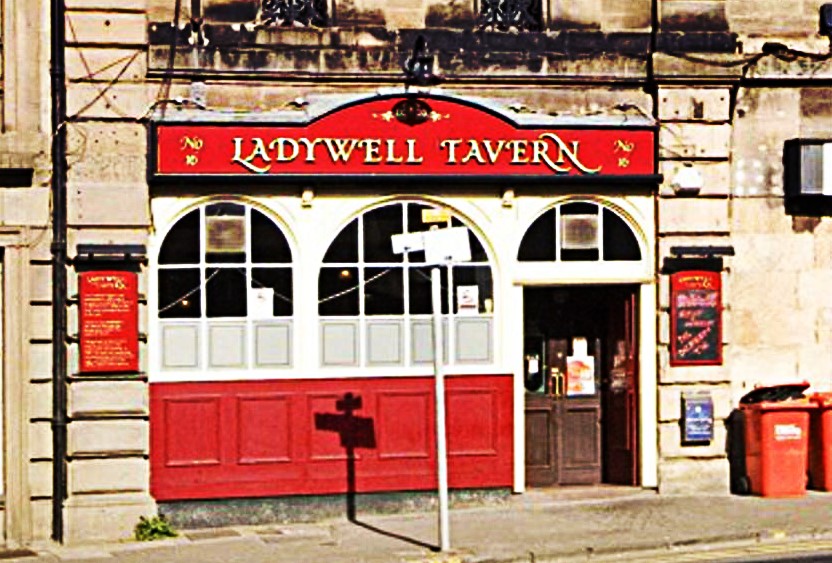
The Well of the Blessed Maria de Dundee, or the Lady Well, stood at the corner of the Hilltown and Lady Well Lane which is mentioned in a contract between the Constable of Dundee and Burgesses on 21st September 1409. In the 15th century this well was ducted and culverted to flow into the Scouringburn and remained the primary water source for the burgh’s water even as late as 1836.  It was in use until 1872, when it was demolished on the construction of Victoria Road in 1872. Its name is perpetuated in the name of the pub Ladywell Tavern and in the Wellgate, Dundee. 

   The author of Dundee Delineated (p. 21) states that the Cross Well was associated with the Market Cross of Dundee – ‘often the place of joy and amusement in holidays, when the town gave itself up to mirth and good humour’.  It was east of the Cross, near the junction of Peter Street with the Seagate, but in 1777 water was later diverted to St Clement’s Lane, behind the Town-house in the Marketgait.  In a grant of land by King Robert I in 1325 for the erection of the Tolbooth, the territory is described as being between a water conduit on the west and the Cross Well in the east.  Access to St Clement’s Well (also known as Bischop’s Well or Saint’s Well) was still used following the Reformation when a school was erected on part of the church lands, the well being in the kirkyyard.  Ownership of another part of the land was disputed by a mariner named Andro Renkyne (Andrew Rankine) who owned a house there (which survived into the 19th century).  This may have been an old ecclesiastical building and Andrew went to the town authorities in 1607 for permission to make a window in his house which would allow him to draw water from the well, ‘with this provision that he hald the windok continually close, except at sic time as the water is drawn thereat, and that he close up the windok with stane wark quhenever he beis requirit’ (Maxwell, The History of Old Dundee, p. 91.)  Maxwell notes:  ‘When the buildings were demolished a few years ago, the saint’s old well – its water yet pellucid and fresh – was discovered at the angle where the school joined Andro’s house.  Above it was the window which he struck furth for drawing water; but it had long before been built up and the purpose of it forgotten, and its curiously recessed position and uncouth masonry only served as a puzzle for ingenious antiquaries.’

    St Francis’ Well was situated ‘amid the sunny slopes of the Gray Friar’s meadows’ (History of Old Dundee, p. 166) and (Gray) Friar’s Well was its alternative name.  It was situated in the rising ground west of the site where Dundee High School was later built.  In March 1562-3, following the destruction of the Franciscan Monastery and gardens, a man named James Patrie was brought before the burgh authorities for casting down the well and ‘he confest and grantit that he took down the common well callit the Friar well, quhilk servit the hail town with guid and wholesome water, and [he was] referrit [to]...in the Bailies’ and Council’s will thereanent; and they being advisit with his offence, declarit that he sall pay for the reparation of the said well and common warks the soum of ten pounds; always, gif he big and repair the well as weill as it wes before with lime mortar, or Pasch next, this pain to be remitted; otherwise, the day past and the well nocht biggit, to pay the soum but favour.’  His motivation was perhaps religious zeal, but the council recognised that the purity of water supply overcame any Papist associations. 

                           
   A further notice gave Patrie another reminder, after which the work was evidently done.  But thirty years later the structure of the well was again ruinous.  In October 1591 the authorities resolved that the well ‘be of new biggit and made close, so that na common access be had thereto.’ The site of the well was later occupied by the United Presbyterian Church in Bell Street (and now by an office building) and the confusion about its exact location is noted by the CANMORE database which pertinently notes that even the Ordance Survey wrongly pinpointed its site.

St Ninian’s Well, Arbroath


   In contrast with the urban continuation of the usage of wells, those wells in less populated areas were also subject to changing fortunes, ending in neglect and loss of knowledge sometimes about their exact locations.  Such was the case with St Ninian’s Well at Arbroath.  It was located on the shore near a chapel dedicated to the saint, as described by David Miller (Arbroath and its Abbey, pp. 129-30):

Close to the promontory called Arbroath Ness...the Abbot and Convent of Arbroath founded a chapel...The site of this chapel is a pleasing spot, marked by a spring which bears the name of St Ninian’s or Ringan’s well.  In the Arbroath register the chapel is usually described as situated in the den or valley of Seaton.  St Ninian’s chapel and altar were consecrated by the Bishop of Dromore, on 24th August 1485...The field in which the chapel and burying-ground stood formed the glebe of the chaplain, and has been long known as St Ninian’s Croft... After the Reformation it seems to have fallen into the hands of the proprietors of Seaton, and still forms part of that estate.  All vestiges of the chapel have been removed, and the site subjected to the ploughshare. 

   Although current O.S. maps show St Ninian’s chapel and well near the shore, at the east end of what is now Victoria Park (which was opened in 1897), surveyors for the Place Name Book in 1859 were unable to identify the sites. Historically the site on the Seaton Cliffs was called either St Ninian’s Croft or St Ninian’s Heugh.   Several stone coffins were found in the area when a road was constructed here in the 18th century.  Further human remains were discovered in 2009 during the construction of a play park, prompting investigation by police and archaeologists.  The remains were recognised as two human bodies, obviously from a medieval cemetery.  Pottery from the 11th century was also uncovered.  But the site long predated the chapel and even the nearby abbey.  A skeleton uncovered 200 m away in 1988 proved to to from the late 6th or early 7th century.

   As for the well itself, it had dwindled to a mere trickle, sadly dripping from a stark metal pipe which pokes out of a stark stone slab.  It is reckoned that most of the water has been diverted to a nearby ‘Wishing Well’.  Although it has sadly changed, quite why it could not be found in 1859 is a bit of a mystery as George Hay in 1886 (Aberbrothock Illustrated, p. 46) referred to is as ‘a spring whose water percolates into a rock-basin beside the path’, and he quotes a couplet from local poet Alex Balfour:

                                  The banks are green, the flowers are fair,
                                  Around St Ringan’s crystal well.


Previous published posts on wells:


Further Reading

Colville, A., Dundee Delineated (Dundee, 1822).

Hainey, Sheila, ‘Arbroath – St Ninian’s Burials,’ The Pictish Arts Society Newsletter 55 (Summer 2010).

Hay, George, Aberbrothock Illustrated (Arbroath, 1886).

Lenman, Bruce, Lythe, Charlotte, and Gauldie, Enid, Dundee and Its Textile Industry, 1850-1914, Abertay Historical Society Publication No. 14 (Dundee, 1969).

Maxwell, Andrew, The History of Old Dundee (Edinburgh & Dundee, 1884).

Miller, David, Arbroath and its Abbey (Edinburgh, 1860).


Thursday, 22 August 2019

Olden Days Death (and Some Humour)

Here's a couple of anecdotes about death and dying in the 'good' old days.  The first concerns a certain Johnny Baxter of Montrose, ordered by the doctor to give his wife a sup of whisky in her extremity.  The doctor called again a few hours later and questioned Johnny about whether he had actually administered the spirit to his spouse.

 'Weel, as fae's daith, doctor' he said.  'I got the whusky for her, but ye see, ye tellt me she couldna last till morning, and that naething would dae her ony guid, so I jist thocht it's a peety tae waste guid whusky, and so doctor -' he issued a mighty sigh '- I jist took the drappy mysel.'
   The doctor's face showed strong disgust, so Johnny added quickly to redeem himself, 'I gied her the hooch [whiff] of it.' [Scottish Life and Humour, p. 83.]

   The second story concerns a man attending the funeral of an Angus farmer's wife long, long ago. He was weeping fit to burst and had been in the same condition at two other funerals in the recent past.  One of the other mourners asked why he was so grievously affected:

   'John, man, what's wrang wi ye? I'm sure she wisnae ae drap's bluid tae ye.'
   'It's no that,' John replied tearfully.  'A'body's wives are deein but mine!'
   [Scottish Life and Character, p. 465.]


The Lyke Wake and Funeral Superstition


Did the distant generations of Scots have a unique attitude to death?  Maybe so.  One of the most interesting accounts of death and its customs in rural Angus concerns the parish of Kinnell.  The following extracts are from Glimpses of Men and Manners About the Muirside (pp. 178-180):

During the nights previous to the internment friends and neighbours took their turn, generally in pairs, to remain in the room where the corpse lay, provided with a candle, a Bible and a bottle of whisky. A tale is told of what really took place at a 'lyke wake' in this district many years ago.  The scene was a portion of an old castle, part of which had been patched up and turned into a farmhouse.  The aged mother of the farmer had died, and two elderly females were watching by her remains.  the corpse was laid out of an old-fashioned 'press bed,' having a shelf at the foot. The watchers, seated before the bed with a candle, etc., on a small round table, had fallen into a dose.  A well-filled bolster placed on the shelf at the foot of the bed, struck and upset the table, waking the good women from their slumbers, and they, thinking the deceased had come to life again, flew down the stairs in great alarm, gasping out 'She's risen!' 'she's risen!'
The hour at which a death occurred in a village the bellman was informed, and however late or dark the night he passed along the tinkling dead-bell to call attention to his intimation.  The bellman summoned all to the funeral, and for anyone to absent himself  was regarded as a discourtesy to the dead and an insult to the living.  It was only after the year 1700 that the presence of the minister was usual.  
There were many superstitions connected with funerals...if the funeral party walked to the place of burial in a straggling manner, it was regarded as an omen  that another death would soon occur under the same roof.

   Edwards also observed regarding the watch over the corpse (pp. 181-2):

From the moment of death until the departure of the funeral procession to the place of burial...the corpse was watched...by parties of friends and neighbours, who relieved each other.  Silence was observed, but this did not prevent the consumption of much ale and whisky.  Among the poorer classes the internment took place soon after death, in order to lessen the cost of watching, but the well-to-do deferred the funeral for about a week, and sometimes a fortnight, in order that the hospitality of the house might be more extensively offered and enjoyed.


The Parish Mort-Cloths


In centuries past, when there was no bier or coffin to contain the recently departed person, the body was wrapped in a parish mort-cloth, which covered it until it reached the place of burial.  Parishes often had several of these, a basic one and a grander one, for the poorer and more well-off parishoners. They were hired out for funerals and were a useful source of revenue for kirk sessions.  On 13th September 1702 it was recorded that Dun was hiring out its mort-cloth to those in the parish for £1 10 shillings and to outsiders for £2 10 shillings. Fees elsewhere were highly variable.  An old lady called Erskine, buried in Montrose in 1674, was charged £6 6 shillings 8d for use of the best morth-cloth.  The list of those who used the small and large mort-cloths in Dundee between 1655 and 1817 has been compiled by the Friends of Dundee City Archives.

   But sometimes charges for use of the mort-cloth were waived; for instance, in the case of the following in Auchterhouse in February 1694:

In regard Patrick Ogilvie hath borne the burden of David Edieman, his father-in-law, for some years bye gone, and that he was unable for work, therefore the session determined that he should pay nothing for the mortcloth at his burial, he being in a mean condition. [Annals of an Angus Parish, p. 143.]


   On 10th February 1724 the kirk session of Auchterhouse enacted:

(1)That there should only be a sixpence paid for the use of the second mort-cloth att children's burialls. (2) That all plaids upon corps (corpses)shall be discharged (forbidden) in time comeing, and that poor people who are not able to pay shall have the use of the second mort-cloth gratis, (3) That none without the parish bury here without our mort-cloth. 
   The Rev. Inglis notes that poorer people sometimes used plaids to wrap the remains of their loved ones in as they could not afford the mort-cloth fees.

   The minister and another man from Auchterhouse journeyed to Dundee on 2nd December 1716 to purchase two new cloths.  The cost of the better one, 'made with all furniture requisite', was the remarkable sum of £198 Scots, or £16 10s sterling.  The poorer one was 'English cloth, unmade, for the meaner sort', and cost £25 : 12s Scots, or £2, 2s,8d. sterling.  In 1646 the kirk-session of Brechin was obliged to buy another mort-cloth when their was stolen by English troopers.


   In earlier days a burial box was sometimes used, wherein the body in its winding sheet was transported to the grave, then deposited when the bottom of it was withdrawn.  In 1563 the General Assembly ordained

that a bier should be made in every country parish, to carry the dead corpse of the poor to the burial-place, and that those of the villages or houses next adjacent to the house where the dead corpse lieth, or a certain number out of every house, shall convey the dead corpse to the burial-place, and bury it six feet under the earth .


The mort-cloth, too, was used sometimes in later years to cover bodies which were contained in proper coffins.

   The Rev. Inglis relates how the fine velvet of a mort-cloth in the Carse of Gowrie was purloined by a Frenchman who had designs on it for another purpose:

When the French prisoners of war, in the early years of last century, were taken from the port of Dundee to Perth prison by road, they frequently were billeted in the Parish Church of Inchture. A French prisoner getting his eye on the beadle's best velvet mort-cloth managed to secure it, and got it under his arm ready to proceed with it to Perth. The beadle, however, missed it, pounced upon the culprit when he was on the march, and when he asked him what he meant to do with his mort-cloth, he said, 'It was just the very ting for velvet slippers.' [An Angus Parish in the Eighteenth Century, p. 81.]


Illustration of Auchterhouse House from cover of Annals of An Angus Parish


Some Sources


D. H. Edwards, Glimpses of Men and Manners About the Muirside (Brechin, 1920).
William Harvey, Scottish Life and Character in Anecdote and Story (Stirling, 1899).
Violet Jacob, The Lairds of Dun (London, 1931).
William Marshall, Historic Scenes in Forfarshire (Edinburgh, 1875).
Rev. W. Mason Inglis, An Angus Parish in the Eighteenth Century (Dundee, 1904).
Rev. W. Mason Inglis, Annals of An Angus Parish  (Dundee, 1888).
William Sinclair, Scottish Life and Humour (Haddington, 1898).


Tuesday, 8 March 2016

Well, Well, Well.


Right, you asked for this:  an extensive, but frustratingly un-comprehensive, list of wells which exist or once existed in Angus, with informative notes.  Who could resist?  In fact, nobody asked for this at all, but you’re going to get it anyway.  Some of these astounding springs have been mentioned before and I have helpfully labelled these with an asterisk [thus *].  Names in the list with square brackets denote wells in locations where the specific name of the well is either unknown or unsure, so the location as been used instead.   Apologies in advance for failing to distinguish between healing wells, holy wells and miscellaneous wells.

   Hold on to your hats and we’ll begin, with a hot hundred or thereabouts of the hottest springs:

1. Aberneathan Well, two miles NW of Kiriemuir.  Possibly from the Pictish personal name Nechtan,  either St Nechtan or King Nechtan?
2. Agricola Well.  At Castleton, Eassie, a reputed Roman site; supposed to have been named by locals after the Roman general, but more probably given the name by a local antiquary.
3. [Balmossie Den*], near Broughty Ferry.
4. Barrel Well, Brechin.
5. Batties Well, Haughead, Arbirlot.
6. Battle Well, Battle Drum, Montreathmont Moor, Brechin.
7. Beardie’s Well, Brechin. A well which was on the north side of the Nether Wynd in Brechin, supposedly the property of the Earls of Crawford.  This well was therefore supposed to be linked with Alexander, the 4th Earl of Crawford, one of whose nicknames was Beardie.
8. Bell’s Witter, Clach of Glentaire, Clova.
9. [Benvie*]  Well haunted by the White Lady since plague times.
10. Bra Well, Stracathro.
11. Camperdown or Cammerdown Well, Dunnichen.  This was renamed after  the late 18th century naval encounter won by Duncan of Lundie. It was originally St Causnan’s Well (there was a St Causnan’s Chapel nearby.)  Causnan again is a colloquial form of Constantine.  Local dignitary George Dempster took it upon himself to give the spring its new name following the battle.
12. Camp Well, near the site of supposed Roman site at Campmuir, Kettins.
13. Cardinal’s Well, south of Lownie Hill, near Dunnichen.  Local tradition says it was named after Cardinal Beaton, who favoured this spot.  The cardinal is also associated with many castles in Angus. It was said that the water from the well was conveyed for some special use at Arbroath Abbey.
14. Carlin Well*, Craigton of Airlie.  Now vanished and named after the Cailleach, the Old Hag of Scottish Folklore. Adjacent is Carlinwell Farm.
15. Cartyheugh Well, Kelly Den, St Vigeans.
16. Cattle Well, Lochmill, near Kirriemuir.
17. Chapel Well, near Whitemire, Aberlemno.
18. College Well, St Michael’s Mount, Brechin.
19. Corryvannoch Well*, on the slopes of Mount Keen.  The most famous healing well in Angus where pilgrimages would be made and sick children carried.
20. Craig Well, Lundie.
21. Cuttle Well, the Den, Kirriemuir.  One of the more conspicuous and best loved wells in Angus, it has been damaged in recent times by land slips and is ripe for restoration.

Long gone children play around the Cuttle Well, Kirrie Den.

22. Docken Well, Lintrathen.
23. Dripping Well, Arbroath.
24. Droustie’s Well*, Lochlee, near the home of the Dark Age saint.  Also, more formally known  as St Drostan’s Well.  It was located in a field named ‘Piper’s Shade’ and cured all sorts of diseases.  When some jealous healers poisoned the well some locals stones them to death and buried them in a circle around the spring.
25. Duckladge Well, Lintrathen.
26. Dundas Well, Pitlivie Moor, Arbirlot.
27. God’s Well, Arbirlot.
28. Golan Well, Auchenchapel, Glen Isla.
[Hangie’s Well, Cargill.  This is a  dubious example, cited by Andrew Jervise in Memorials of Angus and the Mearns, in that Cargill is in Perthshire and not Angus(so we won't count it), though Jervise states that it may have been in Angus once.  The well was on the property of a local hangman and, when it was excavated, a large number of human bones were found here.  So good a tale that we forgive the Perthshire-ness of the location.]
29. Hassock Well, North Whitehills, Forfar.
30. Helly Well, near Shelterfield, Arbirlot.
31. Hen Well, east of Finavon Hill.  Note nearby place-name Henwellburn.
32. Hogg’s Well, Fairy Knowe, Dunnichen
33. Holy Well, Balnaboth, Cortachy.  Near ancient church ruins.
34. Holy Well, Broughty Ferry.
35. Hore Well, Lundie.
36. Horse Well, Smithton Hill, Lundie.
37. Iron Harrow Well, south of Hayston Hill, Tealing.
38. Jenkin’s Well, in Balrownie Wood, Menmuir.
39. King’s Well, Carmyllie.
40. King’s Well, Newtyle.
41. [Kirkden Well] renowned for reducing swelling in feet and legs.
42. Knellock Well,  Gallows Hill, Inverarity.
43. Lady Well, Auchterhouse.
44. Lady Well, Brechin.
45. Lady Well, Dundee.  Perpetuated in the name of the pub Ladywell Tavern and in the Wellgate, Dundee.  ‘The Well of the Blessed Marie de Dundee’ was a holy site in the medieval burgh and was one of the primary water sources for the city until it was demolished on the construction of Victoria Road in 1872.

Ladywell Tavern Dundee, where many a thirst has been quenched.

46. Lady Well, Farnell.
47. Lady Well, Chapelton, Menmuir
[Note also the place-name Ladlewell, east of Forfar:  possibly a corruption of Lady Well?]
48. Lammer Well, St Vigeans.
49. Lanuner Well, by Newton Hill, near Arbroath.
50. [Logie-Pert*]  well in kirk-yard, used to treat sores.
51. Lunan Well, Lunanhead Forfar.
52. McComie’s Well*, Glen Isla.
53. Madie's Well, on the banks of the Lunan, Kinnell.  Nearby was Madie's Heugh.  Possibly a corruption of parish patron St Maelrubha (or other wise Magdalen?).
54. Maid’s Well,  Rescobie.  Any connection with St Triduana who once reputedly lived here?
55. Marywell, Craig parish (anciently Inchbrayoch), close to the coastal village of Usan.
56. Mary Well, Kirriemuir.  Recalled in the local name Marywell  Brae.
57. Mary’s Well, Edzell.
58. Mary’s Well, St Vigeans.
59. Matty’s Well, Panbride.
60. May’s Well, Dunnichen.
61. Medicine Well, Idvies, also known as Medicie Well.
62. Medicine Well, Montrose.  This was, for a short spell in the 18th century, a fashionable spa.
63. Meg Blair’s Well, Lochlee.
64. Monk’s Pool, Kirkton, Lochlee.
65. Monk’s Well, St Vigeans.
66. Naughty Well, Kinnell.  Is this a colloquial corruption of an older (Celtic?) name?  We would love to get to the bottom of this one. The well was close to the ancient chapel of Bolshan.
67. Neil's Well, near the kirk of Kingoldrum.
68. Nettle Well, near Edzell.
69. Nickie’s Well, Witchwood, St Vigeans.
70. Nine Maidens’ Well, Bracken Bruach, Auchterhouse.
71. Ninewells, Dundee.  Close to the River Tay, on the west of the city.  Now commemorated as the name of the largest hospital in the region.
72. Nine Wells, Finavon.  On the hill above the old kirk.  A burn trickles down from the spot.
73. Nine Maiden’s Well, Forfar.  Located in the vicinity of Craig O’ Loch Road.
74. Nine Maiden’s Well, Kirkton of Strathmartine.  Near the kirk, this is importantly in the vicinity of the folk-tale of Martin and the Nine Maidens.
75. Nine Maiden's Well, Cortachy.  Near the church.
76. Nine Wells, Glamis.  The supposed home of the Nine Maidens, in Glen Ogilvy, was located within Glamis parish.
77. Nine Wells, close to Peallock Quarry, Lunan.
78. Nine Wells, Oathlaw.

[Few other areas in Great Britain have so many Nine Wells/Nine Maiden’s Wells, which points to a significant  local cult in the area which became Angus.]

79. Pater Well, near Deerpark Cottage, Kinnaird.
80. Paterlochwell, near Cottarward, Dunnichen.
81. Peatmire Well, Black Wood, Arbirlot.
82. Purdie’s Well, near Ochterlony, Rescobie.
83. Queen’s Well*, Glenmark, Lochlee.  Re-named in honour of Queen Victoria, but originally named Tobar na clachan gualaich, the Well of the White Stone.
84. St  Aidan’s Well, Kirkton of Menmuir.
85. St  Andrew’s Well, Monikie.
86. St Andrew’s Well, Lintrathen.
87. St Anthony’s Well, Auchterhouse.  On Henderson Hill, marked as ‘disused’ on modern maps.
88. St Bride’s Well, Templeton, Nevay.
89. St Columba’s Well, Shielhill, Kirriemuir.
90. St Fergus Well*, Glamis.
91. St Innen’s Well, Fern.  Located in a place named Wellford.
92. St Iten’s Well, Menmuir.  The name is probably a corruption of Aidan, the patron of Memuir parish.  (Same as no. 83?)
93. St John’s Well, Guynd.
94. St Kane’s Well, Monifieth.
95. St Madden’s Well, Airlie.
96. St Martin’s Well, Bridgend, Lethnot.
97. St Martin’s Well, St Martin’s Den, Logie.  Famous for curing scurvy.
98. St Mary’s Well, Oathlaw.
99. St Mary’s Well, Rescobie.
100. St Murdoch’s Well, West Drum, Brechin.
101. St Ninian’s Well, Arbroath.
102. St Peter's Well, Tealing.
103. St Ringan’s Well, Arbirlot.
104. St Sinavy’s Well*, or Sunny Vie, near Mains Castle, Dundee.
105. St Trodlin’s Well, Rescobie.  Named after Triduana.
106. St Vivian’s Well, Fern.
107. Scots Well, Lochee.
108. Scotston Well, Auchterhouse.
109. Seggie Well, Carmylie.
110. Silver Hill, St Vigeans.
111. Sinruie Well, Kirkden. Possibly corrupted from St Maelrubha?
112. Sod’s Well, east of Grange of Conon, St Vigeans.
113. Tannie's Well, Kinnell.  Another well whose name may be a corruption of an older name.
114. Tothel Well, West Mill, Dunnichen.
115. The Tottler, Milto of Conon, Carmyllie.
116. Well of Bowhale, Glen Isla.
117. Whey Wells, Fern.
118.  Witch’s Pool, Kirriemuir.
119.  Wormiehills Well*.  Well and place-name near Arbroath.