Sunday, 19 August 2018

Is Angus Part of "Ballad Land"?

   The ballad tradition in Scotland in one of the jewels in the national culture and flourised mostly in two areas, the borders and the north-east, which means in this context Aberdeenshire and Moray and Banff.  Any geographical definition of North-East Scotland usually excludes Angus, which sometimes (uneasily?) sits in geographical designations such as 'North East Central Scotland'.  There are relatively few ballads which can conclusively be proven to have Angus as their setting, which is not to say there were not songs and ballads ascribed to particular authors of the 19th century and before which passed from person to person and may have entered oral tradition to some extent.

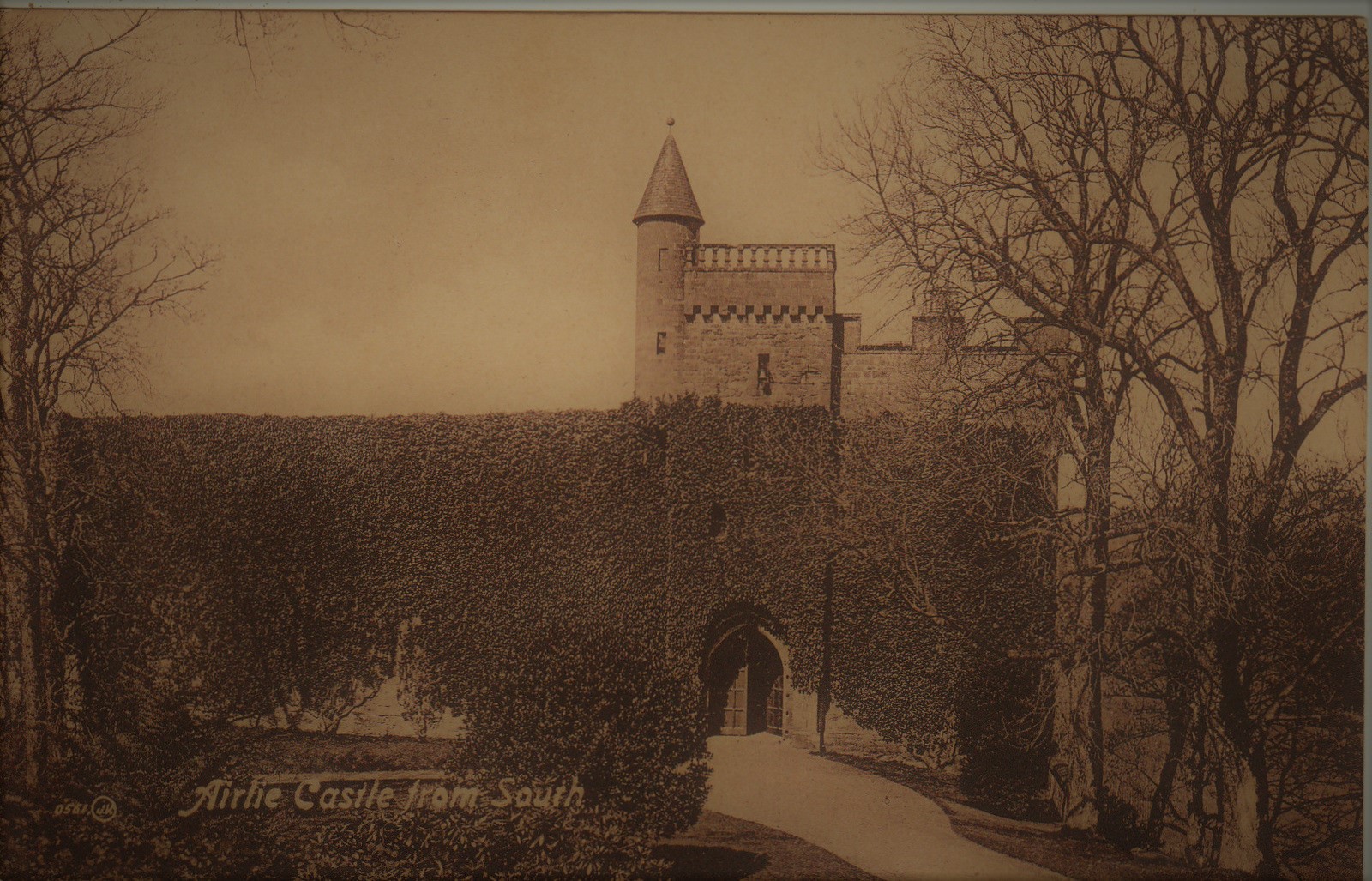
   Considered here are certain ballads which may have Angus as a backdrop, though the claim can be contested.  At the end of the article I could not resist adding another variant of 'The Bonnie Hoose o Airlie', whose location of course is not in dispute.


Young Reiden


   The redoubtable Andrew Jervise states in Memorials of Angus and the Mearns (1861, vol I, pp. 85-8) that this ballad has been placed by some in the parish of Farnell.

At Red Den, on the west side of the parish...the spring called Reiden's Well is locally described as the scene of the tragedy of 'Young Reiden,' celebrated in the ballad of that name.  This idea, except in the third line of the opening stanza of the ballad as rehearsed by the old people of Farnell, is not borne out by the context, and it appears to have originated in the peculiarity of the name, and in the freak of some local rhymster, who (although he preserves 'Clyde water' and other associations of the older ballad) makes his version open prosily thus:—

Young Reiden was a gentleman,
A gentleman of fame ;
An' he 's awa' to East Fithie,
To see his comely dame.

Fithie had a castle, the remains of which form the back wall of a cottar house; and upon an adjoining knoll to the east, popular story avers that the 'lady fair' was burnt for themurder of young Reiden. The lands of Fithie gave surname to a family that held a respectable position in the county from about the middle of the thirteenth century until within these two hundred years. These lands also paid feu-duties to the Bishop of Brechin, and probably the De Fithies were vassals of the Bishops down to the year 1457, as at that time George Leslie, the first Earl of Rothes, had a grant of Easter Fithies, and this was confirmed by charter, under the Great Seal, to the third Earl in 1511. In little more than a century afterwards the property came intothe hands of Sir Robert Carnegie of Kinnaird. At one time


View towards Greenlaw, Farnell


Leezie Lindsay


   Like may traditional ballads, 'Leezie Lindsay' is frustratingly short of internal detail which would help the reader/hearer know who the characters are or where the scene of the narrative was set.  According to Robert Ford's Vagabond Songs and Ballads of Scotland (1901), the main female character was known in the common tradition of the Mearns to be one of the Lindsay family's branch from Edzell in Angus.


Will ye gang wi me, Leezie Lindsay?
Will ye gang tae the Highlands wi' me?
Will ye gang wi me, Leezie Lindsay?
My bride and my darling tae be?

Tae gang tae the Highlands wi you, sir.
I dinna ken how that can be.
For I ken na the land that ye live in,
Nor ken I the lad I'm gae wi'.

O Leezie, lass, ye maun ken little
If sae be ye dinna ken me,
For my name is Lord Ronald McDonald,
A chieftain o' high degree.

She has kilted up her skirts o' green satin,
She has kilted them up to her knee,
And she's aff wi' Lord Ronald McDonald,
His bride and his darlin' tae be.


Sir James the Rose

   In a previous post (More On The Lindsays and the Families of Stirling and Auchterhouse Castle)
 I noted that the historian of Auchterhouse parish, Rev. James Inglis, tried his best to prove that the ballad called 'Sir James the Ross' has its setting locally.  According to him, the ballad relates of the deadly rivalry between Sir James Ross and Sir John Graeme, both suitors of Matilda, daughter of the Earl of Buchan.  It only remains to be added that no other written authorities (that I can find anyway) give any credence for stating that the story had its origins here.  There are few modern academics who seem to be attempting to discover the 'truth' or otherwise of the border and north-east ballads.  In the the Edwardian age) Fitzwilliam Elliot devoted much energy in this area in his work The Trustworthiness of Border Ballads (published in 190), but it was perhaps an impossible task.


The Bonnie Hoose o Airlie

   As I said above, I will finish with another version of 'The Bonnie Hoose o Airlie'.  No need here to go into the backstory of the ballad.  But an interesting aside is provided by Robert Bond's Vagabond Songs and Ballads of  Scotland (1901), which shines a light on the latter days of ballad performance in an urban setting:


Thirty and odd years ago there was a decrepit old man who used to haunt the Nethergate and Perth Road of Dundee who sang nothing else, and his rendition was so singularly absurd that he had many mock imitators among the younger generations thereaway, who knew the old vocalist only by the self-created name of  'Leddy Ogilby.' 

It fell upon a day, and a bonnie summer day,
When the aits grew green and the barley,
That there fell out a great dispute
Between Argyle and Airlie.

The Duke o' Montrose has written to Argyle
To come in the morning early;
And he's up and awa' by the back o' Dunkeld,
To plunder the bonnie House o' Airlie.
Lady Ogilvie look'd ower frae her high Castle wa'.
And O, but she sigh'd sairly,
When she saw Argyle wi' a hunder o' his men.
Come to plunder the bonnie House o' Airlie.
'Come down, come down, Lady Ogilvie,' he says,
'Come down, and kiss me fairly;
Or I swear by the sword that hangs in my hand,
I winna leave a stannin' stane in Airlie.
'I'm no come down to thee, proud Argyle,
Nor wad I kiss thee fairly;
I'll no come down thou fause, fause lord,
Tho' thou shouldna leave a stannin' stane in Airlie.
If my gude lord had been at hame,
As he's awa' wi' Charlie,
There durstna a Campbell in a' Argyle,
Set a fit upon the bonnie green o' Airlie.
'If my gude lord were here this nicht,
As he is wi' King Charlie,
The dearest blude o' a' thy kin,
Wad slocken the burnin' o' Airlie.
'O, I ha'e borne him seven bonnie sons.
The youngest ne'er saw his daddie,
And though I had as mony ower again,
I wad gi'e them a' to Prince Charlie.'
Argyle in a rage attacked the bonnie ha'.
And he's to the plundering fairly;
And tears tho' he saw, like dewdrops fa'.
In a lowe he set the bonnie House o' Airlie !
'What lowe is yon ?' quo' the gude Lochiel,
'That loups ower the hilltaps clearly ?'
'By the God of my kin !'" cried the young Ogilvie,
'It's my ain dear bonnie House o' Airlie !
'It's no the bonnie house, nor the lands a' reft.
That grieves my heart sae sairly;
But O, the winsome dame and the sweet babes I left.
They'll be smoor'd in the black reek o' Airlie.'
'Draw your dirks ! draw your dirks ! " cried the brave
Lochiel;
'Unsheath your swords !' cried Charlie,
'And we'll kindle a lowe round the fause Argyle,
And licht it wi' a spark out o' Airlie.'


Sunday, 12 August 2018

Humour in the Bygone Kirk

   Forthcoming posts on this site will jot down shadier aspects of bygone life associated with religion, such as violence at the Reformation and afterwards, Protestant and Catholic martyrdom, and other dark morsels.  But to ease us all in gently, here are a few anecdotes of times when the Kirk was the centre of the universe, around which all else orbited. These snippets on the lighter side of religion come either from the Rev Dr Charles Rogers or Robert Chambers.  While some of the anecdotes are difficult to either find amusing or to make sense of (being from a vanished age), they do open the window on the past a chink.


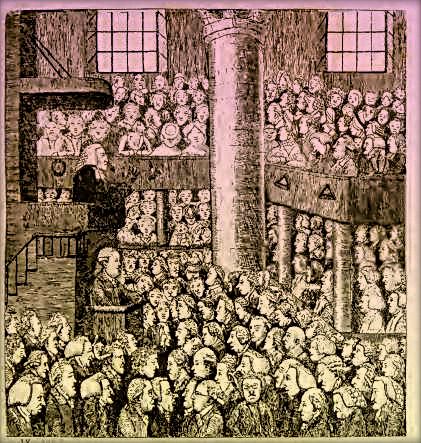
John Kay caricature of a distracted congregation


Not that all the stories are entirely light hearted when you dig beneath them. Dr Rogers tells the tale of a local farmer hauled before the Presbytery of Brechin, to give evidence concerning the Rev. John Gillanders, minister of Fearn, who was accused of drunkenness. The lawyer who conducted the prosecution asked the witness if he had heard Mr. Gillanders acknowledge that he had been in the habit of drinking to excess.

   'I never heard him say that,' the farmer said carefully, then added, 'But I have often heard him say that he was not.'

   John Gillanders was born in Aberdeenshire in 1757.  After being a schoolmaster at Tannadice he was ordained on 7th June 1786.  He died unmarried in 1802, and no details have come my way to confirm or counteract the slander of alcoholism brought against him.

   Many ministers at the past had the provervial gift of the gab, loquaciousness being a requirement of the calling, so to speak.  In the late 18th century there were two particularly talkative ministers in charge of neighbouring parishes.  When they were both at any gathering they competed to see who could monopolise the conversation the best, at the expense of all others.  Once the two divines happened to be having breakfast together and one of them launched on an immense and unending story which went well beyond any of his previous storytelling exploits.  So engrossed was he is his own oratory that he overfilled the teapot and did not even notice when it overspilled, first onto the table and then down on to the floor.  When at last he paused in his monologue, announcing that he was near the end, his guest sourly remarked:

   'Aye, ye may stop noo - it's rinnin oot the door!'

   It was a common jibe against ministers that they spoke so much that they sometimes spoke nonsense, or at least got muddled in their speaking.  The Rev. Alexander Imlach of Murroes (born 1727) was one such imprecise speaker, but the sole surviving instance of his verbal muddledness is no mild as to be near insensible.  When he was preaching one day he loftily invoked an old saying and stated, 'O Lord, bless all ranks and degrees of persons, from the king on the dunghill to the beggar on the throne.'  Then he corrected himself:  I mean, from the beggar on the throne to the king on the dunghill!'

   But other times it was the congregation who got misled by the speeches of the preachers, either through their own failings or because the ministers were too high falluting in their speeches.  Until the time of the French Revolution it was a widespread tendency among the ministry to make constant mention of the Antichrist in their preaching, by which they meant the Pope of Rome.  Times change, even in the kirk, and soon a milder exhortation to pray for the altar and the throne.

   Some time after this change an old parishoner approached the Rev Mr M- of Montrose and asked him earnestly:

   'Sir, I hae something to speir at ye, but ye maunna tak it ill.'

   'Na,na,' assured the minister.  'I'll no tak it ill.'

   'Ou, dear me,' said the auld wife.  'Is yon Annie Christie deid, or is she better, that ye prayed sae lang aboot, for I ne'er hear ye speak aboot her noo?'

   the minister alluded to here may be the Rev James Mitchell (1763-1835), who was a tutor and  close friend to Walter Scott, who described their association:


He was a young man of excellent disposition and a laborious student. From him I learned writing and arithmetic. I repeated to him my French lessons, and studied with him my themes in the classics. I also acquired by disputing with him (for this he readily permitted) some knowledge of school - divinity andchurch history, and a great acquaintance n particular with the old books describing the early history of the Church of Scotland, the wars and sufferings of the Covenanters, and so forth. I, with a head on fire for chivalry, was a Cavalier, my friend was a Roundhead ; I was a Tory, and he was a Whig. I hated Presbyterians, and admired Montrose with his victorious Highlanders ; he liked the Presbyterian Ulysses, the dark and politic Argyle, so that we never wanted subjects of dispute...

   Mitchell left his charge at Montrose in 1805 because of local difficulties, chief of which was 'because he could not persuade the mariners of the guilt of setting sail of a Sabbath'.


   Long ago, a newly appointed minister in Angus was coached about the character of his parishoners by a knowing elder:

   'When you ca on John Ramage o the Hillfoot, sir, ye maun speak aboot anything except plooin and sawin.'

   Why was that, the minister asked?

   'John, ye see, sir,' replied the elder,' is sure tae notice your deficiency in thae matters; and if he should find oot that ye dinna ken aboot plooing an sawin, he'll no gie ye credit for kenning onything else.'


   A different tale type is represented by the following story.  Late one Saturday night an old and rather lame Angus minister asked a servant to fetch the pulpit bible from the kirk as he was anxious to consult it for something.  The servant as first declined, saying he was too afraid to venture alone through the dark kirk-yard alone.  A conversation ensued and a compromise was reached.  The minister would accompany him, but as he couldn't walk his man would have to give him a cuddy-back.  John grumbled and mumbled, but agreed to carry the minister and fetch the bible.  On the way back, with the minister on his shoulders and large bible beneath his arm, he was alarmed to hear a voice ask from beneath a tombstone:

   'Is he fat?'

   Believing that the lurking ghost or bogle was querying his mortal burden (possibly with the purpose of devouring him),he discarded the minister and yelled,

   'Tak him as he is!' and ran away.

    Somehow the minister struggled back to the manse first.  What he said to John is not recorded.  Next day it was explained that two sheep stealers were in the area.  While one of them kept watch behind a gravestone, the other was on the look out for a beast to steal.  The overheard remark was actually a comment from the first about the size of the sheep his comrade had got hold of!


Saturday, 28 July 2018

Lost Treasures of Angus - Patrick Paniter's Panels from Montrose

Patrick Paniter was a man of parts, professional cleric and collector of beneficies, courtier and political adviser to King James IV.  After service abroad, Paniter became rector of Fetteresso in the Mearns and Vicar of Kilmany in Fife.  He became Secretary to the king (James IV) and gained further, more important religious posts associated with Dunkeld and then Moray.  His first benefice in Angus came was the rectorship of Tannadice.  Patrick's family came from Newmanswells, near present Borrowfield, north of Montrose.  This local connection explains why the well connected cleric cared so much about this specific foundation in the burgh. There is a theory that the panels actually come from the local kirk, after it was demolished in the last years of the 18th century.  The first of the family recorded locally was one William Paneter, mentioned around 1350, while Andrew Panter was a burgess of Montrose.

   This close connection with Montrose explains why he ordered the restoration of the derelict Hospital of St Mary in the burgh.  A royal charter dated 18 August 1512 tells us that Patrick Paniter rescued the hospital from the hands of powerful laymen, recovered its alienated lands, and also rebuilt the foundations its hall, chapel and other buildings.  According to R. L. Mackie, 'For this reason he was granted, as Preceptor of the Hospital, the power to recast its constitution, and the sole right of electing poor bedesmen, scholars, and chaplains.' Paniter arranged the rebuilding of the hospital from his own pocket and by obtaining indulgences from other who contributed from Pope Julius II.  As the Dominican friary in the burgh was also in similar decline, Paniter revived it by annexing the hospital to it, a move which meant Montrose would be serviced with preachers and the old friary could be ased as an asset.  The vicar of the hospital was tasked with praying for Paniter's uncle and brother. 

   The family who gained the property before Paniter were the powerful Erskines of Dun, who were destined to be major players in the Reformation and afterwards as staunch Protestant Reformers as well as significant players both locally and nationally.  John Erskine of Dun had resigned the lands of Spittal Fields to Patrick on 19 October 1509, though agents acting on behalf of Dun's grandson challenged this nine years later. 


Early 20th century view of the coast at Montrose


   Nothing now remains in Montrose of the ancient hospital buildings, but, remarkably, there are 18 panels - possibly from the dias of the hall of the hospital - which have survived are are now in the National Museum of Scotland in Edinburgh.  They were integrated in an old property in Montrose and were saved when it was demolished around the year 1878.   The panels are mostly carved with floral patterns, but some carving intriguingly portray monks satirically shaped like foxes and pigs.  Some experts believe the work as a native Scot perhaps influenced by Flemish woodwork.  Along with a door the panels were discovered in the 19th century and are linked to Patrick by including his family's coat of arms. 

   Patrick himself, who was born around 1470, luckily survived the mass cull of Scots at the Battle of Flodden.  He was certainly present on the field that day, since in May 1514 Pope Leo X granted him absolution and license to retain his holy orders and the Abbey of Cambuskenneth, despite him having 'manipulated engines of war' on the battlefield, where he was present as King James IV's secretary. The final petition from the Governor of Scotland, the Duke of Albany, went to the Pope in 1517, aformally asking the hospital to be dissolved and annexed to the friary. Patrick himself died peacefully in 1519 in Paris.


Some Works Consulted


R. L. Mackie (ed.), The Letters of James the Fourth 1505-1513 (Edinburgh, 1953).

James S. Richardson, 'Oak Panels Presented to the Museum by the National Art Collections Fund,' Proceedings of the Society of Antiquaries of Scotland, 71 (1938-9), pp. 324-5.

John Warrack, Domestic Life in Scotland, 1488-1688 (London, 1920).


Previous Posts on the Lost Treasures of Angus


Saturday, 14 July 2018

The King's Cadger Road - A Fishy Tale

Forfar as a set of the peripatetic Scottish court in the Middle Ages has definitely been under investigated.  Malcolm Canmore and Queen Margaret have a lingering remembrance in the area, in folklore, history and place-names, but otherwise there is relatively little known about royal associations here, and certainly their origins, partly because the castle (or castles, as there may have been two of them) was erased during the Wars of Independence.  One surprising survival about the logistics of the king's presence here is the memory - if not the actual physical survival - of the King's Cadger Road.  This route was recognised as the official pathway between the fishing village of Usan (Haven), south of Montrose and the king's residence at Forfar.


The approximate line of the Cadger's Path between Usan and the royal burgh of Forfar

   Quite when the King's Cadger Road was developed is unknown.  The author of the Old Roads of Scotland website points out that the Fyschergate mentioned in a charter of Arbroath Abbey is almost certainly identical to the King's Cadger Road.  The road stretched apparently from the market cross of Forfar to the coast.  The royal cadger would bring fish to the court each day it was in attendance and it was 'in breadth the width of a mill wand'.  This measure has been explained by the laborious process by which these round mil stones were transported before the advent of properly surfaced roads.  A  long piece of wood - the mill-wand - was put through the centre of the stone and used to roll it from the quarry to the actual mill.

   The route passed through Montreathmont Moor and was marked by various subsiduary wayside names:  Cadger Slack, Cadger Burn, among them.  When the moor was divvied up between the adjacent estates in 1780 the laird of Usan asserted his right to the Cadger Road across the moorland, and received as his share an allocation of land in it equal to the superficial extent of the ancient road. According to David Adams:

Ainslie's map of Angus in 1794...may preserve the eastern part of the King's Cadger Road.  The most likely route seems to be from Usan in a straight line south of Dunninald as far as the A92 and then zig-zagging north of Upper Dysart, passing Gightyburn and Rossie Farm School to meet the track from craig and Ferryden tto Kinnell and then crossing Wuddy Law to pass north of Bolshan.  West of that the route is not traceable with any certainty...

   The residence of the cadger himself was called Strook Hill and stood just to the south-west of Usan.  The lands of the cadger were in the form of a strip, comprising 30 acres, reaching from the shore at Usan to the kirkyard of St Skeoch.

Reid summarises a legend which says that one of the king's cadgers was waylaid by the laird of Rossie, so he and his accomplice son were executed on the top of Kinnoull Hill:

It would appear they exhibited a natural reluctance to mouth the scaffold under the fatal tree.  The King himself attended the execution, and seeing their dilatoriness he called out to them 'Mount, boys!' to which circumstance is ascribed the derivation of the name of the farm of Mountboy, which lies on the south side of the Hill of Kinnoul, though Mon-bois (wooded moss) is the origin.
   There are various confusing named in the locality 'King's Seat' or 'Ginshot Hill' are applied to the artificial eminence locally said to be the place of the execution.  One source says that the 'crown of the hill' (possible meaning the artificial mound) was called Kinshie Hill.

   The family who supplied the sea fish to the king were named Tulloch and they held the lands of Bonnington or Bonnyton, through which the Cadger Road passes, under the tenure of supplying fish to the royal table. In 1399 the office of the keeper of the Moor of Monrommon was in the possession of this family.   The Tullochs' lands passed to the Wood family many centuries ago.  One of their number, John Wood, was created a baronet in 1666. There was a Castle of Bonnyton, though this has long since vanished also.


   There is an old Scots saying which is probably not local to Angus (though it would be nice to think it was):

the king's errand may come in the cadger's gate (or the king will come in the cadger's road).

   The meaning is that even great events may come by unsuspected routes, or that great men may also have to walk humble paths at times. There is another rhyme, recited to bairns when jogged on the knee, called The Cadger's Ride.  Again, it is not uniquely from Angus but, who can tell, may well have originated here:


This is the way the ladies ride,
Trit, trot, trit, trot, trit, trot,
This is the way the gentlemen ride,
Trit, trot, trit, trot, trit, trot,
This is the way the Cadgers ride,
Creels an a', creels an' a'.


Usan


Some Works Consulted


Adams, David G., Usan, or Fishtown of Ullishaven (Brechin, 1989).
Carrie, John, Ancient Things in Angus (Arbroath, 1881).
Edwards, D. H., Around the Ancient City (Brechin, 1904).
Jervise, Andrew, Epitaphs and Inscriptions of the North-East of Scotland (Edinburgh, 1875).
Reid, Alan, The Royal Burgh of Forfar (Forfar, 1902).
Rxton Fraser, Rev. William, St Mary's of Old Montrose, or Parish or Maryton (Edinburgh, 1896).


Saturday, 16 June 2018

A Mixed Bag of Rhymes (Part Two)

As a modest celebration of this blog's 150th post, I give you a second selection of randomly gathered rhymes from around the county. (The previous post can be found here: A Mixed Bag of Rhymes).  One of the simplest rhymes in that first entry was a simple recitation of place-names in one part of north Angus, but there is music in the words and poignancy when one thinks that the places mentioned may no longer exist, or not as habitations, and the people who lived there are long vanished and forgotten:

Deuchar sits on Deuchar Hill,
looking doon on Birnie Mill,
the Whirrock an the Whoggle,
the Burnroot an Ogle,
Quiechstrath an Turnafachie,
Waterhaughs an Drumlieharrie.

which leads on nicely to another localised rhyme:

There's Blackha, Buckit Hill,
Lochtie an the Lint Mill,
Cowford, the Waulk Mill, 
The Millton an Balmadity,
The Bogie an Ba'quharn.


   Another northern Angus locality which has a rhyme attached to it is Ledbakie which, in the 19th century, was joined to the neighbouring farm of Blairno.  Its situation, at the foot of the imposing hill of Berrycairn, means that it is destitute of sunlight and gets hardly any light at all in winter time.  A local rhyme described it thus:

Nae wonder though the maidens of Ledbakie be dun
Atween Martinmas an’ Canlemas they never see the sun.

   According to the Rev. Henry Cruickshank, writing in 1899:

It is a drearie place even in summer...A story, probably untrue in actual detail...is traditionally given respecting the Cobbs of Ledbakie. In their evening worship they sang a Psalm, which, whether long or short, was gone through from beginning to end. A person passing by one night on the way to Nathro overheard the family singing as was their wont. When he returned next morning, they were engaged in the same pious exercise. He put forth a report that the Psalm was the 119th, and that they had been singing it the whole night.

   Alan Reid in The Royal Burgh of Forfar (1902) gives another localised rhyme, in this case featuring places and burns in the Tannadice area:

The Feerich and the Fogil,
The Burn root of Ogil,
Deuks-Dubs, Tirlywhangie,
Water o Saughs an Drumly Harry.

   Reid also gives another rhyme, from Forfar (which he thinks may be the work of mid-Victorian local poet Davie Herd), and here the focus is not lost and forgotten places, but the names of local characters:

The Steeple o Farfar's biggit on a knowe,
Gang and speir at Bailie Low;
Bailie Low's busy workin,
Gang and speir at Doctor Rankin;
Doctor Rankin's sellin sa,
Gang and speir at Doctor Law;
Dr Law's awa wi's wife,
Gang an speir at Bailie Fyfe;
Bailie Fyfe's awa wi's coo,
Gang and speir at Benjie Rew;
Benjie Rew's lickin Jock
Wi a muckle kail stock!


   Civil strife in 18th century Brechin occurred in the hurly-burly local political field of Brechin in the early 18th century, with fierce rivalry between competing and successive provosts.  The provost who took over the hot seat of provost in 1733 was David Doig of Cookston.  His father had been provost in 1715 and had the misfortune to be imprisoned by the Earl of Mar for being a staunch Hanoverian.  The second provost Doig was deposed by a previous incumbent, John Knox, in 1740, and it may have been fans of the latter who composed a scandalous epitaph about the second provost Doig when he died:

Provost Doig's deid - God be thankit;
Mony a better dog's deid, since he whelpit.


Wednesday, 13 June 2018

The Punishment of Women - Flyters and Scolders


On the centenary of the granting of votes for women in the United Kingdom it is probably a good time to examined the treatment of women in the more remote past.  Fornication was one of the sins for which women were more blamed than men as a matter of course.  In the burgh records of Dundee one can almost taste the seething rage of the authorities when, in  October 1564, they wrote that:


'the women, quhilk are the principal occasions of fornication,' sometimes escape' unpunishit because they are with bairn the time of their apprehending,' devised an ingenious method both severe and safe for chastising delinquents, and enacted 'that the woman apprehendit, of quhat estate that ever she be, sail be brocht to the Merkat Croce openly, and there her hair sail be cuttit oft', and the samin naiht upon the cuck-stule, and [she shall besides] mak her public repentance in the kirk, and this for the first fault. And for the second fault, she sail be had to the Merkat Croce, her hair cuttit oft' and nailit up as said is, and her self carryit in ane cart throw all the pairts of the town, and twa shillings tane of her fee to pay the carter for his lawbours; and sail also forfeit the pain contenit in the auld acts.' The punishment awarded to the male offender, who, by the narrow reasoning of the time, was reckoned the least culpable, was administered with much laxity. During the two days of imprisonment, his companions appear to have had access to him, and there being no stint of food or drink, they would probably spend the time in carousing. Restrictions were, however, now imposed upon this, and it was decreed that the man 'sail remain forty-eight hours in the steeple upon bread and water, and nane to enter in the steeple to bear him company except the officer, under the pain of forty shillings, to be taken of ilk ane of them and distribute to the puir.' The man's friends were to be fined if they found their way in to him, which is a curious illustration of the system of prison discipline then observed. [Maxwell, History of Dundee, p. 83.]


   Again, in July 1580, it was:

'statute and ordained that gif it sail happen ony young woman to commit fornication, and efter she be conceivit with bairn sail be fund ganging with her bare hair as ane shameless [person], then incontinent she sail be had to the cuck-stule, and upon the skaffet thereof her hair sail be cut off, and there nailit, to the example of uthers.'  [Maxwell, History of Dundee, pp. 83-84.]

   In October 1580 the loose, scolding tongues of women were enacted against:


Gif it sail happen ony men's wyiffs or uther women to be heard openly in shameful flyting, reproaching, sclandering, cursing, banning, or making ony horrible imprecations or fearful blasphemies of the name of God betwix them and ony uther persons, then the offenders having money to pay sail stand in ward till they pay forty shillings to the reparation of the common warks, and also sail pass to the Market Croce, or to the place quhair they offendit their neighbours, and upon their knees ask forgiveness. And the person that hes na money to pay, sail be put in the cuckstule be the space of three hours in maist patent time of day, and theirefter satisfie the pairtie in manner foresaid.[Maxwell, History of Dundee, p. 233.]


   'Scolding' as a particularly female crime was targeted by church and burgh officials in all areas as a perennial menace to mankind.  In Arbroath in 1732 a woman was imprisoned for scolding two male neighbours, John Anderson and John Wilson.  Her husband and sister-in-law bailed her out on condition she led a more peaceable life thenceforth.


   Early the following year, also in Arbroath, there was a case of a woman offender sent by the kirk-session to the presbytery, who promptly sent her case back to the session:

The Session, considering that the said Agnes had appeared twelve times before the congregation without any visible signs of repentance, found also that she had been guilty four times of fornication, and had not give a true account of the father of her child, the person she had accused being exculpate by the Presbytery, and that more public appearances would tend to no edification, agreed to this sentence:  That she must lie under a scandal unabsolved, and remove out of town peremptorily at Whitsunday next [History of Arbroath, Hay, p. 241.]

   George Hay wonders that the woman had not received the usual punishment of being ordered to sit for twelve sabbaths before the congregation dressed in sackcloth.  But then again Agnes does not perhaps seem the type who would have countenanced such a sentence.


Consulted


George Hay, The History of Arbroath to the Present Time (Arbroath, 1876).

Alexander Maxwell, The History of Old Dundee (Dundee, 1884).


Tuesday, 5 June 2018

Pitalpin - An Actual Battle or A Dundee Myth?


Death in Angus or Slaughter in Galloway?


The very first post in this blog focused on a battle between Scots and Vikings - the Battle of Barry - which never in fact happened.  This post also details a battle which, very likely, is a fiction.  The place-name Pitalpin is now subsumed within the western part of Lochee, itself now engulfed within the city of Dundee.  The first part of the name is pit, a Pictish term for a piece of land or farm, and the second part seems to be the personal name Alpin.  The name has given rise to the legend that Alpin, father of the mid-9th century king Kenneth, or Cinaed, who supposedly united the Picts and Scots, was slain here in battle.

   The equation of the Pictish pit with an English word with quite a different meaning signals that the story is relatively modern.  Let's get the facts out of the way first.  All the early chronicles and annals agree that this Alpin was killed in Galloway.  One source (formerly known as the Chronicle of Dalriada) states Alpin was slain around the year 841 in that region after he had wholly destroyed and devastated it, 'And then the kingdom of the Scots was transferred to the kingdom of the Picts.' Another version adds the detail that he was ambushed by a single assassin in woodland beside a ford while he rode out with his men. This evidence, it must be said, is not accepted as irrefutable fact and questions remain about the race and identity of his opponent, for instance.  The actual place pinpointed as his burial spot was the Taxing Stone on the east side of Loch Ryan, known in the 13th century as Laight Alpin, 'Alpin's Grave', but latterly just Laight.  His death is supposed to have occurred just over the border at Glenapp, Ayrshire.  Despite the relatively meagre facts the traditions of Alpin's death in Galloway are altogether earlier and more convincing than rival stories that he died in Angus.


The Taxing Stone, or Alpin's Grave, Galloway


Disputed Identity


   Modern scholarship has determined that both Alpin and his son Cinaed - supposed destroyer of the Picts - both bore Pictish names.  Scholars point out that both kings were celebrated in elegaic poetry; Alpin's name was certainly remembered and Clan Gregor many centuries later adopted him as a supposed ancestor.  Alpin in cognate with the British Celtic name Elphin, which is recorded in royal pedigrees and may be identical with the Pictish form.*  This puts new light on his supposed battled against the Picts.  It is possible, maybe even likely, that the place-names Laight Alpin and Pitalpin at opposite sides of the country record two different men named Alpin.  In connection with the name near Dundee we should note the place-name Rathelpie near St Andrews, Fife, which was formerly Rathalpin, the'fort of Alpin'.  A connection with the man who may have owned an estate at Pitalpin is conceivable.

   * Irish scholar T. F. O' Rahilly postulated that this personal name may have had an exceptionally long pedigree and be derived in fact from the 2nd century Roman governor of Britain, Clodius Albinus.

   Moreover, there was another king named Alpin who is recorded in the early 8th century. He was apparently one of the participants in a contest for the Pictish throne, displacing and expelling a ruler named Drust in the year 726.  Two years later there was another battle, possibly at Moncrieff in Perthshire, and Alpin's son was killed.  Shortly afterwards he was defeated again by Nechtan. He is heard of no more.

A Confusion of Sources:  Earlier Writers


   Many later histories of Dundee, presumably through misguided local pride, make prominent space for the Battle of Pitalpin (sometimes called the Battle of Liff) fought to the west of the burgh.  The range of detail makes it difficult to determine where each author received his sources if he had not invented them himself.  Even the date of the encounter is disputed, with the years 831, 833, 834, and other years touted.

   One early national source was the History of John Lesley, Bishop of Ross, writing in the late 16th century.  According to him, a Pictish king named Brude (Brudie) defeated and captured Alpin in a battle at a place named Horestia.  There he commanded that Alpin be beheaded and 'stukne on a stake and borne to Camelodun his heid. As now in this days will testifie the place, qhauir alpin was heidet, takeng the name fra him; the place is neir Dundie, and from Alpin now namet Pasalpin.'  The stone where Alpin was beheaded, the King's Cross, is also known as the Standard Stone from the 'fact' that Alpin planted his flag here before the battle.  But the tale goes back at least to the work of (local and) national historian Hector Boece of Dundee, at least in the free translation published by John Bellenden in 1536.  According to this, Alpin had partial Pictish ancestry and tried to take over their kingdom.  He ravaged all Angus and was encamped in a hill near Dundee when Brude's army approached and the Scots were defeated, partly via a ruse from disguised women and carriage men among the Picts (which incident is similar to something which is supposed to have happened at Bannockburn):

In this battall was tane, King Alpine; and brocht, with his handis bound, to the nixt village, quhare he was heidit, with ane hewing ax, the iv yeir of his regne; fra the incarnation,DCCCXXXIV yeris. The place, quhare King Alpine was heidit, is callit yit Pasalpine, that is to say, the heid of Alpine. Efter this huge victory of Scottis, King Brudus returnit to Camelon with King Alpinis heid, and put it on ane staik on the hieast part of all thair wailis, to be ane signe of his victory. [The History and Chronicles of Scotland, vol. 2, reprinted Edinburgh, 1821, p. 149.]


    Boece's account of the battle, wherever it was derived, was followed and embroidered by later historians in the 16th century, including the Englishman Ralph Holinshed and eminent Scot George Buchanan.  The latter states that Alpin particpated in a battle at Restenneth, which is also probably a fiction.  He also gives an account of the name of the king's death site:

The king's head was fastened to a pole and carried up and down the army, till at last the set it up for a spectacle in the most eminent place of the greatest town they had (which then was Abernethy). The place were he was slain as yet retains his name, being called Bas Alpin, i. e., The Death of Alpin.


The King's Cross stone illustrated in the book Lochee As it Was and Is

Local  Excitable Writers


   One of the earliest written localised versions of the battle was contained in The History of the Picts,  a work probably  composed by the somewhat shadowy Henry Maule of Melgund Castle, in the late 17th century. (He was the last of his line, leaving only a daughter.)  While his account is confined to a short summary, later proud local writers gave minute accounts of the conflict.  Even the clerical writers of the New Statistical Account got carried away in their descriptions of the battle.  One minister insisted that Brude camped with his Pictish army on the Tothelbrow, in the parish of Strathmartine, while four miles to the south, on Dundee Law, the Scots and Alpin had their base.  The Scottish king is said to have raised his royal standard in the stone later called the King's Cross, 'in the centre of which a hole is hewn ten inches by eight, and ten inches deep'.  Here the unfortunate king also had his head cut off.

   The stone is still in situ, on the Camperdown estate of the Duncan family, now Camperdown Park, and it was probably the base for an upright cross
(as its name suggests) which has not survived.  Not far west of this position a souterrain was uncovered in the 18th century, showing evidence of settlement here in earlier Pictish times.  

   Even the eminent Alexander Warden, writing in volume 4 of Angus or Forfarshire (p. 177), gives a confused account of the encounter.  He states that it was the 8th century Alpin who was a participant in the battle, though he repeats the beheading story and says the corpse was buried at Pitalpin.  He adds:  

Some forty years ago a human skeleton was found there, which was for a time, shown in Dundee as the remains of Alpin.  Near the close of last century several graves or cists, constructed of rude slabs of stones, were found in the locality, and in 1732 a fine 'snake bracelet', now in the Museum of the Society of Antiquaries in Edinburgh, was found in the same vicinity.

   It is probably worth pointing out that the name Pitalpin originally attached to a small settlement on the Lochee/Dundee to Newtyle road, some distance north of the present Pitalpin street names to the west of Lochee (which would be to the south-east of Dryburgh marked on the map below.  King's Cross Road in Lochee is similarly some distance away from the King's Cross stone.). The CANMORE website shows the location  of the original Pitalpin near the current Telford Road in Dryburgh Industrial Estate, Dundee.


   As described by James Myles in Rambles in Forfarshire (1850), Pitalpin's location is described as:

immediately after...the three milestone from Dundee, and close to the edge of the turnpike road [where] there is a thickly planted grove; it is encircled by a well cultivated field...The little dark-looking grove is called Pitalpy [p. 191]

   Further information about the battle and its supposed site was discussed in the book Lochee As it Was and Is (pp. 216-224) by Alexander Elliot

Last century a mound quite close to Pitalpie had to be removed to make way for the opening up of that part of the estate of Dryburgh for agricultural use, the ground at that date being covered with gorse and timber. When the mound was opened it was ascertained to be an ancient sepulchre. Its contents consisted of several graves, and from the manner of their construction it was evident they had been the last resting-places of persons of distinction. Much care seems to have been bestowed upon the formation of these antique funereal repositories, each being built around internally witli flagstone slabs, and carefully covered with the same material. In ancient times it was only to the remains of the great and powerful that such elaborate sepulture was extended. Under the circumstances, and seen in the light of the legendary chronicle, it was only to be expected that the sepulchre would be regarded as having sheltered the remains of King Alpin and some of his distinguished generals who had shared his fate. A snake bracelet is also said to have been found amongst the debris [in 1732].'
In the Dundee Advertiser of date 16th September 1842 it is freely stated that the remains of the unfortunate King had been discovered at King's Cross. It is therein recorded that 'a skeleton was found in digging through the mound at Pitalpin on which the stone stands to commemorate the battle fought between the Scots and Picts in the year 834. This skeleton must be the remains of King Alpin, who was taken prisoner in the action and beheaded by the Picts, for though some historians state that his head and body were removed by the Scots to Icolmkill and there buried, yet the fact of now finding the head severed from the body, which was in the centre of the mound, and distant some fields from the mass of bones of those who fell in action, renders it certain that it must be the skeleton of some chieftain, and there is no record of anyone of note having fallen on that occasion except Alpin. . . . These royal remains have been carefully collected and placed in a shell, and are now deposited in the Watt Institution, where they may be seen by the public.'
   He also states that,

Pitalpie Village was situated on rising ground on the N side of the 3-mile stone on the Coupar Angus road. A solitary ash tree marks the spot. The village consisted of eight thatched cottages which were occupied till nearly 1830. About then, they were removed, but the foundations and approach road can still be traced.


   Elliot discusses James Thomson's History of Dundee (first published in 1847) as being one of the first local historians to seriously doubt the Battle of Pitalpin, based on accounts of his death in south-west Scotland.  Then he goes on:


Thomson's view coincides with the statement of a person advanced in years who was conversant with the incident. This person, when questioned upon the finding of the remains, declared in homely Scotch that they were 'juist those of a bit tinkler-buddy.' Returning to the historic stone and the place it is alleged to hold in our annals, another and more reasonable theory has been adduced. It is contended that, instead of being a useful adjunct to a battlefield, it fulfilled a higher and probably a more legitimate destiny. Research—hard, stern, analytic—in this and in innumerable instances ousts tradition from its place and declares it a usurper. The romantic story of the standard, dear as it has been to Dundonians, when subjected to the broad light of inquiry, is found to have had no foundation in fact. That is the opinion of those who have given much serious thought to the subject.
The King's Cross stone with Camperdown House in the background


The Damning Verdict?


   It has to be obvious that the so-called Battle of Pitalpin (a.k.a. The Battle of Liff) never in fact took place.  There was a misapprehension by later historians that there were Picts in Galloway and this may have contributed to the confusion between that region and Angus. If Pitalpin commemorates anyone it is unlikely probably to be the king generally supposed to have died there, though there is some possibility that it could be the earlier royal Alpin who participated and perished in the 'Pictish war' in the third decade of the eighth century.  Most of the conflicts in that confusing period seem to have been fought, as far as we can tell, in southern Pictland.  Local pride among Dundee writers seems to have perpetuated the legend, the origin of which shows a confusion in the derivation of the term 'pit'.  The king's death here may be connected, in a legendary sense, with the supposed murder of Pictish royals by his son Kenneth at Scone, who are supposed to have be murdered by being cast down into a pit while at a banquet - retrospective associated revenge for that equally suspect slaughter?